
TL;DR
- The trigger, the timing, the depeg prints, the venue specificity, the headline totals and the exchange's own remediation are documented. Two tariff posts preceded the cascade, a 14:57 UTC threat and the formal 100 percent announcement before the 20:50 UTC violent phase; between 21:36 and 22:16 UTC, USDe, wBETH and BNSOL dislocated on one venue while holding elsewhere; roughly 19.1 billion dollars liquidated across 1.6 million accounts by aggregator count; the exchange compensated users and changed its collateral pricing.
- Five preconditions converged: record derivatives leverage, a promotional yield campaign that industrialised recursive borrowing against a synthetic stablecoin, cross-margin accounts pricing exotic collateral off one venue's own thin order books, receipt tokens with almost no standalone market depth, and a Friday-evening liquidity trough. Each was visible in advance; the combination was the trap.
- Three phases in roughly ninety minutes: an orderly macro sell-off from 20:50 UTC, a venue-specific collateral implosion from 21:36 to 22:16 UTC that converted falling prices into mass liquidation, and an auto-deleveraging and liquidity-vacuum phase in which even hedged and winning positions were forcibly closed while bids disappeared.
- The headline 19.1 billion dollars is a floor, not a total. Aggregators compile liquidations from exchange data feeds that sample rather than enumerate events, so centralised-venue figures systematically undercount. Hyperliquid, whose on-chain order book makes every liquidation publicly verifiable, alone recorded about 10.3 billion dollars per CoinGlass data, a figure Hyperliquid's founder has publicly acknowledged, implying that opaque venues contributed more than their reported shares suggest.
In one block
The October 2025 liquidation cascade was a self-reinforcing deleveraging event in which a macro announcement triggered forced selling across a record-leveraged crypto derivatives market, and a venue-specific failure in collateral pricing converted an orderly decline into the largest liquidation in crypto history.
What is established fact, before the interpretations begin?
Quick answer
The trigger, the timing, the depeg prints, the venue specificity, the headline totals and the exchange's own remediation are documented. Two tariff posts preceded the cascade, a 14:57 UTC threat and the formal 100 percent announcement before the 20:50 UTC violent phase; between 21:36 and 22:16 UTC, USDe, wBETH and BNSOL dislocated on one venue while holding elsewhere; roughly 19.1 billion dollars liquidated across 1.6 million accounts by aggregator count; the exchange compensated users and changed its collateral pricing.
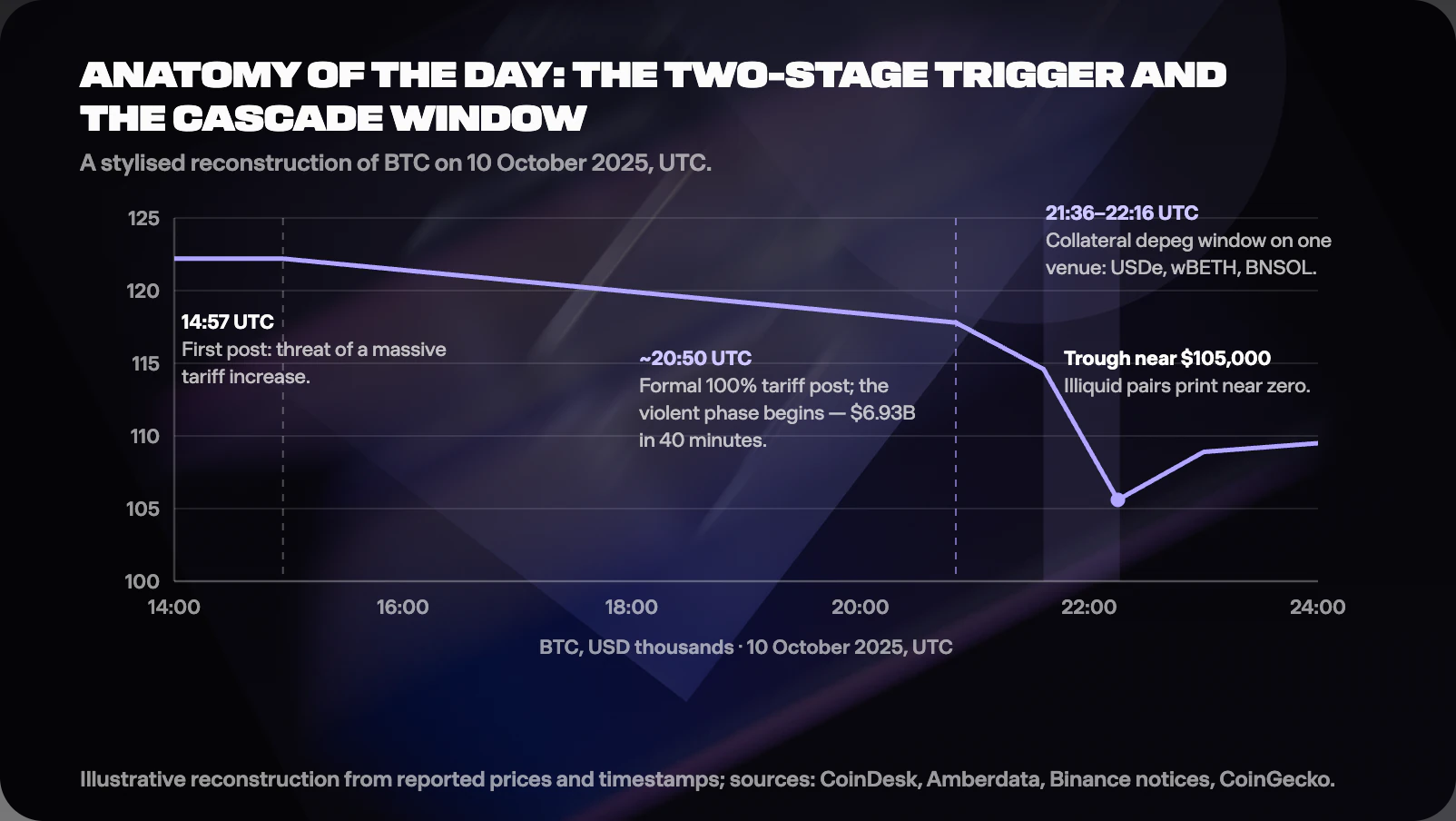
Reconstructions of contested events should begin with the uncontested core, so here it is. The trigger arrived in two Truth Social posts on Friday 10 October 2025. At 14:57 UTC, 10:57 in New York, the US President threatened a massive increase in tariffs on Chinese goods, calling Beijing's export controls hostile; equities reversed off their highs and crypto began sliding from Bitcoin's level near 122,000 dollars, with early liquidations already approaching a billion dollars. The formal post specifying an additional 100 percent tariff, effective 1 November, landed in the late US afternoon, and per Amberdata the cascade entered its violent phase at 20:50 UTC, liquidating about 6.93 billion dollars in the following 40 minutes, a rate near ten billion dollars per hour. Aggregate liquidations across venues reached roughly 19.1 billion dollars over 24 hours by aggregator count. More than 1.6 million trader accounts were liquidated, and about 87 percent of the liquidated notional was long positions. Aggregate open interest fell from around 217 billion dollars to roughly 123 billion; Bitcoin futures open interest on exchanges fell by about 20 billion dollars in a single day, and funding rates dropped to their lowest levels since the 2022 bear market.
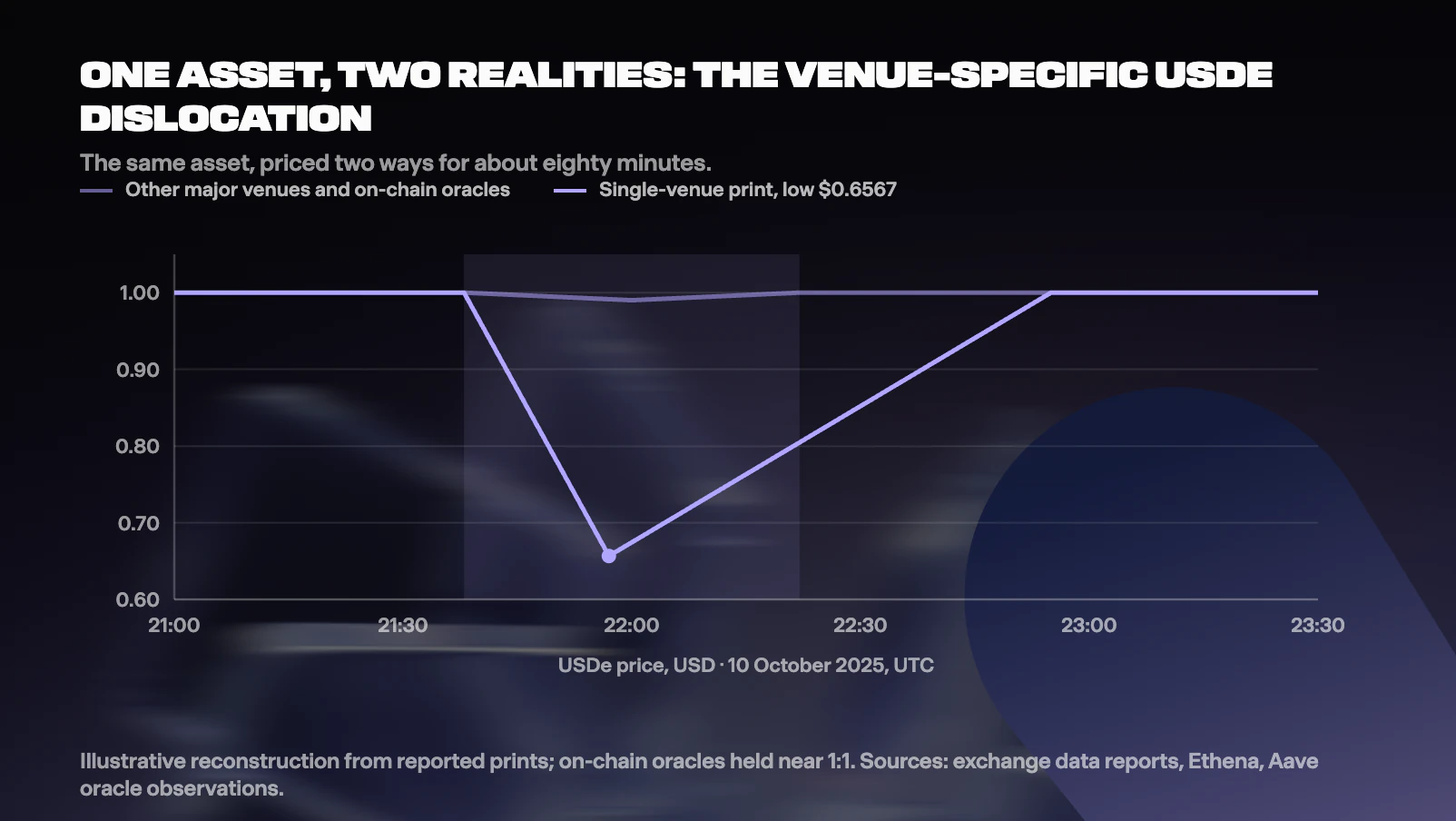
The venue-specific facts are equally documented, because the exchange at the centre published them. Binance's own compensation notices define the dislocation window precisely: users holding USDe, BNSOL and WBETH as collateral who were affected by the depeg between 21:36 and 22:16 UTC on 10 October would be compensated for the difference between their liquidation price and the market price at midnight UTC. During that window, USDe printed as low as 0.6567 dollars on Binance while trading near a dollar on other venues and while on-chain lending oracles continued to read it at one to one. Wrapped Beacon ETH fell to roughly 430 dollars, about 89 percent below the ETH it represents; BNSOL printed around 34.90 dollars against a far higher SOL elsewhere. Several thin altcoin pairs printed at or near zero as bids vanished, and infrastructure strained across the industry: Binance reported systems under heavy load with internal transfers and Earn redemptions delayed by roughly half an hour, later attributed in part to a database performance regression causing a 33-minute processing delay, while dYdX went offline for around eight hours and the Lighter venue for about four and a half.
Also established: the vulnerability had been publicly scheduled for repair. On 6 October, four days before the event, Binance announced changes to how it priced these very collateral assets, moving away from its own order-book prints toward more robust index construction, with implementation dated mid-October. The cascade arrived inside that announced window. And afterwards, the exchange compensated on a large scale: a direct reimbursement pool of about 328 million dollars for users hit by the index deviations, plus a discretionary programme of around 300 million, over 600 million dollars in total across initiatives, alongside pricing-logic changes including redemption prices in the index and a price floor for USDe. Compensation and remediation are facts; what they imply about causation is where the interpretations divide.
What conditions made the market this breakable?
Quick answer
Five preconditions converged: record derivatives leverage, a promotional yield campaign that industrialised recursive borrowing against a synthetic stablecoin, cross-margin accounts pricing exotic collateral off one venue's own thin order books, receipt tokens with almost no standalone market depth, and a Friday-evening liquidity trough. Each was visible in advance; the combination was the trap.
Cascades are built before they are triggered. By early October 2025, aggregate open interest across crypto derivatives stood near 217 billion dollars, a record, with funding rates signalling crowded long positioning after a strong run to all-time highs. Leverage of this size is a stock of forced future selling waiting for a price to release it.
On top of the visible leverage sat a less visible layer. From late September, Binance ran a promotion offering around 12 percent annualised yield on USDe holdings alongside zero-fee trading on the USDe pair. Traders quickly discovered the loop: deposit collateral, borrow stablecoins, buy more USDe, redeposit, repeat. Published analyses documented loops levered up to roughly ten times, meaning the system carried substantial hidden leverage denominated in an asset whose dollar value everyone treated as fixed. Yield loops of this kind are functionally identical to the recursive positions that have amplified DeFi liquidations for years; the novelty was their scale inside a single exchange's unified margin system.
The unified account itself was the third precondition. Cross-margin ties every position in an account to the value of its pooled collateral, so a fall in any collateral asset weakens all positions simultaneously. Binance's system accepted yield-bearing and wrapped assets, USDe, wBETH, BNSOL, as collateral at high loan-to-value, with liquidation thresholds around the low nineties in percentage terms, and, critically, it priced that collateral from its own internal spot pairs rather than from external multi-venue indices or redemption values. The fourth precondition made that pricing choice dangerous: the receipt tokens had very little standalone market depth. One widely cited analysis put daily wBETH order-book depth near 2,000 ETH, a puddle beneath billions of dollars of collateral valuation. Collateral worth billions, priced off books worth millions, is a mechanism awaiting a shove.
The fifth precondition was the calendar. The escalation unfolded across a Friday, with the decisive formal post landing late in the US afternoon and the violent phase beginning at 20:50 UTC, before Asian markets were fully staffed, into the weekly liquidity trough where market-maker balance sheets and attention are thinnest. And hovering over all of it was the schedule: the exchange had announced on 6 October that this exact pricing design would be fixed in the following week. Whatever one concludes about intent, the market spent four days inside a publicly documented vulnerability window.
How did the cascade actually unfold?
Quick answer
Three phases in roughly ninety minutes: an orderly macro sell-off from 20:50 UTC, a venue-specific collateral implosion from 21:36 to 22:16 UTC that converted falling prices into mass liquidation, and an auto-deleveraging and liquidity-vacuum phase in which even hedged and winning positions were forcibly closed while bids disappeared.
Phase one was conventional. The morning threat post hit equities and crypto together; Bitcoin slid from around 122,000 dollars, majors fell in single-digit percentages, and perpetual funding flipped as crowded longs began to unwind, with the formal 100 percent post then compressing the selling violently from 20:50 UTC. Liquidation engines fired normally. Notably, and centrally to the later dispute, roughly three quarters of the day's liquidations occurred before the collateral dislocations began, according to the exchange's own published accounting, a figure that remains venue-supplied rather than independently audited but that no published reconstruction has overturned.
Phase two began at 21:36 UTC and lasted forty minutes. The reconstruction analysts have converged on, supported by the venue-specific prints and by the exchange's subsequent pricing redesign, and which no regulator or the venue has formally confirmed as the official cause as of this review, runs as follows: as liquidations sold collateral, the unified-margin engines dumped USDe, wBETH and BNSOL directly into their own thin spot books rather than converting receipt tokens to their underlying assets or routing across venues. Prices on those books collapsed: USDe to 0.6567, wBETH toward 430 dollars, BNSOL toward 34.90, prints that existed nowhere else in the market. Because the same books were the pricing source for collateral valuation, every account holding these assets as margin was instantly and simultaneously impaired at marks detached from global fair value, triggering another wave of liquidations that sold more of the same assets into the same books. This is the reflexive loop at the heart of the event: the liquidation engine was both the seller and the price oracle, feeding on its own output. Accounts that were solvent at global prices were liquidated at local ones.
Phase three was the vacuum. Auto-deleveraging activated to keep venues solvent, forcibly reducing profitable and hedged positions, which converted the market makers who would normally absorb panic into forced participants in it. Simultaneously, infrastructure strain, the roughly 33-minute internal processing delay, server-busy responses and delayed transfers, prevented many traders from posting collateral that would have saved their accounts, turning manageable margin calls into total losses. With market makers pulling quotes and users locked out, some order books emptied entirely; several small tokens printed at or effectively at zero. One analysis found around 3.2 billion dollars of positions vanishing within a single 60-second span at the worst of it. By roughly 22:30 UTC the forced flow was exhausted, prices stabilised near the lows with Bitcoin around 105,000 dollars, and the slower arithmetic of the aftermath began.
How big was it really? The measurement problem
Quick answer
The headline 19.1 billion dollars is a floor, not a total. Aggregators compile liquidations from exchange data feeds that sample rather than enumerate events, so centralised-venue figures systematically undercount. Hyperliquid, whose on-chain order book makes every liquidation publicly verifiable, alone recorded about 10.3 billion dollars per CoinGlass data, a figure Hyperliquid's founder has publicly acknowledged, implying that opaque venues contributed more than their reported shares suggest.
A flagship analysis owes its readers honesty about the data itself. The canonical figure, roughly 19.1 to 19.4 billion dollars depending on the snapshot, comes from aggregators compiling exchange feeds, and those feeds are known to report a sample of liquidation events rather than the full stream. The one venue whose numbers require no trust is instructive: Hyperliquid settles on a transparent on-chain book, every forced closure is publicly auditable, and it alone showed about 10.3 billion dollars, with over a thousand wallets wiped to zero according to on-chain trackers. If a single venue with a fraction of global market share verifiably accounts for more than half the headline number, the true global total is very likely materially higher than reported. Industry executives said as much in the aftermath; precise upward revisions are unknowable by construction, which is itself the finding.
This matters beyond pedantry. Liquidation data is the industry's primary lens on leverage risk, and 10 October demonstrated that the lens is foggy exactly where the risk concentrates. The measurement gap has since become part of the policy conversation: transparent liquidation reporting is one of the concrete reforms analysts converged on after the event, and one of the few with no serious counterargument.
What are the competing explanations?
Quick answer
Four accounts circulate among credible sources: an organic macro cascade, a venue design failure that amplified it, a coordinated exploitation of an announced pricing-fix window, and trading on advance knowledge of the announcement. They are not mutually exclusive, and the strongest synthesis combines the first two while leaving the third and fourth open.
The event's interpretation split the industry publicly, including a rare open dispute between major exchange executives about what broke. Below, each explanation is presented with its evidence and its weaknesses, attributed to those who advanced it. Readers should note what the explanations share: nobody disputes the trigger, the depeg prints or the venue specificity. The dispute is about weight and intent.
Explanation one: the organic cascade
The null hypothesis, and the exchange's own position. A genuine macro shock hit the most leveraged crypto market in history during a liquidity trough, and the rest is mechanics. Its strongest evidence is sequencing: Binance's published data indicate roughly 75 percent of the day's liquidations occurred before the collateral dislocations began, and independent analysis by the researcher Jiang, published through Wu Blockchain, reconstructed the same order, with broad altcoin liquidations beginning around twenty minutes before the USDe and wBETH breaks. Cross-venue market data from Kaiko showed bid-side liquidity evaporating on several major exchanges at peak selling, meaning the vacuum was industry-wide rather than confined to one venue. Former Binance chief executive Changpeng Zhao called claims that the exchange caused the crash far-fetched. The weakness of this account is what it leaves unexplained: it accounts for a large sell-off, and it does not by itself explain why three collateral assets lost a third to nearly ninety percent of their value on one venue while holding everywhere else, or why accounts solvent at global prices were liquidated at local ones.
Explanation two: venue design failure as the amplifier
The broadest analyst consensus, and the account best supported by the physical evidence. The unified account system priced exotic collateral off the venue's own internal spot pairs; liquidations dumped that collateral into those same thin pairs with no smoothing, floor or external anchor; the resulting prints re-marked everyone's collateral; and the loop fed itself for forty minutes. Ethena's founder Guy Young located the failure precisely in the venue's pricing path, noting USDe redeemed and traded normally everywhere else while on-chain oracles held one to one. Uphold's head of research Martin Hiesboeck described it publicly as a design failure rather than an attack, in which the system dumped collateral immediately at any price. The exchange's own behaviour is the strongest corroboration: it had announced a fix to this exact pricing design four days earlier, it compensated precisely the users caught in the index deviations, and its remediation, external and redemption-anchored pricing, a floor for USDe, more frequent risk reviews, repairs exactly the mechanism this explanation names. Its weakness is scope: design failure explains the amplification brilliantly and says nothing about whether anyone pulled the trigger deliberately.
Explanation three: coordinated exploitation of an announced window
The attack hypothesis, advanced in varying strengths by analysts including the pseudonymous ElonTrades and the researcher YQ, and taken seriously by mainstream coverage. Its logic: the 6 October announcement told the world that collateral pricing was broken and would be fixed by mid-month, creating a publicly documented eight-day window; a sophisticated actor could pre-position shorts, then dump a relatively modest quantity of USDe, estimates in circulation ranged around 60 to 90 million dollars, into the venue's thin books during macro stress, mechanically triggering the reflexive loop. On those estimates, the amplification from initial push to total liquidations would exceed three hundred times, which proponents note echoes classic DeFi oracle manipulations, Mango Markets among them, executed at exchange scale. Circumstantial support includes reports of large short positions opened on Hyperliquid roughly twenty minutes before the tariff announcement. The counter-evidence is real: the 75-percent-first sequencing suggests the loop was already running before any hypothetical push; books that thin needed no attacker once forced selling began; and no on-chain investigation has produced attribution that survives scrutiny, with one widely shared wallet analysis explicitly caveated by its own investigators. Verdict: mechanically plausible, strategically rational, and unproven. It should be carried as a live hypothesis rather than a conclusion.
Explanation four: trading on advance knowledge
Distinct from orchestrating the cascade: simply knowing the announcement was coming and positioning for it. On-chain observers documented substantial short positions in Bitcoin and Ether opened on Hyperliquid shortly before the 20:50 UTC post, which closed profitably after the crash. The inference of foreknowledge is unproven and arguably unnecessary: tariff escalation was a live public theme, large macro shorts are placed every day, and survivorship bias guarantees that whoever happened to be short before any shock looks prophetic afterwards. Follow-on wallet analyses attempting to identify the trader circulated widely and were explicitly flagged as unverified by cautious investigators. This explanation, if true, would implicate information asymmetry around the announcement itself rather than any flaw in crypto market structure, which is precisely why it should be kept analytically separate from explanation three.
| Explanation | Strongest evidence | Main weakness | Status, July 2026 |
|---|---|---|---|
| Organic cascade | 75 percent of liquidations before the depegs; industry-wide bid evaporation (Kaiko); independent sequencing analyses | Cannot explain single-venue depegs of 35 to 89 percent | Established as the trigger and first phase |
| Venue design failure | Single-venue prints; on-chain oracles at 1:1; the exchange's own prior fix schedule, compensation window and remediation | Explains amplification, silent on intent | Broad analyst consensus as the amplifier |
| Coordinated exploitation | Announced 6 to 14 October fix window; modest push sufficient for the loop; pre-positioned shorts reported | Sequencing evidence; no proven attribution; thin books needed no attacker | Plausible, unproven, live hypothesis |
| Advance knowledge | Large shorts opened shortly before the announcement, closed in profit | Consistent with ordinary macro positioning; attribution unverified | Unproven; analytically separate from market structure |
Who lost, who paid, and who profited?
Quick answer
Losses fell overwhelmingly on leveraged longs, about 87 percent of liquidated notional, across 1.6 million accounts, with yield-loop participants and holders of the three dislocated collateral assets hit hardest. Auto-deleveraging imposed losses on hedged market makers. The exchange paid over 600 million dollars across compensation programmes. Winners included pre-positioned shorts and whoever bought the zero-adjacent prints.
The distribution of pain shaped the politics of the aftermath. Retail and professional longs bore the direct liquidations; the subset who had built recursive USDe yield loops discovered that their 12 percent carry trade contained a total-loss tail. Holders of wBETH and BNSOL as collateral were liquidated at prices detached from the assets' redemption value, the injury the compensation programme specifically targeted. Auto-deleveraging spread losses to the other side of the book, closing profitable shorts and hedges at the venue's discretion, which converted neutral liquidity providers into casualties and, for the duration, removed them as stabilisers. Insurance funds absorbed negative-equity accounts, effectively selling dollar assets at half price into the hole. On the other side of the ledger: shorts positioned before the announcement, whoever supplied bids into the vacuum, and anyone who bought receipt tokens at 11 to 65 percent of fair value and later redeemed at par.
The exchange's response was large by any standard: a direct reimbursement pool of roughly 328 million dollars for users affected by the index deviations in the defined 40-minute window, calculated against midnight UTC marks, plus a discretionary goodwill programme of around 300 million, with public apologies from senior leadership. Some contemporaneous reports placed the combined relief figure higher still, above 700 million; this article carries the conservatively documented total of over 600 million. The exchange has consistently maintained that the crash was triggered by the macro shock rather than caused by its systems, and its compensation was framed as user protection rather than an admission. Rival executives publicly disagreed, one calling for regulatory scrutiny of venues with outsized liquidation volumes, and the dispute over responsibility was still shaping industry commentary in mid-2026, when former insiders and competing exchange leadership were openly attributing the market's prolonged malaise to trust damaged that night.
What has changed since, and what has not?
Quick answer
The proximate flaw was fixed: collateral pricing moved to external and redemption-anchored indices with floors and more frequent risk review, and compensation was paid. The structural conditions, 24/7 trading without circuit breakers, fragmented price discovery, venue-level margin engines, opaque liquidation data and returning leverage, remain in place.
The documented version of the mechanism has been engineered away, though remediation reduces a specific risk rather than proving impossibility. The affected venue completed its move to index pricing incorporating redemption values, set a floor for USDe valuation, and instituted more frequent review of collateral risk parameters; other venues quietly audited their own collateral lists and pricing paths. Ethena's USDe, whose mechanism functioned normally throughout, recovered its market standing precisely because the failure was demonstrably in the pricing path rather than the asset.
The general mechanism is intact. Crypto still trades continuously with no coordinated halt mechanism, so a doom loop has no fuse; price discovery remains fragmented across venues whose margin engines each mark against their own view of the world; auto-deleveraging remains a standard, discretionary and largely opaque backstop; liquidation reporting remains sampled and unverifiable outside transparent on-chain venues; and leverage began rebuilding in the months that followed, even as market sentiment remained visibly scarred into mid-2026. The reform conversation that followed, coordinated circuit breakers, verifiable liquidation reporting, external collateral oracles as standard, ADL transparency, produced real proposals and, as of this writing, no binding industry-wide adoption. The next cascade will run on whichever of these remains unfixed.
What should experts take from the anatomy?
Quick answer
Six transferable lessons: collateral oracles must reference external and redemption values, never the liquidating venue's own books; recursive yield is hidden leverage; announced fix windows are attack windows; ADL makes market makers procyclical exactly when you need them countercyclical; measurement opacity is itself a systemic risk; and solvency at global prices is worthless if your venue marks locally.
- Never let the liquidation engine be its own price oracle. Collateral valuation must anchor to multi-venue indices and redemption values, with floors and smoothing, because any internal-book design becomes reflexive precisely under the stress it exists to manage.
- Count recursive yield as leverage, because it is. A 12 percent carry loop levered ten times is a short volatility position with a total-loss tail, whatever the dashboard calls it. Risk systems should look through the loop to the true exposure.
- Treat announced vulnerability windows as live threats. Publishing that a pricing flaw will be fixed next week is publishing that it exists this week. The patch-gap discipline that mature software security learned decades ago now applies to market microstructure.
- Model auto-deleveraging as a liquidity destroyer. ADL protects venue solvency by conscripting the hedged and the profitable, which removes stabilising flow at the extremes. Any strategy that assumes market makers will be present at the bottom has not modelled the bottom.
- Demand verifiable liquidation data. The only venue whose figures needed no trust reported more than half the global headline on its own. Opacity does not merely hide risk after the fact; it prevents pricing it beforehand.
- Hold collateral where it is priced honestly. Accounts solvent at global prices were destroyed at local ones. Where your assets are marked matters as much as what they are worth.
Frequently asked questions
What caused the October 2025 crypto crash?
A two-stage tariff shock on 10 October 2025, a 14:57 UTC threat of a massive increase followed by the formal announcement of an additional 100 percent tariff on Chinese imports, triggered deleveraging across a record-leveraged market, with the violent phase beginning at 20:50 UTC. The decline became the largest liquidation event in the aggregator record when three collateral assets dislocated on a single venue between 21:36 and 22:16 UTC, collapsing account equity and forcing a reflexive wave of further liquidations.
How much was liquidated on 10 October 2025?
Roughly 19.1 billion dollars across more than 1.6 million accounts in 24 hours, per aggregator data, several times larger than the previous record events of March 2020 and November 2022; Reuters contemporaneously reported it as roughly nineteen times both. Analysts widely treat the figure as an undercount, because exchange feeds sample liquidation events and the one fully transparent on-chain venue alone recorded about 10.3 billion, though differing venue definitions prevent a rigorous combined total.
Was the October 2025 crash a coordinated attack?
Unproven in either direction. The cascade arrived inside a publicly announced window for fixing the exact collateral-pricing flaw that amplified it, and pre-positioned shorts were documented, which keeps the hypothesis live. Against it: the exchange's own accounting indicates most liquidations preceded the depegs, the thin order books required no attacker once forced selling began, and no attribution has survived scrutiny. This article carries it as a plausible, unproven hypothesis.
Why did USDe fall to 0.65 dollars?
Only on one venue, and that is the point. Liquidation engines sold USDe into that venue's thin internal books, which were also the pricing source for collateral, while USDe traded near a dollar elsewhere and on-chain oracles held one to one. Ethena's mechanism functioned normally throughout; the failure was in the venue's pricing path, which has since been redesigned.
What is auto-deleveraging and why did it matter?
Auto-deleveraging, or ADL, forcibly closes profitable opposing positions when a venue's insurance fund cannot absorb liquidation losses. On 10 October it converted hedged market makers into forced sellers at the worst moment, removing the natural stabilisers and deepening the vacuum. Its opacity and procyclicality became central reform topics afterwards.
Did any exchange or lender collapse because of the cascade?
No. Unlike the Terra or FTX episodes, no major venue or lender became insolvent; the damage was concentrated in trading losses and the destroyed positions of 1.6 million accounts. That is precisely why the event is the cleanest case study of pure market-structure risk on record: everything failed except the institutions.
Could the October 2025 cascade happen again?
The documented pricing flaw was redesigned, which removes that specific version of the mechanism without proving no variant can recur, and the general conditions persist: continuous trading without circuit breakers, fragmented price discovery, venue-level margin engines and opaque liquidation reporting. A repeat would require a different amplifier, and the anatomy shows the market still contains candidates.
Sources and further reading
Key references for this flagship, current as of July 2026. This event remains actively analysed; figures and attributions are re-checked at each quarterly review.
- CoinDesk Research, Market Spotlight: the 19 billion dollar liquidation that shook crypto. https://www.coindesk.com/research/market-spotlight-the-19-billion-liquidation-that-shook-crypto
- CoinGlass, 10 October 2025 liquidation data: 19.13 billion dollars across 1,618,240 traders in 24 hours, with Hyperliquid the largest single venue at roughly 10.3 billion. https://www.coinglass.com/LiquidationData
- Hyperliquid founder public statements acknowledging the roughly 10 billion dollar venue liquidation total and defending the platform's transparent on-chain reporting (June 2026). https://www.cryptotimes.io/2026/06/03/hyperliquid-founder-defends-platform-after-10b-october-liquidation/
- FTI Consulting, October 2025 crypto crash: when leverage met liquidity. https://www.fticonsulting.com/insights/articles/crypto-crash-october-2025-leverage-met-liquidity
- CoinGecko Learn, the October 10 crash explained, including Binance's sequencing data and the exchange-dispute record. https://www.coingecko.com/learn/october-10-crypto-crash-explained
- Brave New Coin, USDe depeg on Binance: was it a coordinated attack? Including the 6 October announcement timeline. https://bravenewcoin.com/insights/usde-depeg-on-binance-was-it-a-coordinated-attack
- CCN, on-chain evidence review of the coordinated-attack hypothesis, with the YQ analysis and investigator caveats. https://www.ccn.com/education/crypto/october-2025-crypto-crash-coordinated-attack-onchain-evidence/
- Wu Blockchain, post-crash analysis roundup including the Jiang sequencing reconstruction and wBETH depth data. https://wublock.substack.com/p/crypto-liquidation-catastrophe-post
- NewsBTC, the design-failure account and Binance's compensation notices with the 21:36 to 22:16 UTC window. https://www.newsbtc.com/news/crypto-crash-triggered-binance-margin-exploit-uphold/
- Amberdata, how 3.21 billion dollars vanished in 60 seconds: the crash in seven charts. https://blog.amberdata.io/how-3.21b-vanished-in-60-seconds-october-2025-crypto-crash-explained-through-7-charts
- The Crypto Times, July 2026 retrospective on the trust debate and Binance's 600 million dollar relief total. https://www.cryptotimes.io/2026/07/02/binance-october-10-flaws-fueled-current-crypto-bear-market-ex-cfo-okx/
Quick quiz: did it stick?
Seven questions on the anatomy. Answers with reasoning follow.


You have completed a quiz on “Anatomy of the October 2025 Liquidation Cascade”! Share your achievement on social media.
 Was this helpful?