
TL;DR
- Smart-contract risk is the gap between what code was intended to do and what it provably does under adversarial conditions. The recurring failure classes are access control, reentrancy, arithmetic and rounding, upgrade-key abuse, and unsafe external calls. Most large losses trace to control and privilege errors rather than exotic mathematics.
- Oracles import external truth, usually prices, into a deterministic system that cannot verify the outside world. If an attacker can move the number the contract reads, they can make honest code execute a dishonest outcome, without any bug in the contract itself.
- A bridge locks assets on one chain and issues representations on another, so it concentrates enormous value behind a validation mechanism, usually a small multisig or external validator set, that is weaker than the security of either chain it connects. That combination, maximum value density behind minimum-trust validation, has made bridges the source of several of the largest infrastructure losses in the ecosystem's history.
- As contract auditing matured, sophisticated attackers shifted to the humans and infrastructure around the code: signing workflows, key custody, insiders, and the software supply chain. The 2025 Bybit theft, roughly 1.5 billion dollars, is the defining example, and it broke no cryptography and exploited no contract bug.
In one block
Crypto risk is the set of ways a blockchain system can cause loss despite its cryptography working correctly. It spans code (smart-contract bugs and upgrade keys), inputs (oracle and dependency manipulation), infrastructure (bridge validator sets and operator signing), and markets (leverage, liquidity and reflexive liquidation cascades).
What actually goes wrong at the smart-contract layer?
Quick answer
Smart-contract risk is the gap between what code was intended to do and what it provably does under adversarial conditions. The recurring failure classes are access control, reentrancy, arithmetic and rounding, upgrade-key abuse, and unsafe external calls. Most large losses trace to control and privilege errors rather than exotic mathematics.
A smart contract is publicly executable code holding value, in an environment where the attacker reads the source, forks the state, and rehearses the exploit for free before firing it. That threat model is unlike ordinary software, where obscurity, patching and server-side control provide margin. Deployment freezes the logic unless an upgrade path exists through proxies or admin functions, and every upgrade path is itself an attack surface, so teams choose between the risk of code they cannot fix and the risk of keys that can change it.
The failure classes are well catalogued, and worth stating precisely because auditors and allocators need a shared vocabulary.
Access control and privilege
The most expensive category, and the least glamorous. A function that should be restricted is callable by anyone; an owner key with sweeping powers is compromised; an initialiser can be called twice. The 2022 Nomad bridge exploit turned a flawed initialisation into an open invitation, where after one address demonstrated the method, hundreds of copycats replayed it in the same hours, draining roughly 190 million dollars in a chaotic free-for-all. The lesson is that privilege is the crown jewel, and any path to it, including an upgrade key held on a single laptop, is the real vulnerability.
Reentrancy
The classic. A contract makes an external call before updating its own state, and the called contract calls back in to exploit the stale state. The DAO in 2016 remains the archetype: roughly 3.6 million ETH drained through recursive withdrawal, and the response, a contentious hard fork whose state change the majority adopted as today's Ethereum while the unforked chain continued as Ethereum Classic, established that on-chain immutability is a social choice under sufficient pressure. The classic reentrancy pattern is well understood and mitigated by checks-effects-interactions and reentrancy guards, yet it still recurs in novel forms, including read-only reentrancy against view functions that other protocols trust.
Arithmetic, rounding and precision
Overflow and underflow are mostly handled by modern compilers, but rounding and precision errors persist, especially in share-based vaults where a rounding direction becomes an economic exploit at scale. Donation and inflation attacks against empty ERC-4626 vaults are a live example: an attacker manipulates the share price before the first legitimate depositor, and rounding does the rest.
Compiler and language-level failure
Rare, and therefore instructive, because it breaks the assumption that a correct program is a safe program. In July 2023, a bug in specific versions of the Vyper compiler broke the reentrancy protection developers believed they had, and several Curve stablecoin pools were drained of tens of millions of dollars, with totals varying by valuation timing and later recoveries. The affected pools had not written the reentrancy flaw into their own logic; the tool beneath the source was broken. The takeaway for experts is that the trusted computing base extends below your source code, into compilers, libraries and client implementations.
Why are oracles and price feeds a distinct risk?
Quick answer
Oracles import external truth, usually prices, into a deterministic system that cannot verify the outside world. If an attacker can move the number the contract reads, they can make honest code execute a dishonest outcome, without any bug in the contract itself.
A blockchain is a closed, deterministic machine. It knows its own state perfectly and the outside world not at all. Any protocol that needs a price, an interest rate, a random number or a real-world event depends on an oracle to bridge that gap, and the oracle becomes a trusted input the contract cannot independently check. This is a category error waiting to happen: the contract can be flawless and still be fed a lie.
The dominant attack is price manipulation against a thinly traded market that an oracle reads. In October 2022, an attacker manipulated the price of the MNGO token on Mango Markets, using the inflated collateral value to borrow and drain roughly 114 million dollars from the protocol. No contract was buggy in the traditional sense; the oracle faithfully reported a price the attacker had temporarily created. Spot-price oracles reading a single venue are the most exposed. Mitigations include time-weighted average prices, multiple independent sources, circuit breakers on implausible moves, and deviation thresholds, but each adds latency or complexity, and latency is itself a risk during fast markets.
Flash loans sharpen every oracle attack. By borrowing enormous uncollateralised capital within a single atomic transaction, an attacker can move a shallow market, exploit a protocol that reads it, and repay the loan, all before any block finalises. The flash loan is not the vulnerability; it is the amplifier that turns a small manipulable surface into a large one. Any protocol whose safety leans on attackers being capital-constrained is fragile by design: where deep flash-loan liquidity exists, enormous sums are borrowable for the length of one transaction at modest fee cost, and temporary capital scarcity is not a security assumption that survives composability.
Why are cross-chain bridges the most dangerous structure in crypto?
Quick answer
A bridge locks assets on one chain and issues representations on another, so it concentrates enormous value behind a validation mechanism, usually a small multisig or external validator set, that is weaker than the security of either chain it connects. That combination, maximum value density behind minimum-trust validation, has made bridges the source of several of the largest infrastructure losses in the ecosystem's history.
Bridges exist because blockchains are islands. Assets native to one chain cannot natively exist on another, so a bridge holds the real asset in a contract on the source chain and mints a wrapped claim on the destination chain. The locked pool is the problem. It grows with adoption into a nine or ten figure honeypot whose safety rests on whatever mechanism the bridge chose to authorise releases, rather than on Ethereum's validator set or Bitcoin's hashpower. Almost always, that mechanism is the weakest link in the entire path.
The taxonomy of bridge trust models maps directly onto how they fail. Externally verified bridges rely on a set of validators or a multisig to attest to events; compromise enough of those keys and you own the pool. Optimistically verified bridges assume messages are valid unless challenged in a window, which fails if the challenge mechanism or its assumptions break. Natively verified bridges have each chain verify the other's consensus, which minimises external trust assumptions at the cost of implementation complexity that has itself produced failures, so no model is safest in every dimension: each trades different trust, liveness, upgrade and governance assumptions. That said, most catastrophic losses have hit externally verified designs, because a validator set of five, or nine, or a single upgrade key, is a far softer target than a blockchain.
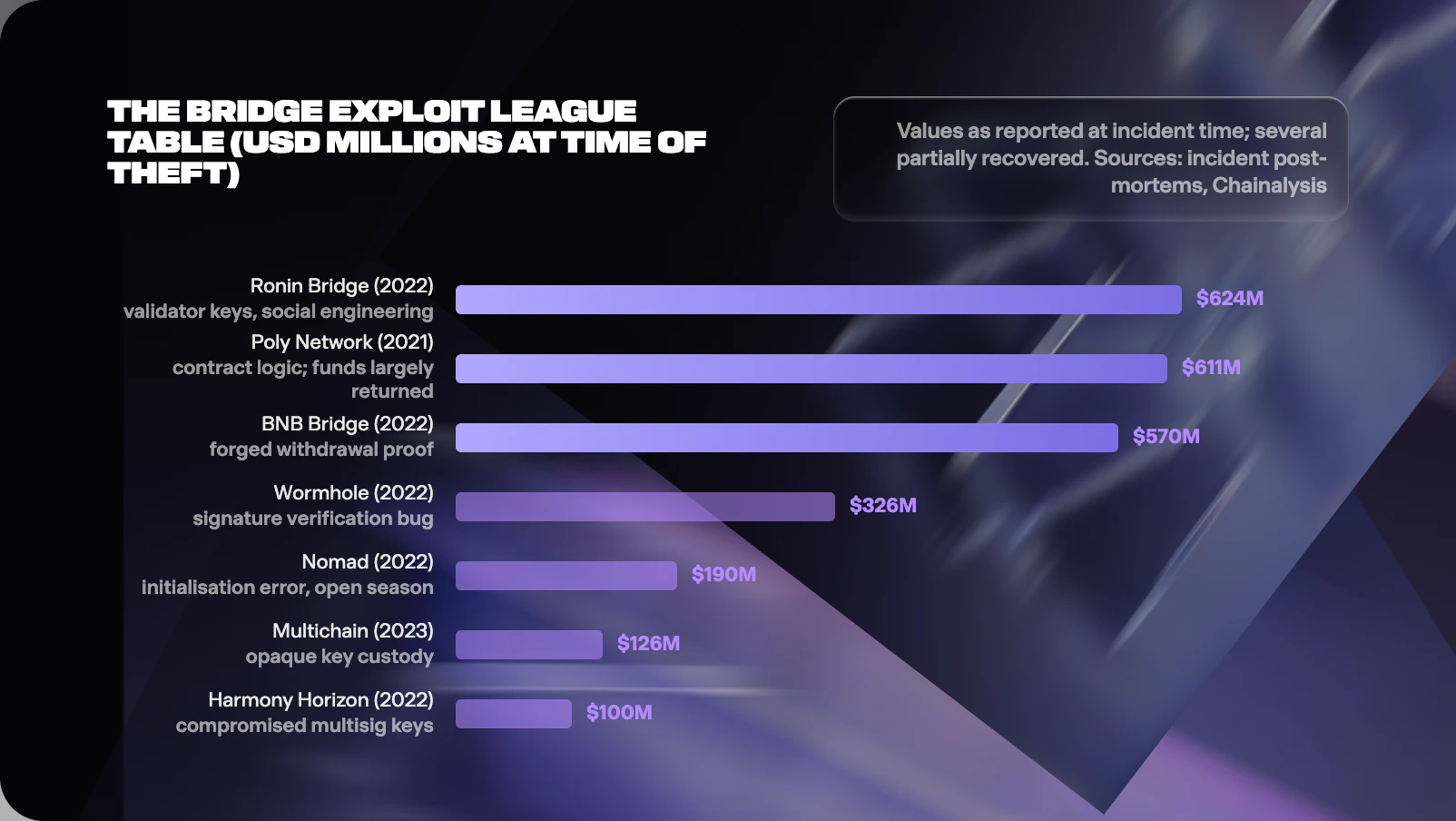
Ronin: five of nine keys
The Ronin bridge, supporting the Axie Infinity game, was secured by nine validator keys, of which five were needed to authorise a withdrawal. In March 2022, attackers later attributed to North Korea's Lazarus Group obtained five, four through a compromise of the Sky Mavis infrastructure and a fifth via a validator the studio had approved for a third party and never revoked. With five signatures they signed two withdrawals draining roughly 624 million dollars. The cryptography performed exactly as designed; the trust assumption behind it had quietly rotted. Worse, the theft went unnoticed for six days, because nobody was watching the pool. Detection is part of security, and here it was absent.
Wormhole: a signature check that was not
In February 2022, an attacker exploited a flaw in Wormhole's signature verification on Solana, forging the approval of a transfer and minting 120,000 wrapped ETH, roughly 326 million dollars, that was never backed by locked collateral. The bug was a failure to properly verify guardian signatures, a single validation gap that let the attacker fabricate authorisation. Jump Crypto recapitalised the hole to prevent contagion, which prevented a wrapped-asset depeg but also demonstrated how bridge failures propagate: the wrapped token is only as solvent as the bridge behind it, and its holders on the destination chain bear the risk.
Nomad: open season
Nomad in August 2022 is the cautionary tale about upgrade error and copycat dynamics. A routine upgrade marked a zero root as valid, which effectively made any withdrawal message pass verification. The result was a public looting rather than a single sophisticated theft: once the method was visible in the mempool, hundreds of ordinary users copied the exploit transaction, swapping in their own addresses, and drained roughly 190 million dollars in hours. It is the clearest demonstration that on a public chain an exploit is a public good for attackers, replicated at the speed of copy-paste.
How did the threat surface move from contracts to operators?
Quick answer
As contract auditing matured, sophisticated attackers shifted to the humans and infrastructure around the code: signing workflows, key custody, insiders, and the software supply chain. The 2025 Bybit theft, roughly 1.5 billion dollars, is the defining example, and it broke no cryptography and exploited no contract bug.
This is the most important structural shift in crypto security, and experts who still frame risk as smart-contract risk are fighting the last war. Chainalysis recorded about 3.4 billion dollars stolen in 2025 within its tracked dataset, a tracker-specific figure rather than a census, but the composition tells the real story: roughly two thirds of it came from just three incidents, and DPRK-linked actors took about 2.02 billion, a 51 percent year-on-year rise, from far fewer attacks than the year before. Fewer, larger, more sophisticated, and aimed at operations rather than code.
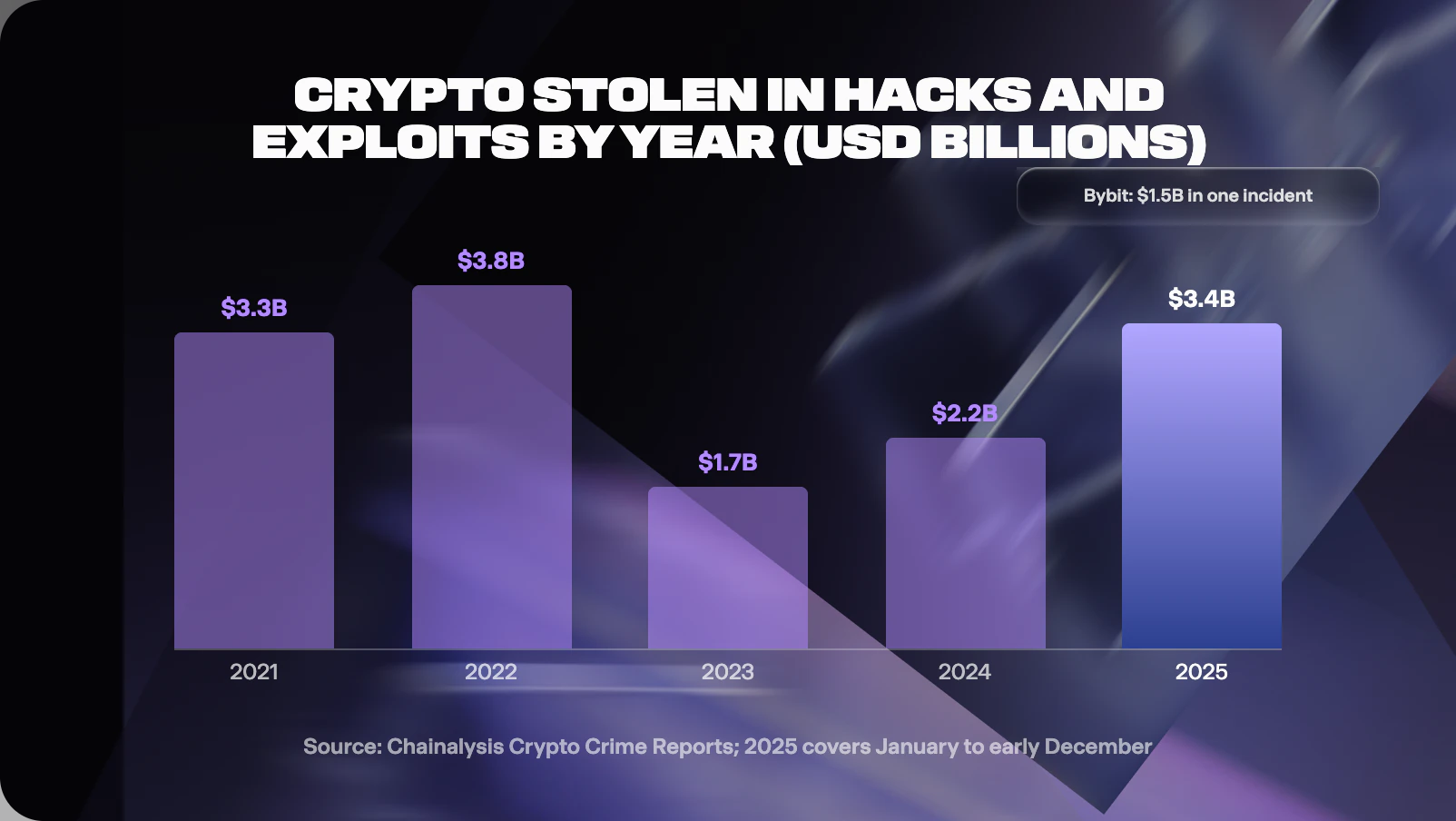
The Bybit attack is worth dissecting because it is the template. In February 2025, attackers compromised the workflow around a routine cold-wallet transfer, manipulating what signers saw so that they approved a transaction whose real effect differed from its displayed effect. The signers were legitimate, the keys were legitimate, the multisig thresholds were met; the deception happened at the interface between human intent and cryptographic authorisation. Approximately 400,000 ETH, about 1.5 billion dollars, left in a single event that the FBI attributed to North Korea's TraderTraitor cluster, with independent forensic reviews of the compromised signing flow reaching the same interface-manipulation conclusion. The industry's own security firms converged on the same conclusion afterward: top-tier adversaries now compromise signing infrastructure and operator workflow rather than hunting logic errors, because that is where the return on effort is highest.
The operator threat surface has several distinct faces, and each needs its own controls.
- Signing-workflow compromise. The attacker does not steal the key; they corrupt what the signer believes they are approving, through a manipulated interface, a malicious front-end, or a poisoned transaction payload. Clear signing on independent hardware, out-of-band verification of destination and amount, and blind-signing refusal are the defences.
- Key custody and insider risk. A privileged key on a single machine, an insider with quiet access, or a poorly governed multisig collapses to a single point of failure. Threshold signatures and multi-party computation distribute authority so that no one device or person can unilaterally sign, which is the architectural answer to seed-phrase and single-key fragility.
- Software supply chain. Compromised npm packages, poisoned build pipelines, malicious dependencies and backdoored developer tooling let attackers reach signing environments without touching the chain at all. In 2025 this vector produced several major incidents and remains badly under-defended.
- Front-end and infrastructure. DNS hijacks, compromised hosting and malicious script injections turn a legitimate protocol's own website into the attack, with the contracts entirely innocent. Users signing on what they believe is the real interface are the victims.
What makes systemic and market-structure failure different?
Quick answer
Systemic failure needs no bug and no theft. It emerges when leverage, thin liquidity, cross-margin collateral and reflexive liquidation engines interact, so that a local shock propagates into a market-wide cascade. Composability, crypto's greatest strength, is also its primary channel of contagion.
The risks above are adversarial: someone attacks something. Systemic risk is different and, for an expert, more interesting, because the system harms itself while every component behaves as designed. The market-structure layer sits at the top of the stack precisely because it aggregates everything beneath it: the same composability that lets protocols plug into each other frictionlessly lets a failure in one propagate to all, at machine speed, with no human in the loop to pause it.
The October 2025 liquidation cascade
On 10 October 2025, crypto experienced the largest liquidation event in the aggregator record. A two-stage macro shock, a tariff-escalation threat followed hours later by the formal announcement of an additional 100 percent tariff on Chinese imports, hit a market carrying record derivatives open interest of around 217 billion dollars into thin weekend liquidity. The documented cascade does not require a fraud hypothesis, though deliberate exploitation remains unproven either way. Roughly 19 billion dollars of leveraged positions liquidated within 24 hours across more than 1.6 million accounts, with the most violent phase concentrating billions of dollars of forced selling into a single 40-minute window. Bitcoin fell from around 122,000 dollars toward 105,000; mid-cap and small-cap tokens fell 60 to 80 percent at the trough; some illiquid pairs briefly printed near zero as order books emptied.
The mechanism deserves precision, because it recurs. First, cross-margin, or unified-account, collateral tied every position in an account to its weakest asset, so a drop in one holding forced liquidation of others. Second, a synthetic stablecoin, USDe, dislocated sharply on the dominant venue, trading in the mid-60-cent range there while holding much closer to a dollar elsewhere, which triggered a second wave of liquidations against positions collateralised by it. Third, auto-deleveraging kicked in: to keep the exchange solvent, even well-hedged winning positions were forcibly reduced, turning neutral market makers into forced sellers and collapsing the very liquidity that might have absorbed the move. Each step was a component functioning correctly, and the composition was catastrophic.
Two features distinguish this from a traditional crash. Crypto trades 24/7 with no circuit breakers, so there is no coordinated halt to interrupt a doom loop the way equity markets impose at defined thresholds. And risk is concentrated in venue-level margin engines with high available leverage and price discovery fragmented across exchanges, so the same asset can trade at wildly different prices during stress, and the discrepancy itself triggers liquidations. Notably, no major lender or exchange became insolvent: the damage was trading losses, not fraud or contagion into a Terra or FTX style collapse, which is why it is the purest example of pure market-structure risk the ecosystem has produced.
Stablecoins and depegs as a systemic hinge
Stablecoins are the settlement layer of crypto and by several common measures now carry a very large share of on-chain value transfer, which makes their stability a systemic dependency rather than a product feature. A depeg is not merely a loss for holders; it is a shock transmitted to every protocol that treats the token as a dollar. The catastrophic case remains Terra's UST in May 2022, an algorithmic design whose reflexive mint-and-burn mechanism entered a death spiral and erased roughly 40 billion dollars of value in days. That collapse helped trigger a wider 2022 contagion that felled lenders and funds such as Celsius and Three Arrows Capital; FTX failed later that year in a separate episode driven by its own alleged misuse of customer funds and a liquidity run, rather than as a direct consequence of Terra. The October 2025 USDe dislocation was far more contained, a temporary venue-specific mispricing rather than a collapse, but it rhymed: a stablecoin used as collateral, losing its peg at the worst moment, amplifying a cascade. Collateralisation quality, redemption mechanics and reserve transparency are systemic variables, not marketing bullet points.
Reflexivity and composability as contagion channels
The deep property beneath every systemic episode is reflexivity: prices drive liquidations that drive prices, collateral values determine borrowing that determines collateral values, and confidence funds liquidity that funds confidence. In a composable system where any protocol can build on any other, these loops cross protocol and venue boundaries invisibly. A stablecoin depeg becomes a lending-protocol insolvency becomes a liquidation cascade becomes a further depeg. The strength of DeFi, that everything connects without permission, is identical to its systemic fragility, that everything connects without a fuse. Experts should map dependency graphs the way they audit code, because the correlations that matter are the ones nobody designed.
How should an expert reason about crypto risk as a whole?
Quick answer
Treat risk as a stack and defend in depth: assume any single layer can fail, and ensure no single failure is fatal. Concretely, that means minimising trusted components, decentralising authority, capping value at risk per component, monitoring for anomalies in real time, and stress-testing dependencies and correlations, not just code.
A coherent risk framework does not chase the last exploit; it internalises the gradient of the stack and allocates defensive attention accordingly. The following principles generalise across every layer discussed above.
- Minimise trust surface. Every trusted component, an oracle, a bridge validator set, an upgrade key, a custodian, is a place the system can be attacked. The fewer and the more decentralised they are, the smaller the target. Ask of any protocol: what must I trust, and what happens when each of those things fails?
- Cap value at risk per component. Value locked behind a mechanism should never exceed the cost of corrupting it. Rate limits, per-transaction and per-window caps, and tiered custody keep any single failure bounded, so a compromise is a loss rather than a catastrophe.
- Distribute authority. Threshold signatures, multi-party computation and genuinely independent multisig remove the single point of failure that seed phrases and lone keys represent. The Bybit and Ronin lessons are both, at root, about authority that was nominally distributed but practically concentrated.
- Instrument everything and pause fast. Ronin went unnoticed for six days. Real-time monitoring of pools, anomalous-transaction detection and automated circuit breakers turn a total loss into a contained incident. Detection and response are security, not afterthoughts.
- Stress-test dependencies, not just code. Map the graph of oracles, stablecoins, bridges and collateral your position depends on, and model correlated failure. The October 2025 cascade rewarded whoever had already asked what happens when cross-margin, a stablecoin depeg and thin liquidity coincide.
- Respect irreversibility in design and in habit. Because confirmed transactions cannot be undone, the entire discipline is preventive. Clear signing, verification through independent channels, staged rollouts, and the assumption that any signature could be the fatal one are the behavioural counterpart to the architectural controls.
Frequently asked questions
What is the biggest source of crypto losses today?
Operator and infrastructure compromise, not smart-contract bugs. In 2025 roughly 3.4 billion dollars was stolen, dominated by a few mega-incidents such as the 1.5 billion dollar Bybit theft, which attacked signing workflows rather than code. Separately, market-structure events like the October 2025 liquidation cascade destroyed far more value than any hack, without any theft at all.
Why are cross-chain bridges hacked so often?
Because they concentrate very large locked pools behind validation mechanisms, usually small validator sets or multisigs, that are weaker than the chains they connect. Attackers target the weakest link, and a handful of keys is a far softer target than a blockchain. Ronin, Wormhole, Nomad, Harmony and BNB Bridge together lost over two billion dollars, mostly to key and proof-verification failures, which makes bridges the source of several of the largest infrastructure losses on record.
Can a smart contract audit guarantee safety?
No. An audit reviews one code version under specific assumptions at one point in time. It cannot prove the absence of all bugs, cannot cover future upgrades, and cannot address oracle, governance, economic or operational risk. Audits, formal verification, monitoring and bug bounties are complementary layers, and none is a guarantee.
What is a liquidation cascade?
A self-reinforcing loop in which forced liquidations of leveraged positions push prices down, which triggers further liquidations. With cross-margin collateral, thin liquidity and no circuit breakers, it can wipe out enormous value quickly. On 10 October 2025 roughly 19 billion dollars liquidated in a day, the largest such event on record; the documented mechanics require no fraud hypothesis, though deliberate exploitation remains unproven either way.
How do oracle manipulation and flash loans combine?
An oracle feeds external prices into a contract that cannot verify them. A flash loan supplies enormous uncollateralised capital within one atomic transaction, enough to move a thin market the oracle reads. The attacker distorts the price, exploits the protocol trusting it, and repays the loan, all before the block finalises. The Mango Markets exploit of about 114 million dollars is a canonical example.
Is systemic risk in crypto getting better or worse?
Mixed. Contract auditing and wallet security have measurably improved, and institutional capital dampens some retail leverage effects. But composability, high available leverage, fragmented price discovery and the absence of circuit breakers remain structural, and stablecoins now carry systemic weight. The October 2025 cascade shows the market-structure layer is still fragile even as lower layers harden.
Sources and further reading
Key references for this article, current as of July 2026. Volatile figures are re-checked at each quarterly review.
- Chainalysis, 2026 Crypto Crime Report, stolen funds analysis. https://www.chainalysis.com/blog/crypto-hacking-stolen-funds-2026/
- Chainalysis, 2026 Crypto Crime Report introduction. https://www.chainalysis.com/blog/2026-crypto-crime-report-introduction/
- FBI IC3 public service announcement attributing the Bybit theft to North Korea. https://www.ic3.gov/PSA/2025/PSA250226
- CoinDesk Research, the 19 billion dollar liquidation that shook crypto (October 2025). https://www.coindesk.com/research/market-spotlight-the-19-billion-liquidation-that-shook-crypto
- FTI Consulting, October 2025 crypto crash: leverage met liquidity. https://www.fticonsulting.com/insights/articles/crypto-crash-october-2025-leverage-met-liquidity
- Ethereum.org, oracles documentation. https://ethereum.org/en/developers/docs/oracles/
- Ethereum.org, bridges documentation and trust models. https://ethereum.org/en/developers/docs/bridges/
- Ethereum.org, smart contract security. https://ethereum.org/en/developers/docs/smart-contracts/security/
- Rekt News, incident post-mortems archive (Ronin, Wormhole, Nomad and others). https://rekt.news/
- Investopedia, Terra Luna collapse explained. https://www.investopedia.com/terra-luna-collapse-5218263
- Reporting: FBI Internet Crime Complaint Center at https://www.ic3.gov (US) and Report Fraud (which replaced Action Fraud in December 2025) at https://www.reportfraud.police.uk (England, Wales and Northern Ireland; in Scotland, call Police Scotland on 101).
Quick quiz: did it stick?
Seven questions for the expert reader. Answers with reasoning follow.


You have completed a quiz on “Understanding Crypto Risk: Smart Contracts, Bridges, and Systemic Failure”! Share your achievement on social media.
 Was this helpful?