TL;DR
- Because every strengthening of custody against attackers is also a strengthening against your future self and your heirs, and unlike theft, loss needs no adversary: entropy, forgetting and death come free. The loss statistics are the quiet proof.
- A seed phrase deterministically regenerates the wallet's keys, so recovery is as simple as typing the words into compatible software with the same settings; every failure mode follows from that concentration. One sentence, plus its settings, restores control, to anyone, forever.
- They replace the master secret with a quorum: designated guardians, devices or services that can jointly restore access while none can act alone, which turns recovery from protecting an object into governing a relationship. Loss and theft resistance finally improve together.
- Because law transfers ownership while cryptography transfers access, and the two systems share no interface: a will cannot move a key, and a key ignores the will. Every inheritance disaster lives in that gap.
In one block
Wallet recovery is the set of mechanisms that restore signing authority after loss: a device failing, a phrase burning, an owner forgetting, or an owner dying.
Why is recovery the hard half of self-custody?
Quick answer
Because every strengthening of custody against attackers is also a strengthening against your future self and your heirs, and unlike theft, loss needs no adversary: entropy, forgetting and death come free. The loss statistics are the quiet proof.
Self-custody's defining property, no one else can move your assets, has an exact logical mirror: no one else can help. There is no reset link, and the network cannot distinguish a grieving family from an attacker; it verifies signatures, never stories. Whatever combination of secrets, devices and people your setup requires, that combination must survive every future you actually get, including the futures where you are absent.
The record says this goes badly at scale. River's 2025 custody research estimates roughly 1.57 million bitcoin as likely permanently lost, with the honest caveat that dormancy cannot distinguish a lost key from a patient holder, so the figure is uncertain. The failures documented case by case run heavily to the mundane: forgotten passwords, discarded devices, backups destroyed in moves and floods, and deaths with no succession path. The practical conclusion for an individual is simple enough: your own future is a risk worth planning for, alongside the attackers in the risk articles.
Recovery design is therefore risk allocation, exactly as the multisig article frames its quorum: every mechanism that restores access is, from an attacker's chair, an alternative way in. A phrase in three places recovers from two fires and offers three burglaries. A recovery service that can restore your wallet can, if compromised or compelled, restore it for someone else. The craft is building restoration paths whose activation needs the right combination of parties, times or events, rather than one secret in one place, and the models below are graded on precisely that.
How does seed phrase recovery actually work, and where does it fail?
Quick answer
A seed phrase deterministically regenerates the wallet's keys, so recovery is as simple as typing the words into compatible software with the same settings; every failure mode follows from that concentration. One sentence, plus its settings, restores control, to anyone, forever.
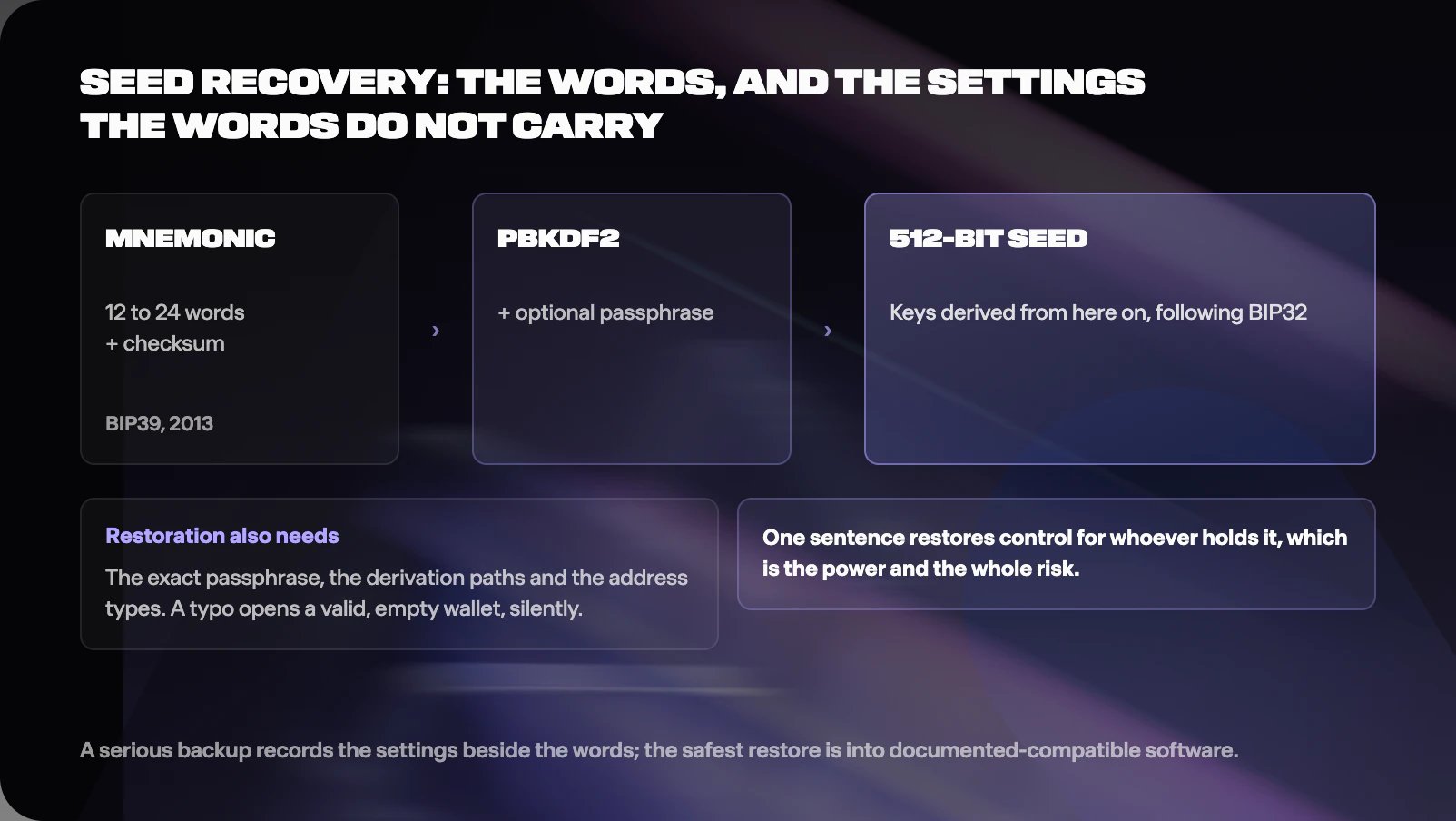
The mechanics are elegant. Modern wallets follow the BIP32 (2012) and BIP39 (2013) standards: at creation, the wallet draws randomness, encodes it as a mnemonic of 12 to 24 words with a checksum, transforms it through PBKDF2, together with any optional passphrase, into a 512-bit seed, and derives keys from that seed through deterministic paths. Restoration reverses it: enter the phrase into compatible software, with the same passphrase, paths and address types, and the same derivation reproduces the same keys, and therefore control of the same funds. No company, server or permission is involved, which is why the phrase became self-custody's standard recovery object, and why a serious backup records the settings alongside the words.
Now the failure catalogue, each item a direct consequence. The phrase is complete: possession permits signing and control of transfers, which is what makes it the theft target, the coercion script, and, as the wallet comparison article puts it, the strong device's weak sentence. The phrase is singular: one unreadable, burnt or lost copy with no duplicate strands everything, and every duplicate made against that risk multiplies the theft surface. The phrase is unforgiving in detail: wrong word order, a misread handwritten word, an unrecorded passphrase or derivation-path quirk can make a technically surviving backup practically useless, and a mistyped passphrase does not even fail loudly, it silently opens a different, empty wallet. And the phrase is only as durable as its medium: paper against decades, ink against water, memory against age.
Two standard refinements trade fragility for complexity. An optional BIP39 passphrase, marketed as a twenty-fifth word though it is any text you choose, splits the secret in two: phrase plus passphrase restores the hidden wallet, while the phrase alone restores the base wallet, which a careful user can deliberately fund and present as a decoy, useful against theft and coercion, and a fresh way to strand funds, since every passphrase, typos included, silently yields a valid wallet, and a passphrase that dies with its only holder is final. Threshold schemes under the SLIP39 standard encode a master secret directly as mnemonic shares, any quorum restores, fewer reveal nothing; SLIP39 is chiefly an alternative to BIP39 rather than a knife for an existing phrase, so adopting it for an existing wallet means migrating to a new seed, and the recovery of the recovery, share locations, holders and thresholds, must itself be documented and maintained. Naive splitting of a BIP39 phrase into halves weakens it badly and belongs on no one's list.
The honest summary: seed recovery works exactly as designed, and its design concentrates everything into one object. The rest of this article is about designs that refuse that concentration.
What do social recovery and MPC change about getting access back?
Quick answer
They replace the master secret with a quorum: designated guardians, devices or services that can jointly restore access while none can act alone, which turns recovery from protecting an object into governing a relationship. Loss and theft resistance finally improve together.
Social recovery, argued for years in a widely cited essay by Ethereum's co-founder and now implemented in smart account wallets, works at the account layer: your wallet is a contract whose signing key can be replaced by approval of a guardian quorum you configured, say three of five, drawn from your own other devices, family, friends or institutions. Lose everything, and your guardians jointly authorise a key rotation; no guardian, or minority subset, can take the account, and a compromised guardian is replaced like a lost multisig key. Delays and notifications on recovery actions blunt guardian collusion and social-engineering attacks, the same policy thinking the institutional article applies to treasuries.
MPC wallets, whose mechanics the threshold cryptography article builds from first principles, reach the same destination at the key layer. In these designs signing never reconstructs a whole key, and where setup used distributed key generation the key exists only as shares from the start rather than being made whole and split by a trusted dealer. Losing a device loses one share, and recovery uses the remaining quorum, typically your second device, an encrypted backup share, or a service or guardian holding one, to re-establish signing and refresh shares so lost material becomes worthless. There is no phrase to type, and in designs built for it, no moment during recovery when a complete secret is assembled to intercept; the setup ceremony and whether a given product achieves this are implementation facts worth confirming. Guardian-based reconstruction extends naturally to the case where the missing party is you, which is why the inheritance section below leans on it.
The new risk surface is the quorum itself, and it should be read with multisig eyes. Guardians can collude, die, lose their own keys or be phished; services holding shares can fail, be breached or be compelled; a recovery flow with weak identity checks is an account-takeover product. The design disciplines are familiar by now: independence among guardians, no single party spanning the quorum, delay-plus-notification on recovery, periodic rehearsal, and documentation your future self can follow. What has genuinely changed is the shape of the problem: no object whose burning is fatal, no sentence whose recital is total, and a mechanism that, unlike a phrase in a safe, can notice and object when the wrong person pulls it.
Why does inheritance break at the boundary of technology and law?
Quick answer
Because law transfers ownership while cryptography transfers access, and the two systems share no interface: a will cannot move a key, and a key ignores the will. Every inheritance disaster lives in that gap.
Walk the gap from both sides. The legal system does its half well: a will or intestacy rules pass title to your crypto to your heirs, probate confirms it, and in the jurisdictions this academy addresses the assets are simply property in the estate, with the tax treatment that implies. What the law cannot do is produce a signature. If the estate's paperwork is perfect and the phrase is unknown, the heirs own, in full legal splendour, assets nobody will ever move. The stranded-coin estimates above plausibly include many such estates, and the pattern shows up wherever sudden death meets undocumented custody, in private family tragedies far more often than in headlines.
The naive fixes each fail a different way. The seed phrase written into the will fails at probate: wills become public documents in many jurisdictions, so the master secret is now published. The phrase handed to an heir in advance fails while you live: it is a standing theft and coercion path, and the physical security article prices what known access does to a household's risk. The phrase in a bank box under the estate's control fails on timing and dependency: frozen boxes, slow probate, a single institution. Secret instructions hidden cleverly fail on the cleverness: heirs cannot use what they cannot find or understand, and grieving non-experts facing hardware wallets and derivation paths make expensive mistakes, or fall prey to the "recovery services" that advertise to exactly them, a scam family this academy's threat articles catalogue.
The structural insight, and it should feel familiar three articles into this cluster: an inheritance mechanism is a recovery mechanism with a time trigger and a different beneficiary, so it must satisfy the same two-direction test. It must not work while you are alive and unwilling, or it is a theft path; it must reliably work when you are gone, or it is a stranding path. Single secrets fail the test in both directions at once. Quorums, delays and designed triggers pass it, which is where the final section goes.
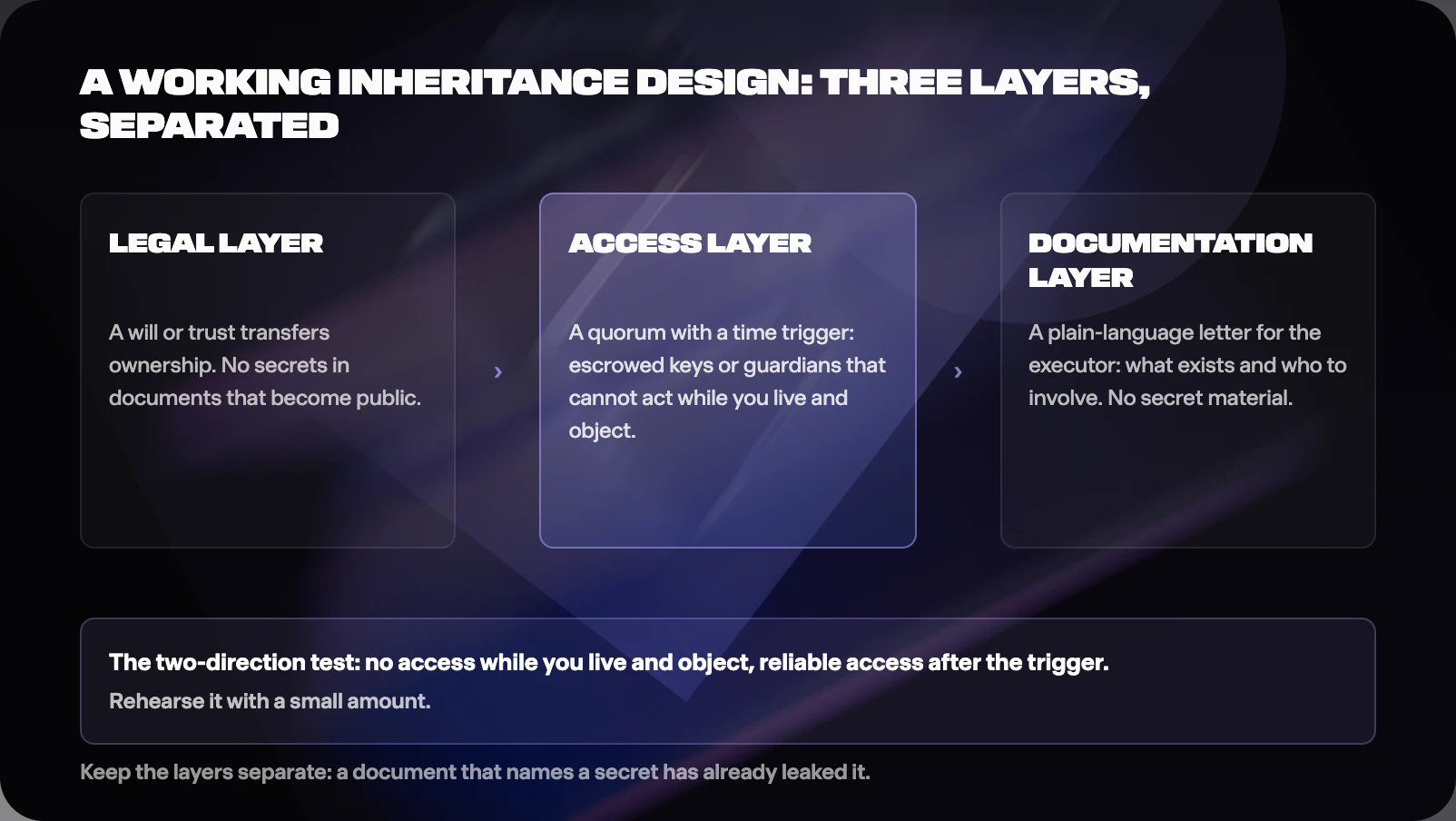
What does a working inheritance design actually look like?
Quick answer
Separated layers, each doing what it is good at: the estate plan transfers ownership, a quorum-based mechanism transfers access on a designed trigger, and plain-language documentation lets a non-expert executor connect the two, all rehearsed while you are alive to fix what fails. No single secret, no single person, no surprises.
The legal layer first, because it is mandatory everywhere: a will or trust that identifies the crypto in appropriate terms, an executor who knows the assets exist, and jurisdiction-appropriate advice on tax and probate treatment. What stays out of the legal documents is any secret material: the will says who receives and points to where instructions live, never how to sign.
The access layer then implements transfer-on-trigger without a master secret, and the mechanisms are this cluster's familiar toolkit rearranged. A multisig arrangement can include an heir's or professional co-signer's key that is useless alone today and forms a quorum with an escrowed key on death, giving survivorship by structure, as the multisig article's shared pattern shows. Guardian-based social recovery and MPC guardian reconstruction do the same at account or share level: heirs or fiduciaries hold guardian positions that cannot act alone while you live and can jointly restore access, behind a delay and verification process, when the trigger fires. Timelock and dead-man-switch constructions add cryptographic triggers, powerful, and demanding maintenance, since a switch you forget to reset becomes its own event. Consumer wallets increasingly productise these guardian-and-beneficiary flows, which matters mainly because it moves inheritance design from expert improvisation into tested software, the same migration multisig once made.
The documentation layer is the unglamorous load-bearing wall: a plain-language letter of instruction, stored with the estate papers and updated on a schedule, that inventories what exists and where, names the arrangement's parts without revealing secrets, and tells the executor exactly who to involve and what process to follow. Assume the reader is intelligent, grieving and has never heard the word derivation.
And the discipline that binds the layers: rehearse. Walk your executor or a guardian through a dry run; restore from the mechanism with a trivial balance; check the arrangement after every life change, marriage, divorce, births, moves, and at least annually. The wallet comparison article's rule scales all the way up: an untested backup is a hypothesis, and an untested inheritance plan is a hypothesis your heirs get to test once, without you.
Frequently asked questions
Should I just tell my partner the seed phrase?
Shared knowledge of a complete secret is a theft, coercion and relationship-breakdown surface while you live, and still fails if the phrase itself is lost. The structured version of the same intent is a quorum: your partner as a multisig key holder or recovery guardian who can act jointly on death, and cannot act alone before it. It achieves the trust without the standing master-key problem.
Is it safe to store my seed phrase in a password manager or cloud note for my heirs?
You would be placing the master secret inside an account whose own recovery, breach and subpoena characteristics you do not control, and heirs would still need that account's access. If a phrase must persist, physical media in separated locations, or proper threshold splitting under a standard like SLIP39, dominates cloud storage; better still is a design where no complete phrase exists to store, which is what guardian and MPC arrangements provide.
What actually happens to crypto if someone dies with no plan at all?
Legally it passes with the estate; practically it moves only if someone can find the wallets and produce signatures. Executors face a forensic project, devices, papers, exchange accounts, with no map, under time pressure, and any custodial accounts depend on each platform's deceased-user process. Much of it plausibly adds to the unmeasured pool of unreachable coins. An hour of documentation, an inventory and instruction letter with no secrets in it, changes that outcome more than any technology.
Do exchanges and custodians handle inheritance better than self-custody?
They convert the cryptographic problem into an administrative one: platforms have deceased-user procedures, courts can compel them, and no signature dies with the owner. The price is the custody trade covered across this cluster, counterparty, solvency and account-security risk while you live. Many estates reasonably hold a mix; what does not transfer is the assumption that self-custody will sort itself out, because it is the one model where nobody can help by default.
How often should a recovery and inheritance setup be reviewed?
Annually, and on every life or technology change: new family circumstances, moves, new devices or wallets, guardians whose situations changed. Reviews are short, verify each key, share or guardian still exists and works, confirm documentation still matches reality, and they are what keep an arrangement from rotting into the very single point of failure it was built to remove.
Sources and further reading
Key references for this article, current as of July 2026. Volatile figures are re-checked at each quarterly review.
- BIP39, Mnemonic code for generating deterministic keys. https://github.com/bitcoin/bips/blob/master/bip-0039.mediawiki
- BIP32, Hierarchical deterministic wallets. https://github.com/bitcoin/bips/blob/master/bip-0032.mediawiki
- SLIP39, Shamir backup for mnemonic secrets. https://github.com/satoshilabs/slips/blob/master/slip-0039.md
- RFC 9591 (FROST threshold signatures): threshold signing need not reconstruct the key, and setup may use a trusted dealer or distributed key generation. https://www.rfc-editor.org/rfc/rfc9591.html
- Vitalik Buterin, Why we need wide adoption of social recovery wallets. https://vitalik.eth.limo/general/2021/01/11/recovery.html
- ethereum.org, account abstraction and smart accounts. https://ethereum.org/en/roadmap/account-abstraction/
- ERC-4337, account abstraction specification. https://eips.ethereum.org/EIPS/eip-4337
- NIST, Threshold Cryptography project. https://csrc.nist.gov/projects/threshold-cryptography
- River, Bitcoin Custody Report 2025: dormancy-based loss heuristics and stated limitations. https://river.com/content/bitcoin-custody-report-2025
- Ontario Securities Commission, QuadrigaCX review report: fraud as the principal cause of the shortfall, with sole key control compounding it. https://www.osc.gov.on.ca/quadrigacxreport/
- Investopedia, estate planning for digital assets and cryptocurrency. https://www.investopedia.com/cryptocurrency-estate-planning-5224867
- Investopedia, what happens to your bitcoin when you die. https://www.investopedia.com/news/what-happens-your-bitcoins-when-you-die/
- Wikipedia, digital inheritance (overview and jurisdiction notes). https://en.wikipedia.org/wiki/Digital_inheritance
Quick quiz: did it stick?
A few questions to check the fundamentals landed. Answers with explanations follow, and nobody is grading you except your future portfolio.


You have completed a quiz on “How Does Crypto Wallet Recovery and Inheritance Work?”! Share your achievement on social media.
 Was this helpful?