TL;DR
- Two families of danger: theft, where someone else gains the ability to move your funds, and loss, where nobody retains it, and the evidence says ordinary holders should take both seriously. Neither is dominated by exotic hacking; both are dominated by the human layer.
- Because every asset answers to a key, every threat is finally an attempt to reach a key, or a consequence of a key being unreachable, so deciding where keys live and what can touch them is the whole game. Products and habits are implementations of that decision.
- Treat your email, phone number and exchange logins as part of your crypto, because attackers do: harden them with phishing-resistant authentication, remove your phone number from recovery paths, and turn on withdrawal controls. The account layer is where novices are actually robbed.
- Match the custody model to what the balance means: custodial convenience for the float you trade, and for savings, self-custody structured so that no single secret, device or company can lose or move everything. The spectrum has three working positions, and mixing them deliberately is normal.
In one block
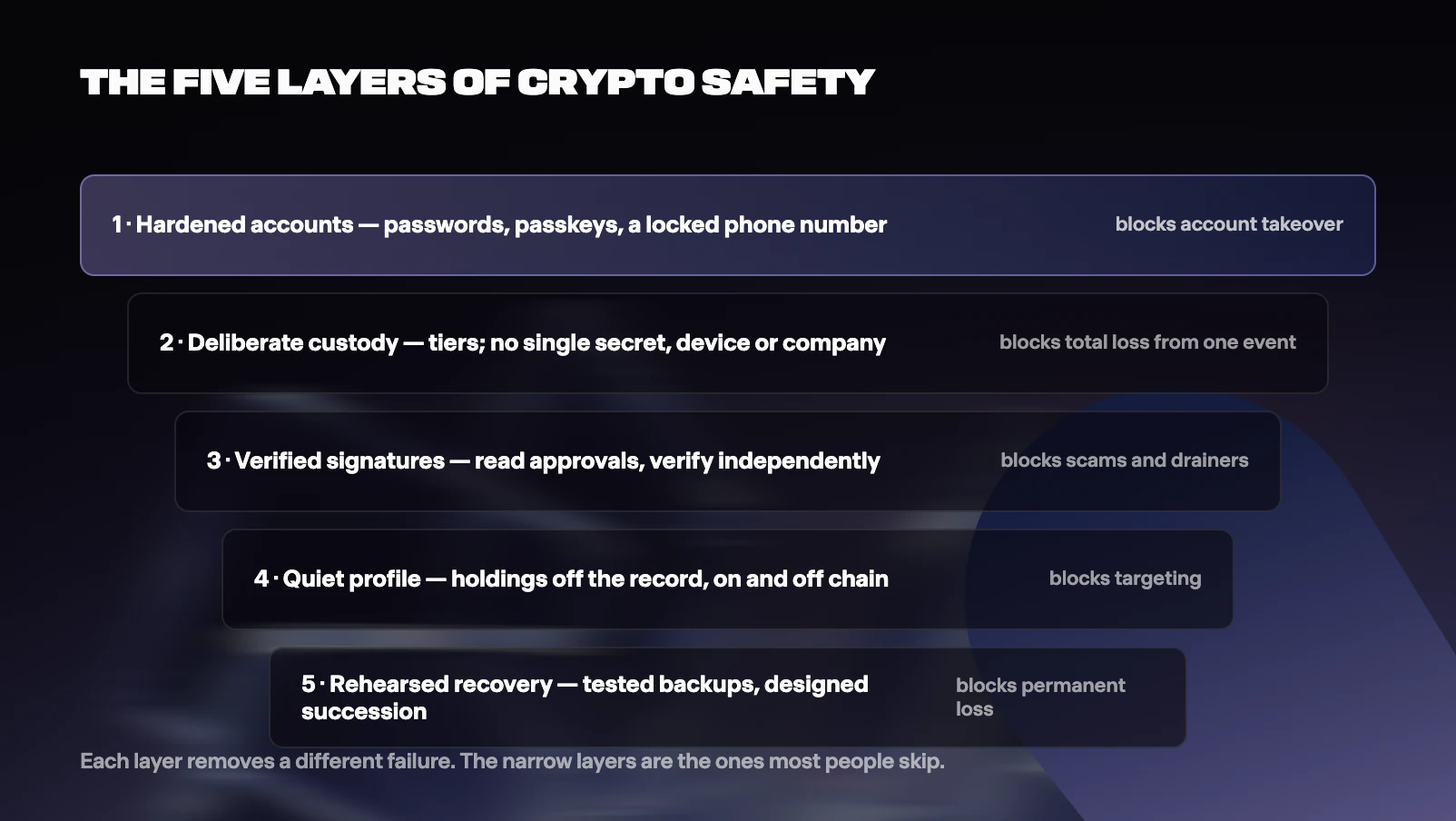
Keeping crypto safe means controlling who can move your assets and making sure that someone is always you. In practice it is five disciplines working together: securing the accounts around your crypto with strong authentication, choosing custody so no single secret or company can lose everything, verifying what you sign before you sign it, limiting what strangers can learn abo…
What actually threatens your crypto?
Quick answer
Two families of danger: theft, where someone else gains the ability to move your funds, and loss, where nobody retains it, and the evidence says ordinary holders should take both seriously. Neither is dominated by exotic hacking; both are dominated by the human layer.
Put numbers to the fear first, because vague dread produces bad decisions. On the theft side, the FBI's Internet Crime Complaint Center logged 181,565 crypto-related complaints in 2025 with 11.4 billion dollars in reported losses, most of it deception rather than intrusion: investment fraud alone accounted for roughly 7.2 billion of it. Hacks in the technical sense stole about 3.4 billion dollars in 2025 by Chainalysis's measure, and the largest single event, the 1.5 billion dollar Bybit theft, attacked a signing workflow rather than any wallet's cryptography. Signature-phishing drainers, the plague of 2023 and 2024, fell to 83.85 million dollars of tracked losses in 2025; ScamSniffer links the drop partly to better wallet warnings and partly to the year's market conditions, so it is a correlation rather than a proven migration of criminals. Physical attacks, the ugliest category, reached a record 72 documented incidents.
The loss side has no complaint hotline, which is why it gets underestimated. Coins stranded by forgotten keys, discarded devices, destroyed backups and deaths without succession do not file reports; they just stop moving. River's 2025 custody research estimates roughly 1.57 million bitcoin as likely permanently lost, while being explicit that dormancy cannot distinguish a lost key from a patient holder, so the figure and its causes are uncertain. Our companion flagship, The Crypto Loss Report 2026, assembles the full taxonomy with sources and caveats; the summary that matters here is still uncomfortable: operational failure is a serious risk in its own right, not a footnote to theft.
Two properties of crypto make both families sharper than their traditional-finance cousins. Base-layer transfers are, in general, not reversible by anyone once settled, so there is no chargeback tier; the exceptions, issuers freezing centrally administered tokens, platforms freezing funds they control, court-ordered recoveries, are narrow and never something to plan around. And control is cryptographic, so the network cannot distinguish you from anyone holding your credentials, or help you when nobody holds them. Those properties are the price of self-sovereign money. The rest of this guide is what paying it well looks like.
Why is crypto safety really a key management problem?
Quick answer
Because every asset answers to a key, every threat is finally an attempt to reach a key, or a consequence of a key being unreachable, so deciding where keys live and what can touch them is the whole game. Products and habits are implementations of that decision.
The mechanism, covered fully in our guide to private and public keys, fits in a paragraph. Your crypto exists as entries on a public ledger. The ledger accepts changes only when they carry a valid signature from the right private key. Whoever can produce that signature controls the ability to move the funds, which is separate from legal ownership, and nobody else, including you on a bad day, can move them at all.
Read the threat list from the previous section through that lens and it reorganises itself. Investment fraud talks you into signing transfers voluntarily. Drainer phishing tricks you into signing permissions you did not understand. SIM swap attacks steal the account credentials standing in front of a custodian's keys. The Bybit attackers corrupted what signers saw so a quorum authorised the wrong payload. Coercion applies force until a key or its backup is surrendered. Forgotten phrases and unplanned deaths leave keys with no living path to them. Different stories, one moral: the key, or the authority in front of it, is always the target or the casualty.
This lens does useful work because it converts shopping questions into design questions. "Which wallet should I buy" becomes "where should signing authority live, in how many pieces, reachable by whom, recoverable how". Our article on who holds your crypto walks the custody spectrum that answers it, from exchange accounts through single-key wallets to MPC arrangements where the key exists only as cooperating shares. Hold that framing; every section below is one layer of the same answer.
How do you secure the accounts around your crypto?
Quick answer
Treat your email, phone number and exchange logins as part of your crypto, because attackers do: harden them with phishing-resistant authentication, remove your phone number from recovery paths, and turn on withdrawal controls. The account layer is where novices are actually robbed.
Most first losses happen before self-custody is even involved, inside accounts: an exchange login, the email that can reset it, the phone number that can reset the email. Our full guide to two-factor authentication and SIM swaps covers the anatomy; the working rules compress well.
Give every account that touches money a unique password from a password manager, and accept no exceptions, because password reuse converts any website's breach into your problem. Put the strongest available second factor on the exchange and, above all, on the email behind it: a passkey or hardware security key where offered, an authenticator app otherwise, SMS codes only where nothing better exists. The reasoning is unforgiving: codes sent by text go to a phone number, a phone number is an account at a carrier, and carriers can be talked into moving it. The FBI recorded 971 SIM swap complaints and 17.4 million dollars in losses in 2025 across all crime categories, and the technique remains a standard opening move against crypto holders.
Then remove the number from the loop entirely: strip it from account recovery options, ask your carrier for a port-out block, and treat "we sent a code to your phone" as a warning sign rather than a comfort. Finish with the controls that survive a bad day: withdrawal address allowlists with delays on changes, so a thief inside your account still cannot send funds anywhere new quickly, and an anti-phishing code so genuine platform emails identify themselves.
None of this requires expertise. It is an afternoon of settings that moves you out of the attacker's cheapest category, and it protects the custodial tier most people keep using for buying and trading even after they adopt self-custody for savings.
How do you choose where your keys should live?
Quick answer
Match the custody model to what the balance means: custodial convenience for the float you trade, and for savings, self-custody structured so that no single secret, device or company can lose or move everything. The spectrum has three working positions, and mixing them deliberately is normal.
Our article on who holds your crypto examines each position in depth; here is the pillar view.
A custodial account keeps keys with a company. You gain recoverable passwords, support desks and convenience; you accept the company's worst day as your own, and the history of exchange failures says that is a real price rather than a theoretical one. Reasonable for on-ramps, active trading and amounts you could shrug off.
Single-key self-custody puts one key in your hands, backed up by one seed phrase. You gain full control and independence from every institution; you accept that one secret now carries everything, with the consequences the next section takes on. A hardware wallet strengthens this position against malware, as our comparison of hardware, software and MPC storage explains, without changing its deepest structure: the device guards the key, and one written sentence still restores it for anyone.
MPC self-custody, in well-designed implementations, keeps the control and dissolves the single secret. The key is held as shares split across your devices and independent parties, cooperating to sign without reconstructing a whole key; no seed phrase exists, no single share moves anything, and losing one share triggers recovery and refresh rather than catastrophe. Those properties are architectural claims to verify for any specific product, signer combinations, recovery paths and provider dependencies included, rather than automatic features of the letters MPC. The design ran institutional treasuries for years, as our key management article records, and now ships in consumer wallets. Where the signer arrangement genuinely requires your participation for every spend, it meets the practical test of self-custody: nobody can move your funds without you. Whether a given arrangement meets it is a question of design and, in some jurisdictions, of regulatory classification, so it is worth asking explicitly of any product.
The honest choosing rule does not crown a winner, and this guide recommends no product. A structure many experienced holders use is tiered: a small hot balance where convenience earns its keep, and the majority in an arrangement whose worst single day you can survive. Every arrangement in this section carries implementation risk of its own, software quality, provider dependencies, your own configuration, and the deeper guides linked here cover those trade-offs. What that structure must never contain is the subject of the next section.
How do you remove the single point of failure?
Quick answer
Find everything in your setup of which there is exactly one, a phrase, a device, a person, a location, and restructure until no single event in either direction, loss or theft, is total. This is the centre of the whole discipline, and the industry's loss record is mostly a museum of ignored single points.
The seed phrase is the canonical case, and our dedicated article gives it fair and full treatment. The phrase is a brilliant standard: one written sentence backing up every key a wallet will ever derive. It is also, structurally, a master secret in both failure directions at once. Every copy made against fire is a gift to a burglar; every copy withheld from thieves is a bet against floods and forgetting; and under coercion, the physical security article's territory, one recitable sentence surrenders everything. Discipline mitigates all of this, and the mitigation has a ceiling, because with a single object, protecting one direction weakens the other.
Structure breaks the ceiling. Multisignature arrangements require several keys for any spend, so one stolen key moves nothing and one lost key strands nothing; our multisig guide covers the craft, including the placement rule that does the real work, keys and their backups distributed so no single place, person or event spans a quorum. MPC reaches the same property below the surface, with shares and refresh instead of multiple on-chain keys, and adds the operational grace of no phrase existing at all. Institutions settled this argument years ago: nobody runs a treasury on one memorisable secret, and the reasons scale down to a family.
Apply the same audit beyond keys, because single points hide everywhere: one email account that resets everything, one phone number behind that email, one cloud account syncing your passkeys and photos of documents, one person who knows where anything is. The fix is always the same shape, a second independent something, plus a written note your future self or executor can follow. Redundancy without documentation is a puzzle; documentation without redundancy is a target. You need both, and neither needs to be clever.
How do you defend against scams and hostile signatures?
Quick answer
Assume every unsolicited contact is hostile and every signature is a live decision: verify destinations independently, read what wallets ask you to approve, and treat urgency itself as the attack's signature. Deception is the largest theft category by far, and it targets judgement rather than technology.
The numbers deserve repeating, because they invert most people's threat model. Reported crypto investment fraud, the long-con "pig butchering" schemes and their relatives, cost victims around 7.2 billion dollars in 2025, dwarfing every hacking category combined. The perpetrators do not break systems; they build relationships, manufacture urgency, and walk victims through sending funds or signing permissions themselves. Our scams pillar and the ten most common scams guide catalogue the species; the drainer article dissects the technical cousin, where a fake mint or airdrop page obtains one signature that empties a wallet.
Defence at this layer is procedural, and the procedures are short. Money moves only on your initiative, never in response to contact, however plausible the caller, whatever logo they wear; legitimate platforms do not phone you to move funds, and nobody honest needs your seed phrase, ever, for any reason. Addresses are verified through a channel independent of the message that supplied them, and never copied from transaction history, which address-poisoning attacks exist to exploit. Signatures are read before approval: what contract, what permission, what amount, with clear signing on a trusted display for anything of size, and refusal as the default when a request cannot be understood. Urgency is treated as evidence: every scam script manufactures a reason you must act in minutes, precisely because reflection is fatal to it.
And because everyone slips, blast-radius limits sit underneath: allowances revoked periodically, per our drainer guide; a hot wallet that holds only what a bad signature may cost; the serious balance behind the structures of the previous section, where one deceived moment cannot reach it. If the worst happens anyway, our incident response guide is the manual for the first hour, and its second lesson is timeless: the "recovery service" that contacts you after a theft is the same industry taking a second pass.
How do you manage physical and privacy exposure?
Quick answer
Control what strangers can learn: an identifiable person with a visible balance is a target for both digital and physical attack, so discretion about holdings is a security control, not modesty. The blockchain's transparency and your own public footprint are the two channels to manage.
This layer surprises people, and 2025 made it unignorable: 72 documented physical attacks on crypto holders worldwide, from robbery to kidnapping, a 75 percent rise in a year, concentrated on people who could be identified as holders and located. Target selection ran on information victims mostly supplied themselves: portfolio talk on social media, conference appearances, human-readable wallet names, and customer data leaked from crypto businesses. Our physical security article covers the defensive craft in depth, including the design principle that matters when prevention fails, custody structured so that no person present can surrender the majority under pressure.
The quieter half is on-chain. Blockchains are public and permanent, so one address linked to your name unravels into a complete financial history readable by anyone forever, a mechanism our on-chain privacy article walks through. The hygiene that limits it is undramatic: fresh addresses where the chain supports them, separate wallets for public-facing and private activity, restraint about attaching your name or handle to anything that holds value, and awareness that every counterparty and every database you touch may eventually leak.
The two halves compound: on-chain visibility plus off-chain identity equals a dossier, and dossiers select targets. The compressed rule for both: your holdings are nobody's business, and every time you make them somebody's business, in a post, a profile, a boast or a name tag on an address, you are spending safety for attention. Spend deliberately if at all.
How do you make loss survivable: recovery and inheritance?
Quick answer
Design and rehearse the path back before you need it: tested backups or share recovery for device failure, and a quorum-based arrangement with plain instructions so that heirs inherit access rather than a riddle. Unrecoverable loss is the largest self-inflicted category, and it is preventable with an afternoon of structure.
Everything earlier defends against enemies; this layer defends against entropy and mortality, which are patient and undefeated. Our recovery and inheritance article treats the subject fully; the pillar summary is three obligations.
First, a tested recovery path for every wallet you run. Seed-based wallets: backups physical, durable, in separated locations, and verified by actually restoring a trivial balance once, because an unread backup is a hypothesis. MPC and guardian-based wallets: the recovery flow read, understood and rehearsed, so its dependencies surface on a calm day rather than a desperate one.
Second, an arrangement that survives you. The gap here is structural: law transfers ownership of your assets, and only cryptography transfers access, so a will without an access design bequeaths entries on a ledger nobody can move. Millions of coins already sit in exactly that condition. The working designs are quorums with a time dimension: an heir's key that is useless today and sufficient with an escrowed second key at probate; guardians who can jointly restore access after a designed trigger and cannot act while you live and object. What never works is the naive fix, a seed phrase in a will, which becomes a public document, or whispered to an heir, which becomes a standing risk.
Third, documentation for a stranger: a plain-language letter with your estate papers, inventorying what exists and how to proceed, containing no secrets itself. Your executor will be intelligent, grieving and unfamiliar with the word derivation; write for that reader.
Then put a yearly review in the calendar, because arrangements rot as devices age and lives change, and a recovery story is only as good as its last rehearsal.
What should you actually do, starting today?
Quick answer
Work in three horizons: today the account layer, this month the custody structure, this quarter the recovery story, and revisit annually. Each step is small; the sequence is the security.
Today, in under an hour: password manager installed, unique passwords on email and exchange, the strongest second factor each offers, phone number stripped from recovery paths and locked at the carrier, withdrawal allowlist switched on. This closes the doors through which beginners actually get robbed.
This month: decide your tiers and move the money accordingly. A hot balance sized to what a mistake may cost; and if you self-custody, a larger portion behind a structure with no single point of failure, such as a multisignature arrangement or an MPC wallet with keys or shares genuinely separated, chosen with the custody and storage guides in this cluster, each of which carries its own implementation trade-offs. While you are at it, revoke stale token approvals and unlink your name from any address that holds real value.
This quarter: the recovery story. Restore something small from every backup or recovery flow you claim to have. Write the letter of instruction. If the holdings would matter to your family, build the inheritance quorum and walk one trusted person through their part. Read the incident response guide once, calmly, so the first hour of a bad day is recall rather than research.
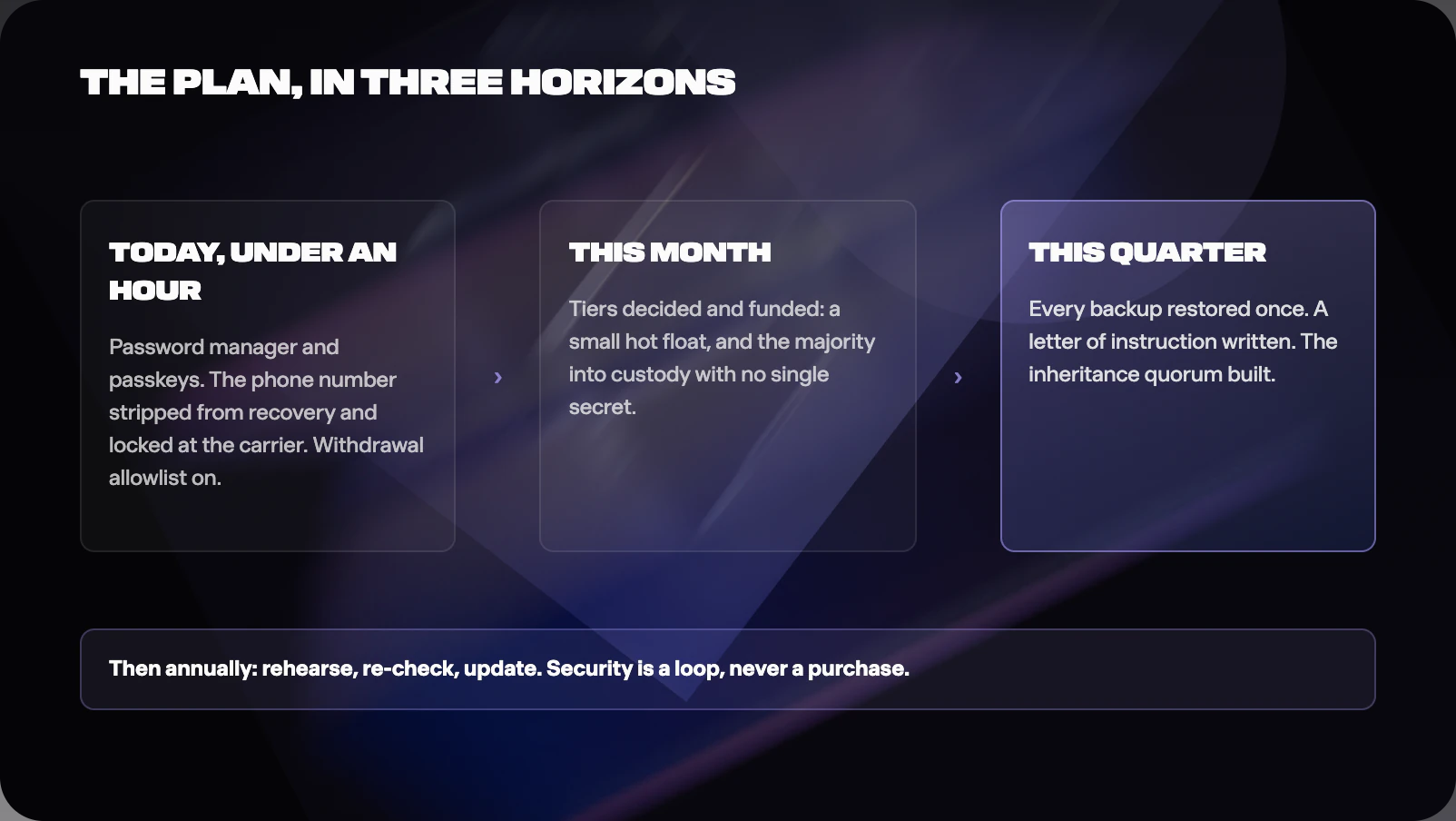
Annually, and after every life change: rehearse recovery again, re-check who and what holds each key or share, update the letter, and re-read the threat picture, because it moves. Security is not a purchase and not a personality trait; it is this loop, run on schedule, by someone who has decided that what they hold is worth an afternoon a year.
That is the whole map. The spokes below this pillar are the terrain in detail, and The Crypto Loss Report 2026 is the evidence file: how every kind of holder actually loses crypto, measured, sourced and worth an hour of any serious holder's time.
Frequently asked questions
What is the single most important thing to do first?
Secure the email account behind your exchange with a unique password and a phishing-resistant second factor, then remove your phone number from its recovery options. Email is the root of the account tree: nearly everything else resets through it, which is why attackers go there first. It costs twenty minutes and removes the cheapest path to everything you hold.
Is a hardware wallet enough to keep crypto safe?
It solves one problem well: keys isolated from an internet-connected computer. It does not read transactions for you, and its seed phrase remains a single object whose loss or theft is total, so a hardware wallet secured by one sheet of paper still has a single point of failure. Treat the device as a strong component within a structure, ideally one where no single secret exists, rather than as the structure itself.
Are exchanges safe to keep crypto on now that regulation is stricter?
Safer in well-regulated venues than in the industry's early years, with segregation rules and audits doing real work, and still a claim on a company rather than crypto you control. Regulation reduces the odds of a bad day; it does not change who bears it. Keep on a platform what you actively use there, secure the account properly, and hold the rest yourself.
What is the safest way to store a seed phrase?
Physically, never digitally: handwritten or stamped in metal, in at least two separated locations, checked periodically, with no photograph or cloud copy ever. That is the ceiling for a single object; it is high but real. Beyond it lie structural options, splitting under a threshold scheme, a multisig arrangement, or an MPC wallet where no phrase exists, which our seed phrase and storage guides compare honestly.
How much does all this actually cost?
The account layer is free. A reasonable self-custody structure costs at most the price of a hardware device or two, and many consumer MPC wallets are free to set up. The real spend is attention: an afternoon to build, an hour to rehearse, a yearly review. Set against the loss data in our companion report, that is a modest price.
Where should a complete beginner start reading?
With this cluster's spokes in order: who holds your crypto, then the seed phrase guide, then ways to hold your keys. Add the scams pillar from the threats cluster before your first sizeable purchase, and the buying guide if you have not bought yet. Each is written to stand alone, so start where your next decision is.
Sources and further reading
Key references for this article, current as of July 2026. Volatile figures are re-checked at each quarterly review.
- FBI Internet Crime Complaint Center, 2025 Internet Crime Report: crypto complaint and loss figures, SIM swap and investment fraud data. https://www.ic3.gov/AnnualReport/Reports/2025_IC3Report.pdf
- Chainalysis, 2026 Crypto Crime Report: stolen funds analysis. https://www.chainalysis.com/blog/crypto-hacking-stolen-funds-2026/
- Chainalysis, 2026 Crypto Crime Report introduction. https://www.chainalysis.com/blog/2026-crypto-crime-report-introduction/
- TRM Labs, H1 2026 crypto hacks analysis. https://www.trmlabs.com/resources/blog/h1-2026-crypto-hacks-reach-record-high-as-losses-fall-below-usd-1-billion
- ScamSniffer, 2025 crypto phishing report: drainer losses and victim counts. https://drops.scamsniffer.io/scam-sniffer-2025-crypto-phishing-losses-fall-83-to-84-million/
- River, Bitcoin Custody Report 2025: dormancy-based loss heuristics and stated limitations. https://river.com/content/bitcoin-custody-report-2025
- NIST Special Publication 800-63B, Digital Identity Guidelines: authentication and the restricted status of SMS. https://pages.nist.gov/800-63-4/sp800-63b.html
- NIST, Threshold Cryptography project. https://csrc.nist.gov/projects/threshold-cryptography
- FBI IC3 public service announcement attributing the Bybit theft to North Korea. https://www.ic3.gov/PSA/2025/PSA250226
- Lee, Kaiser, Mayer and Narayanan (Princeton University), An Empirical Study of Wireless Carrier Authentication for SIM Swaps. https://www.usenix.org/conference/soups2020/presentation/lee
- BIP39, Mnemonic code for generating deterministic keys. https://github.com/bitcoin/bips/blob/master/bip-0039.mediawiki
- Reporting: FBI Internet Crime Complaint Center at https://www.ic3.gov (US) and Report Fraud (which replaced Action Fraud in December 2025) at https://www.reportfraud.police.uk (England, Wales and Northern Ireland; in Scotland, call Police Scotland on 101).
Quick quiz: did it stick?
A few questions to check the fundamentals landed. Answers with explanations follow, and nobody is grading you except your future portfolio.


You have completed a quiz on “How to Keep Your Crypto Safe in 2026: The Complete Guide”! Share your achievement on social media.
 Was this helpful?