
TL;DR
- Start with cryptocurrency, blockchain, Bitcoin, Ether, altcoin, stablecoin and fiat currency. These establish the difference between an asset, the network that records it and the traditional money used to price it.
- Private keys create signatures, public keys verify them, addresses identify destinations, and wallets manage the signing process. Custody determines who can satisfy the network's spending rules and who carries the recovery risk.
- A transaction is an instruction. Fees compete for limited block space, nodes hold pending transactions in local mempools, and miners or validators help order valid updates into the accepted chain.
- Exchanges provide trading venues, market capitalisation estimates size, liquidity measures how easily trades can execute, and volatility describes how sharply prices move. None of these measures proves quality or safety.
In one block
A crypto glossary explains the terms used to describe digital assets, blockchains, wallets, transactions, markets and on-chain applications. The most important distinction is between a record on a network and the authority to change it: the ledger records the asset, while keys, contracts or custodians determine who can act.
How to use this glossary
The terms are grouped by function rather than alphabetically, because related ideas make more sense together. Each entry begins with a definition that can stand alone. Use the category contents below for orientation, or use your browser or document search for a specific term.
Terms people most often confuse
| Pair | The practical difference |
|---|---|
| Cryptocurrency vs blockchain | A cryptocurrency is an asset or token; a blockchain is one possible ledger and execution system that records it. |
| Coin vs token | A coin is native to its own network. A token is issued through another network or protocol. |
| Public key vs address | A public key verifies signatures. An address is the network identifier people normally share; its construction varies. |
| Private key vs seed phrase | A private key signs for one account or derivation path. A seed phrase can regenerate a wallet seed and many keys. |
| Wallet vs assets | A wallet manages signing authority and transaction data. The asset record remains on the network or with a custodian. |
| Gas vs fee | Gas measures work on Ethereum-style networks; the fee is the amount paid. Bitcoin uses transaction size and feerate instead. |
| Confirmation vs finality | Confirmation usually means inclusion and depth. Finality is the stronger point after which reversal is economically or protocol-level exceptional. |
| CEX vs DEX | A CEX is operated by a company and often holds customer assets. A DEX uses on-chain contracts, but may still depend on interfaces, oracles, bridges or administrators. |
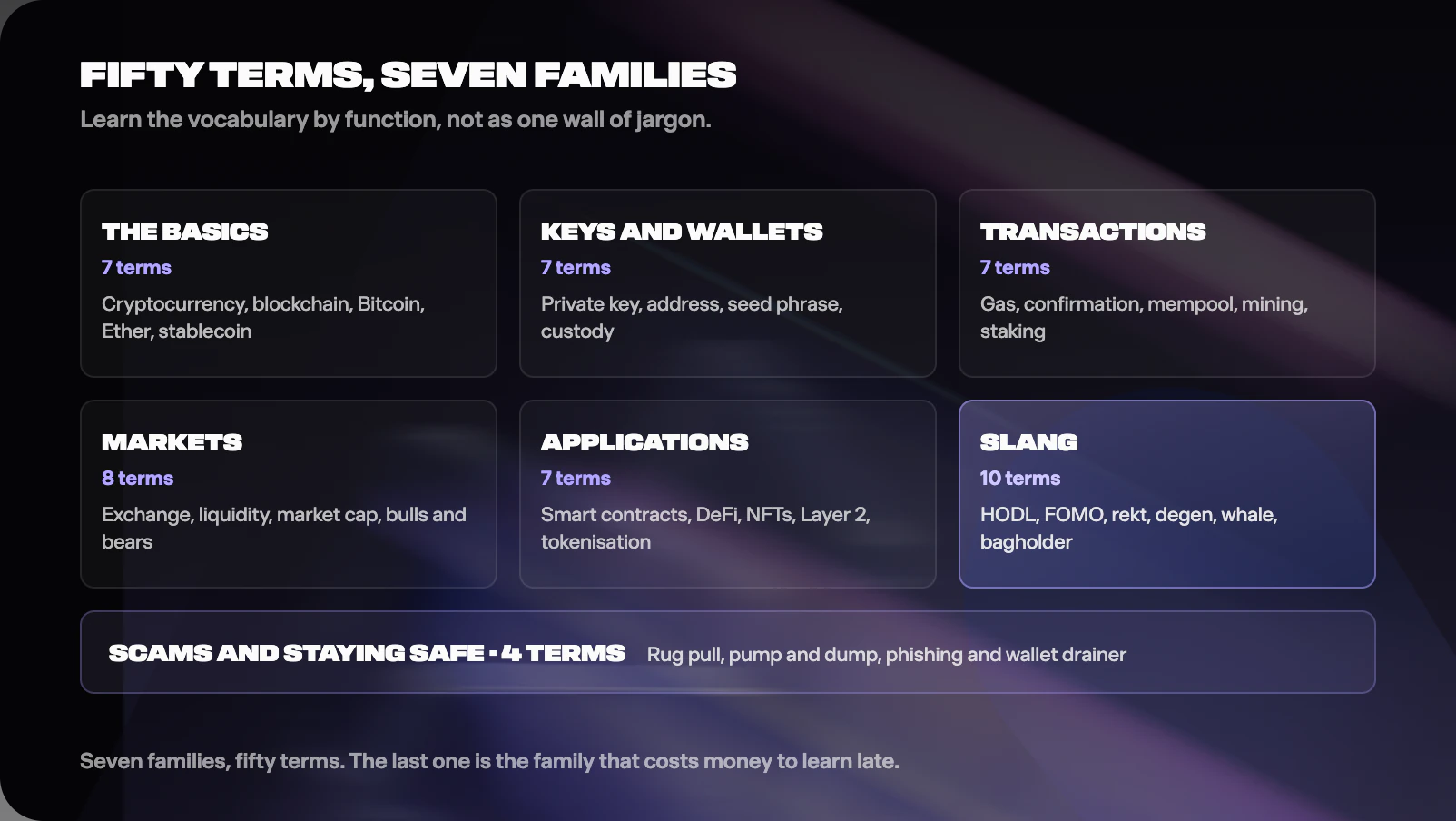
Which terms cover the absolute basics?
Quick answer
Start with cryptocurrency, blockchain, Bitcoin, Ether, altcoin, stablecoin and fiat currency. These establish the difference between an asset, the network that records it and the traditional money used to price it.
1. Cryptocurrency
A cryptocurrency is a digital asset whose ownership or transfer rules are enforced through cryptography and a distributed ledger. Some cryptocurrencies are designed for payments; others are used for network fees, staking, governance, collateral or access to applications. Public access and decentralisation vary by network.
2. Blockchain
A blockchain is a ledger that groups records into ordered blocks and cryptographically links each block to earlier history. Network participants use validation and consensus rules to decide which updates are accepted. Not every distributed ledger is a blockchain, and not every blockchain is public or decentralised.
3. Bitcoin (BTC)
Bitcoin is the first widely adopted decentralised cryptocurrency, launched in 2009. Its consensus rules issue new bitcoin on a declining schedule and limit total issuance to slightly under 21 million units. "Digital gold" is a common investment thesis about Bitcoin, not a technical guarantee of value.
4. Ether (ETH)
Ether is the native asset of the Ethereum network. It is used to pay transaction fees, participate in proof-of-stake validation and interact with Ethereum applications. Ethereum is the network; ether is the asset.
5. Altcoin
Altcoin is an informal label for a cryptocurrency other than Bitcoin. Some speakers also exclude Ether, so usage varies. The term says nothing about quality or risk. A coin is normally native to its own network, while a token is created through another network or protocol.
6. Stablecoin
A stablecoin is a token designed to track a reference value, most often the US dollar. Designs include fiat-reserve-backed, crypto-collateralised and algorithmic or hybrid systems. A peg can fail, and a stablecoin is not automatically equivalent to an insured bank deposit.
7. Fiat currency
Fiat currency is government-issued money whose value is not fixed to a commodity such as gold. Examples include the euro, pound sterling and US dollar. Crypto users often use fiat to distinguish national currencies from digital assets.
Which terms cover keys, wallets and custody?
Quick answer
Private keys create signatures, public keys verify them, addresses identify destinations, and wallets manage the signing process. Custody determines who can satisfy the network's spending rules and who carries the recovery risk.
8. Private key
A private key is secret cryptographic material used to create digital signatures. In a simple single-key wallet, anyone who obtains it can authorise transactions for the corresponding account. Multisignature, smart-contract and threshold systems may require additional keys, shares or rules before assets can move.
9. Public key
A public key is derived from a private key and allows other participants to verify its digital signatures. It is safe to reveal for cryptographic purposes, although users normally share an address rather than the raw public key.
10. Address
An address is a network identifier used to locate an account, script, contract or destination. Its construction depends on the network: it may be derived from a public key, equal a public key, identify a script, or have no private key at all. Sharing an address does not grant spending authority. It can, however, reveal activity and attract spam or targeted scams.
11. Seed phrase or recovery phrase
A seed phrase is a human-readable mnemonic used by many deterministic wallets to derive a binary seed and, from it, many keys and addresses. BIP-39 commonly uses 12 or 24 words, but other lengths and recovery systems exist. Never disclose the phrase; enter it only during a deliberate recovery into verified wallet software or hardware that you control.
12. Wallet
A crypto wallet is software, hardware or a service that manages signing credentials, constructs transactions and shows network data. The assets themselves remain recorded on a blockchain or held by a custodian. Wallet designs include single-key, multisignature, smart-contract, guardian and MPC-based systems.
13. Custodial vs self-custody
Custodial means a provider controls the signing authority and the user has an account or claim against that provider. Self-custody means the user controls the keys, shares, guardians or other recovery method required to authorise transactions. Hybrid and collaborative custody models sit between those endpoints.
14. Hot wallet and cold storage
A hot wallet uses a signing environment connected to an online device, making frequent transactions convenient but increasing exposure. Cold storage keeps the required signing secrets offline and uses a controlled process to authorise transfers. A hardware wallet can support either approach; the security model depends on how it is used, backed up and verified.
Which terms describe transactions and the network?
Quick answer
A transaction is an instruction. Fees compete for limited block space, nodes hold pending transactions in local mempools, and miners or validators help order valid updates into the accepted chain.
15. Transaction
A transaction is a signed instruction submitted to a blockchain network. It may transfer an asset, call a smart contract, create data or change application state. Inclusion in a block is not always immediate, and a transaction can fail, be replaced or be affected by a shallow reorganisation before finality.
16. Gas
Gas is the unit used by Ethereum and similar networks to measure computational and state-changing work. A transaction fee depends on gas used and the price paid per unit. Bitcoin does not use gas; its fees are generally based on transaction weight and quoted in satoshis per virtual byte.
17. Confirmation
A confirmation usually means that a transaction has been included in an accepted block. Each later block increases its depth and normally makes reversal harder. Some proof-of-stake networks also expose an explicit finality state, so confirmation count and finality are not always the same thing.
18. Mempool
A mempool is a node's local set of valid, unconfirmed transactions waiting for possible inclusion. There is no single universal mempool: nodes have different peers and policies, and private order flow can reach block builders without appearing in the public transaction pool.
19. Mining
Mining is the proof-of-work process in which participants repeatedly hash candidate blocks to find one that satisfies the network's target. A valid block can earn transaction fees and a block subsidy if the network accepts it. The accumulated work makes rewriting recent history costly.
20. Staking
Staking is the commitment of assets to a proof-of-stake system so validators can propose or attest to blocks. Honest participation may earn rewards; downtime or defined misconduct can cause penalties, and some offences are slashable. The amount lost depends on the protocol and behaviour - it is not always the entire stake.
21. Block explorer
A block explorer is a website or service that indexes blockchain data and lets users inspect addresses, transactions, blocks and contracts. It is a convenient view of the network, not the network itself; labels and interpretations can be incomplete or wrong.
Which terms cover markets and trading?
Quick answer
Exchanges provide trading venues, market capitalisation estimates size, liquidity measures how easily trades can execute, and volatility describes how sharply prices move. None of these measures proves quality or safety.
22. Centralised exchange (CEX)
A centralised exchange is a company-operated venue that matches trades and usually holds customer assets or signing keys. Users rely on the company's security, solvency, controls and withdrawal policies, in addition to the underlying network.
23. Decentralised exchange (DEX)
A decentralised exchange is an on-chain protocol that enables trades through smart contracts, order books or liquidity pools. Users commonly retain their wallet keys, but the trade may still depend on contract code, front ends, bridges, oracles, administrators or sequencers. "DEX" therefore describes architecture, not an absence of risk.
24. Market capitalisation
Market capitalisation is the current unit price multiplied by circulating supply. It is a rough size comparison, not the amount of cash invested, the value that could be sold without moving the price, or evidence that an asset is sound.
25. Liquidity
Liquidity is the ability to buy or sell an asset without causing a large price change. Deep liquidity usually means tighter spreads and less slippage; thin liquidity can make quoted prices misleading and exits difficult.
26. Volatility
Volatility describes the size and frequency of price movements over time. High volatility increases both upside and downside uncertainty and can trigger liquidations, slippage or forced selling.
27. Bull market
A bull market is a sustained period of generally rising prices and optimistic sentiment. There is no single universal threshold or start date, and different assets can be in different market regimes at the same time.
28. Bear market
A bear market is a sustained period of generally falling prices and weaker sentiment. The term is descriptive rather than predictive: calling a market bearish does not establish how far or how long it will fall.
29. All-time high (ATH)
An all-time high is the highest recorded price for an asset in a specified quote currency, venue and dataset. Different exchanges or currency pairs can record slightly different ATH values.
Which terms describe applications and infrastructure?
Quick answer
Smart contracts execute on-chain rules; DeFi combines them into financial applications; NFTs represent non-fungible token records; Layer 2 systems scale a base chain; and tokenisation links tokens to assets or claims outside the chain.
30. Smart contract
A smart contract is code and persistent data deployed to a blockchain and executed by the network when a transaction or call invokes it. Some contracts are immutable; others are upgradeable or controlled by administrators. "Runs as written" does not mean the code is correct, safe or free of governance.
31. DeFi
DeFi, short for decentralised finance, refers to financial applications built from smart contracts and digital assets, including trading, lending and derivatives. Real systems may also depend on interfaces, oracles, upgrade mechanisms, admin keys and discretionary multisignature controls, so decentralisation exists by degree.
32. NFT
An NFT, or non-fungible token, is a token record designed to be individually distinguishable rather than interchangeable unit for unit. It can reference metadata, a digital item, a ticket, a game asset or a legal right, but ownership of the token does not automatically transfer copyright or ownership of an off-chain object.
33. Layer 2 (L2)
A Layer 2 is a scaling protocol or network that executes activity outside a base blockchain and settles data or proofs back to it, inheriting some of the base layer's security. On Ethereum, rollups are the main L2 model. A sidechain with its own independent security is not a Layer 2 in the strict sense.
Cross-chain and bridges
"Cross-chain" describes moving value or data between separate blockchains that cannot natively talk to each other. Because a coin on one chain cannot simply appear on another, a bridge is the connecting service: it typically locks or holds the asset on the source chain and issues a matching representation, often called a wrapped token, on the destination chain, then reverses the process to move back. The representation is only as sound as the bridge behind it. Bridges concentrate large pooled balances behind a validation mechanism, frequently a small set of keys or validators, whose security varies by design: some bridges verify the other chain natively while many rely on a small external set of keys or validators that is weaker than either chain it connects, and it is this latter class that has been among the most heavily exploited structures in crypto. Treat "cross-chain" as a description of a dependency and a trust assumption, not a guarantee that the assets are as secure as they would be on the underlying chains.
34. Memecoin
A memecoin is a token whose identity and demand are centred on a meme, community or internet culture. Some projects add utilities or governance, but the category is commonly highly speculative and vulnerable to concentration, hype and manipulation. The label alone does not prove fraud.
35. Tokenisation or real-world assets (RWA)
Tokenisation is the creation of a blockchain token intended to represent an asset, claim or record, such as cash, a fund share, a bond or property interest. The enforceable rights depend on contracts, issuers, custodians, regulation and off-chain records; a token entry alone cannot guarantee ownership of the underlying asset.
36. Crypto ETF or ETP
A crypto exchange-traded fund or product gives investors brokerage-account exposure to a crypto asset or related strategy. The investor owns shares in the product rather than the underlying private keys. Product structure, fees, tracking, custody and redemption rules matter. The US SEC approved listings for spot bitcoin ETP shares in January 2024 and spot ether ETP shares later in 2024.
What does the crypto slang mean?
Quick answer
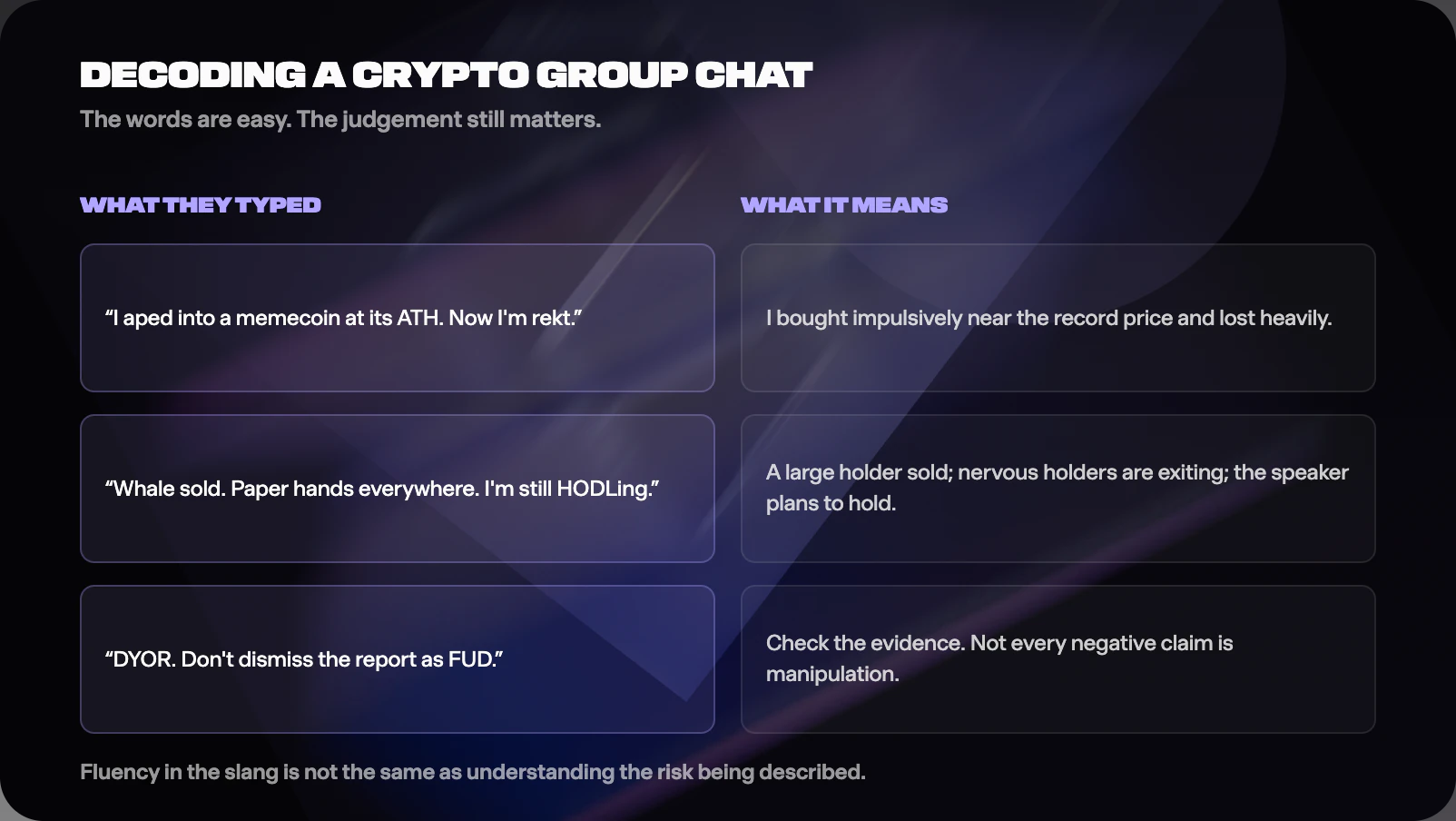
Crypto slang compresses market behaviour and group identity into a few words. Learn the translation, but do not treat the vocabulary as analysis: "diamond hands," "FUD" and "DYOR" can all be used to pressure people into ignoring risk.
37. HODL
HODL means to keep holding an asset despite volatility. It began as a misspelling of "holding" in a 2013 BitcoinTalk post and was later backronymed as "hold on for dear life"; it was not originally an acronym.
38. FOMO
FOMO means fear of missing out: the anxiety that others are profiting from an opportunity you have not joined. In markets it often appears as pressure to buy quickly because a price is rising.
39. FUD
FUD means fear, uncertainty and doubt. It can describe deliberately misleading negative claims, but communities also use it to dismiss accurate criticism. The correct response is to examine evidence, not the label.
40. DYOR
DYOR means do your own research. It is a reminder to verify claims and incentives rather than copying a promoter. It is not a substitute for professional expertise, audited evidence or recognising that some risks cannot be independently assessed by a beginner.
41. Whale
A whale is a holder or trader whose position is large relative to a market and may influence price or liquidity. There is no fixed threshold, and a large visible address may belong to an exchange or custodian representing many users.
42. Degen
Degen, short for degenerate, is slang for a person who knowingly takes very high-risk or highly speculative positions. It is a cultural label, not a technical category or investment strategy.
43. Rekt
Rekt, a stylised form of wrecked, means suffering a large loss, often through a price collapse, leverage liquidation, exploit or scam.
44. Ape in
To ape in means to buy or enter a position quickly with little investigation, usually because of hype or urgency. The phrase normally implies impulsive risk-taking rather than careful analysis.
45. Diamond hands and paper hands
Diamond hands describes refusing to sell through volatility; paper hands describes selling quickly when price falls. Both are social judgements, not risk analysis. Holding can be disciplined or irrational, and selling can be prudent or panicked.
46. Bagholder
A bagholder is someone left holding a declining, illiquid or discredited asset after earlier participants have exited. The term is often pejorative and does not by itself prove that manipulation occurred.
Which terms help identify scams?
Quick answer
Rug pull, pump and dump, phishing and wallet drainer describe different attack paths: abusive insider control, market manipulation, identity deception and malicious transaction authorisation.
47. Rug pull
A rug pull is a deliberate scheme in which insiders use their control, liquidity, token allocation or false promises to extract value from buyers and then abandon or cripple the project. A failed project is not automatically a rug pull; the term implies deception or abusive intent.
48. Pump and dump
A pump and dump is a scheme in which organisers use misleading promotion or coordinated activity to drive buying, then sell their own holdings into the inflated demand. The price commonly falls after the organisers exit. Such conduct may violate fraud or market-manipulation laws depending on the asset and jurisdiction.
49. Phishing
Phishing is deception designed to make a victim disclose credentials or recovery material, install software, visit a fake interface, or authorise a malicious action. Crypto phishing may imitate an exchange, wallet, support team, airdrop, employer or public figure.
50. Wallet drainer
A wallet drainer is malicious tooling or an attack workflow that moves assets after obtaining a dangerous signature, token approval, permit, delegation or compromised key. It does not need to break the blockchain. Revoking approvals can help when only a permission was granted; an exposed seed phrase or private key requires migration to a completely new wallet.
Frequently asked questions
What are the most important crypto terms for a beginner?
Start with private key, seed phrase, address, wallet, custody, transaction, confirmation and stablecoin. Together they explain who controls assets, how transfers are authorised, when a payment settles and where common misunderstandings become expensive.
What is the difference between a coin and a token?
A coin is normally the native asset of its own blockchain, such as bitcoin on Bitcoin or ether on Ethereum. A token is created through another network or protocol, such as an ERC-20 token on Ethereum. Everyday usage is inconsistent, so check the specific asset.
Is a wallet address the same as a public key?
Not universally. Some networks use a public key as the address; others hash a public key, identify a script or contract, or use an address with no private key. An address is the shareable network identifier; a public key is a cryptographic verification key.
Is a seed phrase the same as a private key?
No. A private key signs for a particular account or derivation path. A seed phrase usually encodes entropy used to derive a wallet seed and many keys. Because it can recreate the wallet, it is often even more sensitive than one individual key.
Does Bitcoin use gas?
No. Gas is Ethereum-style terminology for computational work. Bitcoin transaction fees are based mainly on transaction weight and market demand, and are usually quoted as satoshis per virtual byte.
Is a DEX completely decentralised?
Not necessarily. Settlement may occur through smart contracts while the interface, oracle, bridge, upgrade keys, sequencer or governance remains concentrated. Assess the actual control and failure paths rather than relying on the label.
Can someone steal crypto from my public address alone?
A public address normally does not grant spending authority. It can, however, reveal balances and transaction history, attract targeted phishing, and receive malicious or misleading tokens. Theft generally requires a valid signing path, compromised account or exploitable contract.
What does HODL stand for?
It did not originally stand for anything. HODL began as a 2013 misspelling of "holding." "Hold on for dear life" is a later backronym.
How often should a crypto glossary be updated?
Stable cryptographic definitions change slowly, but product categories, network features, regulation and slang evolve. Review technical links and time-sensitive examples at least quarterly, and date every material update.
The bottom line
Crypto vocabulary becomes manageable once the layers are separated. Assets such as bitcoin, ether and tokens are recorded by networks. Keys, contracts and custodians determine who can act. Transactions compete for inclusion and then move toward finality. Markets add price, liquidity and speculation. Applications add code, governance and off-chain dependencies. Slang describes the culture around all of it; scam terms describe how those systems and behaviours are abused.
The definitions worth remembering are the ones that prevent category errors: a wallet is not where the asset lives, a seed phrase is not simply one key, gas is not a Bitcoin fee, market cap is not liquidity, an NFT is not automatically copyright, and decentralised does not mean uncontrolled. Use those distinctions, and the jargon stops hiding the actual risk.
Sources and further reading
Key references for this article, current as of July 2026.
- Satoshi Nakamoto, Bitcoin: A Peer-to-Peer Electronic Cash System, 2008. https://bitcoin.org/bitcoin.pdf
- Ethereum.org developer documentation. https://ethereum.org/en/developers/docs/
- Bitcoin Developer Guide. https://developer.bitcoin.org/devguide/
- Bitcoin Developer Guide: glossary and concepts. https://developer.bitcoin.org/devguide/
- Ethereum.org: developer documentation and glossary. https://ethereum.org/en/developers/docs/
Quick quiz: did it stick?
Five questions. The explanations matter more than the score.


You have completed a quiz on “Crypto Glossary: 50 Essential Terms Explained”! Share your achievement on social media.
 Was this helpful?