
TL;DR
- Bitcoin is an open-source network for transferring and holding a digital asset without a central ledger operator. The network is called Bitcoin; its native asset is bitcoin, usually written BTC. Transactions are verified by full nodes, ordered into blocks through proof of work and settled on a public blockchain.
- The documented aim was to enable direct electronic payments without relying on a financial institution to prevent double-spending. Bitcoin appeared during the 2008 financial crisis, and the genesis block's bank-bailout headline is widely read as commentary, but the evidence does not establish one exclusive motive.
- Satoshi Nakamoto is the pseudonym used by Bitcoin's creator or creators. The identity has never been conclusively verified. Satoshi published the whitepaper, released early software, worked with other developers and then withdrew from public participation around 2010-2011.
- A wallet selects spendable outputs, creates a transaction and signs the relevant inputs. Nodes check the transaction, relay it and keep their own pending-transaction view. Miners assemble valid transactions into candidate blocks and perform proof of work. Full nodes accept a block only if it satisfies every consensus rule, then later blocks add confirmation depth.
In one block
Bitcoin is a peer-to-peer electronic cash and settlement system launched in 2009. It records ownership on a public blockchain and uses proof of work plus independently validating nodes to prevent double-spending without a bank. Its native asset, bitcoin (BTC), is issued on a declining schedule that approaches 21 million units.
What is Bitcoin in simple terms?
Quick answer
Bitcoin is an open-source network for transferring and holding a digital asset without a central ledger operator. The network is called Bitcoin; its native asset is bitcoin, usually written BTC. Transactions are verified by full nodes, ordered into blocks through proof of work and settled on a public blockchain.
Bitcoin combines several older ideas - public-key signatures, peer-to-peer networking, proof of work and replicated ledgers - into a system that prevents the same digital value from being spent twice without appointing a bank or payment company as the final record keeper.
The distinction between the network and the asset helps. Bitcoin with a capital B usually refers to the protocol, peer-to-peer network and ledger. Bitcoin with a lower-case b refers to units of the asset. One bitcoin is divisible into 100 million satoshis, or sats, so owning a whole bitcoin is never required.
A wallet does not contain coin files. It manages keys and constructs transactions that spend previously received transaction outputs. The blockchain records the accepted transaction history; a wallet calculates which outputs its keys can spend. A custodial service can hold bitcoin on a user's behalf, but that is a claim on the custodian rather than direct control of the underlying keys.
| Feature | Bitcoin snapshot as of 11 July 2026 |
|---|---|
| Whitepaper | Published under the name Satoshi Nakamoto in October 2008 |
| Network start | Genesis block dated 3 January 2009 |
| Native asset | bitcoin, ticker BTC; 1 BTC = 100,000,000 satoshis |
| Ledger model | Unspent transaction outputs (UTXOs) recorded on a public blockchain |
| Consensus security | SHA-256 proof of work, independently checked by full nodes |
| Block timing | About ten minutes on average; individual blocks vary |
| Current block subsidy | 3.125 BTC per valid block, plus transaction fees |
| Scheduled supply | Approximately 21 million BTC; more than 20.05 million issued by the data cut-off |
| Settlement | Probabilistic: confidence rises as more valid blocks build on the transaction |
| Payment scaling | Base-layer transactions plus optional systems such as the Lightning Network |
Why was Bitcoin created?
Quick answer
The documented aim was to enable direct electronic payments without relying on a financial institution to prevent double-spending. Bitcoin appeared during the 2008 financial crisis, and the genesis block's bank-bailout headline is widely read as commentary, but the evidence does not establish one exclusive motive.
Digital information is easy to copy. That is harmless for a photograph and fatal for money: if the same unit can be spent twice, no recipient can trust it. Earlier electronic-cash systems generally solved the problem with a central issuer or clearing authority that maintained the definitive ledger.
The Bitcoin whitepaper proposed another arrangement. Digital signatures would prove who authorised a transfer, while a peer-to-peer network and proof-of-work chain would establish a public ordering of transactions. The paper's abstract frames the goal directly: online payments sent from one party to another without passing through a financial institution, while avoiding a trusted third party for double-spend prevention.
The historical setting matters. The paper appeared in October 2008, during a global banking crisis. The first block embeds the text "The Times 03/Jan/2009 Chancellor on brink of second bailout for banks." The text establishes a date and is commonly interpreted as criticism of bank rescues or discretionary monetary institutions.
That interpretation is plausible, but it should not be overstated as a proven manifesto. Satoshi did not leave a single authoritative statement saying that the financial crisis was the sole cause of Bitcoin or that every feature was designed as a response to bailouts. The strongest factual wording is that Bitcoin was created in the context of the crisis, with an explicit technical goal of peer-to-peer electronic cash without a trusted financial intermediary.
What Bitcoin was designed to remove
- A central party that alone decides which transactions are valid.
- The need to trust one company not to alter, censor or lose the definitive ledger.
- A central issuer that can change supply according to its own policy.
- The double-spending risk that normally makes digital cash depend on a clearing authority.
Who is Satoshi Nakamoto?
Quick answer
Satoshi Nakamoto is the pseudonym used by Bitcoin's creator or creators. The identity has never been conclusively verified. Satoshi published the whitepaper, released early software, worked with other developers and then withdrew from public participation around 2010-2011.
The uncertainty is not a missing technical dependency. Bitcoin is open-source software, and its rules are enforced by participants running compatible implementations. Satoshi could propose code and persuade others, but the pseudonym did not provide a permanent administrator key, corporate ownership right or ability to command independent nodes.
Many people have been named or have claimed the identity. None has produced evidence accepted as conclusive by the wider technical and historical community. The safest formulation is therefore simple: Satoshi may have been one person or a group, and the real-world identity remains unknown.
Claims about Satoshi's holdings also require care. Researchers have identified distinctive patterns in early mining and often attribute roughly one million BTC to a dominant early miner believed to be Satoshi. The attribution and exact total are analytical estimates, not a verified address list or a single known "Satoshi wallet". Some early outputs remain unspent, but inactivity does not prove identity, intent, access or even survival.
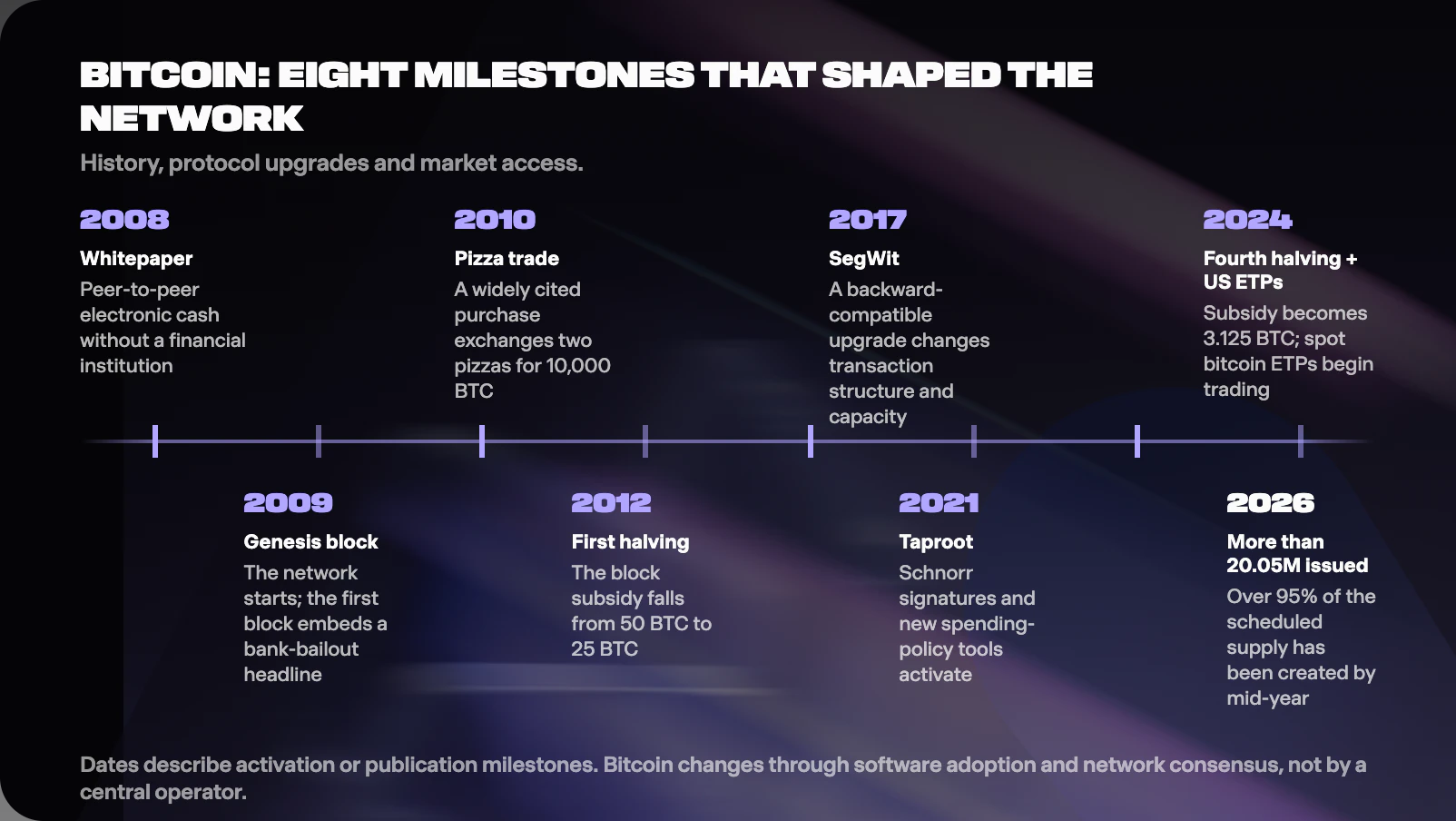
The 2010 pizza exchange is a useful milestone because it demonstrates a move from experimental tokens to an actual trade: a forum offer exchanged 10,000 BTC for two pizzas. It does not prove that retail payments became Bitcoin's permanent dominant use; it shows that the network could transfer value between willing participants.
How does Bitcoin work?
Quick answer
A wallet selects spendable outputs, creates a transaction and signs the relevant inputs. Nodes check the transaction, relay it and keep their own pending-transaction view. Miners assemble valid transactions into candidate blocks and perform proof of work. Full nodes accept a block only if it satisfies every consensus rule, then later blocks add confirmation depth.
A Bitcoin transaction spends one or more unspent transaction outputs, or UTXOs. Each output contains an amount and a locking condition. To spend it, the new transaction supplies data - commonly a digital signature and public-key information - that satisfies that condition. The transaction can create new outputs for the recipient and, when necessary, a change output back to the sender.
The transaction and block pipeline
- Create. A wallet chooses UTXOs, defines recipient outputs, estimates a fee and constructs the transaction.
- Sign. The wallet uses the required private keys or signing shares to satisfy the spending conditions. The keys need not be revealed to the network.
- Validate and relay. Each receiving node checks syntax, signatures, amounts, double-spend conflicts and its own relay policy before passing the transaction to peers.
- Build. A miner or mining pool selects transactions, constructs a candidate block and repeatedly hashes its header while changing available fields.
- Prove work. A valid block header must produce a hash below the current target. Finding one is probabilistic; more hashpower means more attempts per second.
- Verify. Full nodes independently check proof of work, every transaction and every consensus limit. A miner's reputation or energy expenditure cannot excuse an invalid block.
- Confirm. The transaction has one confirmation when included in the accepted chain. Each later block increases the work required to replace that history.
| Participant | What it does | What it cannot do alone |
|---|---|---|
| Wallet or user | Creates and signs transactions; chooses fees and custody method | Cannot force miners to include a transaction or nodes to accept an invalid spend |
| Full node | Verifies transactions, blocks and the chain it treats as valid | Does not automatically earn mining rewards and may not create blocks |
| Miner or mining pool | Orders valid transactions, constructs candidate blocks and performs proof of work | Cannot forge signatures, spend other users' coins or change node rules unilaterally |
| Exchange or custodian | Maintains customer accounts and may control pooled on-chain keys | Does not control the Bitcoin consensus network merely because it holds many coins |
| Lightning node | Routes or participates in off-chain payment channels backed by Bitcoin transactions | Does not replace the base chain's role in opening, closing or enforcing channels |
How are new bitcoins created?
Quick answer
New BTC enters circulation through the block subsidy in a valid block's coinbase transaction. A miner's total block reward equals that subsidy plus transaction fees. The subsidy began at 50 BTC, halves every 210,000 blocks and is 3.125 BTC in the current era.
The first transaction in each block is a special coinbase transaction created by the miner. It collects the allowed subsidy and the fees paid by transactions in that block. Fees are transfers of existing bitcoin; only the subsidy creates new units.
Bitcoin targets an average block interval of about ten minutes. Every 2,016 blocks, nodes recalculate the proof-of-work target using the time taken by the preceding difficulty period, subject to protocol limits. The adjustment keeps issuance tied primarily to block height even as global hashpower changes.
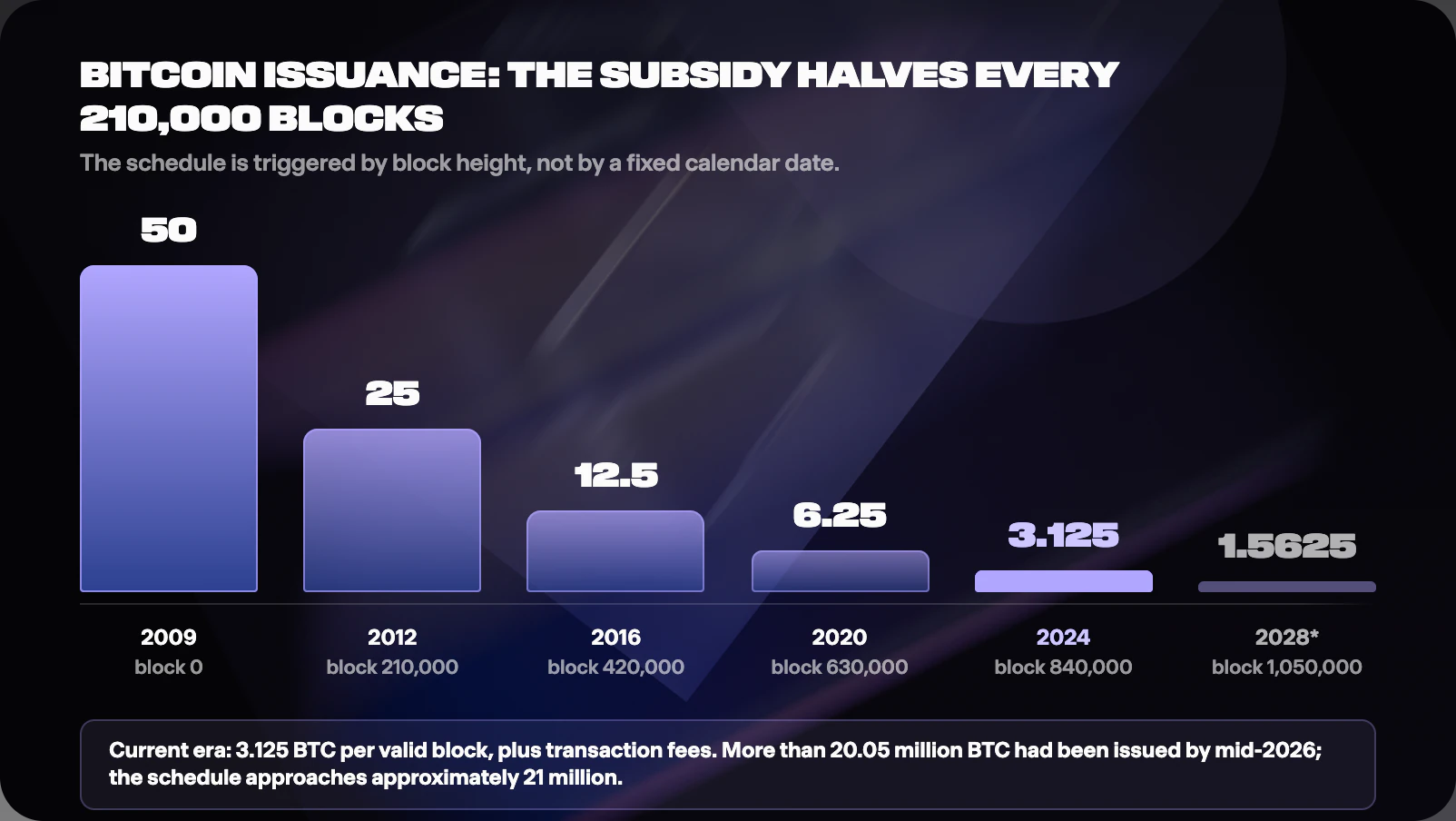
The halving is therefore a block event, not a fixed calendar appointment. At height 210,000 the subsidy fell from 50 to 25 BTC; at 420,000 to 12.5; at 630,000 to 6.25; and at 840,000 in April 2024 to 3.125 BTC. The next scheduled reduction occurs at height 1,050,000, when the subsidy becomes 1.5625 BTC. The expected 2028 date can move because actual block arrivals vary.
What a halving does - and does not do
- It reduces the new BTC subsidy per block by half.
- It does not cut existing balances or transaction fees in half.
- It does not guarantee that price will rise, that mining will remain profitable or that fees will stay low.
- It gradually shifts miner revenue from new issuance towards transaction fees, although the long-term fee market remains an open economic question.
Why is the supply limited to about 21 million?
Quick answer
The issuance schedule is a geometric series: 210,000 blocks at 50 BTC, then the same number at 25, then 12.5, and so on. The sum approaches 21 million. Because Bitcoin counts whole satoshis and rounds each later subsidy down, the current code's exact scheduled maximum is slightly below 21 million.
The familiar 21 million figure is a concise description of the monetary policy, not a pile of coins created in advance. Supply is released block by block. Under the current schedule, more than 20.05 million BTC had been issued by 11 July 2026, leaving fewer than 950,000 BTC of scheduled future subsidy before rounding effects.
The exact theoretical total under the present integer rules is 20,999,999.9769 BTC. In ordinary writing, "approximately 21 million" is clearer and accurate. The final satoshi subsidies are expected around the year 2140, but the date is approximate because it depends on future block timing.
Issued supply is not the same as spendable supply. Coins can be provably unspendable, lost through destroyed keys, locked by scripts or economically dormant. No observer can reliably count every permanently lost coin because an unmoved output may still have a living owner.
Does scarcity create value by itself?
No. Scarcity is one input to value, not a guarantee. A scarce asset also needs demand, liquidity, credible rules, useful properties and a market willing to bear its risks. Bitcoin's price can fall sharply even though the issuance schedule remains unchanged.
Who controls Bitcoin, and can the rules change?
Quick answer
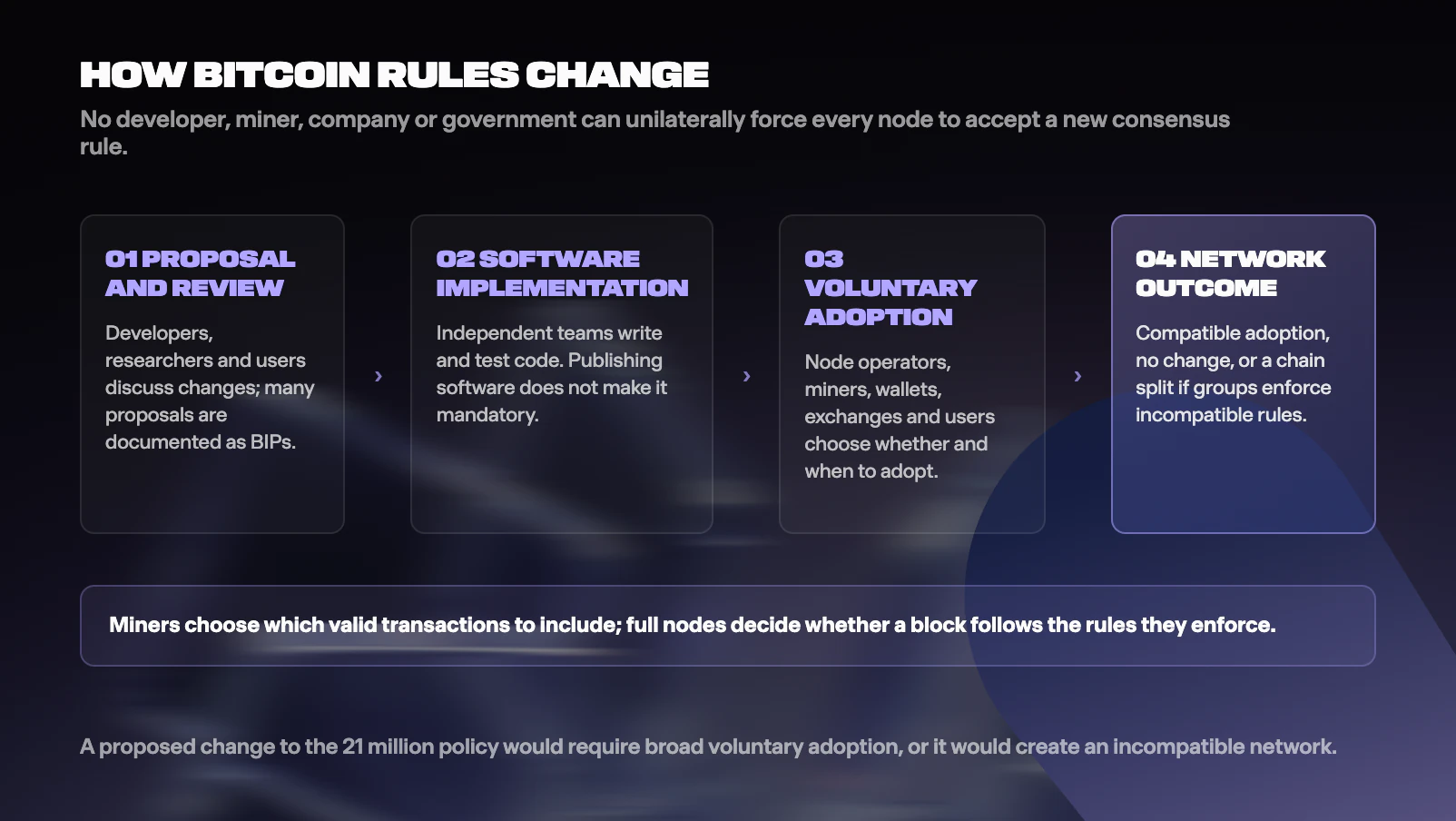
No single actor controls Bitcoin. Developers propose and implement software; node operators choose which rules to enforce; miners choose among valid transactions and compete to extend the chain; wallets, exchanges, businesses and users decide what software and asset they recognise. Rules can change only through voluntary adoption, and incompatible adoption can split the network.
Bitcoin Improvement Proposals, or BIPs, are design documents and coordination tools. Publication does not make a proposal law. A proposal may be discussed, implemented by one or more software teams, ignored, revised or rejected. The current BIP process explicitly notes that there is no formal decision body governing Bitcoin development.
Full nodes enforce the consensus rules in the software they run. A miner can publish a candidate block, but nodes reject it if it creates too much subsidy, spends an output without valid authorisation, exceeds protocol limits or otherwise violates their rules. Conversely, nodes do not force users to value a chain or force miners to provide hashpower; the ecosystem coordinates through incentives and compatible software choices.
Soft forks and hard forks
A soft fork tightens validity rules in a way that can remain compatible with older nodes under specified conditions. A hard fork expands or changes validity rules so that non-upgraded nodes reject blocks accepted by upgraded nodes. If economically significant groups enforce incompatible rule sets, both chains can continue as separate networks and assets.
That is the correct way to describe the 21 million policy. It is not a law of nature, and developers can write software with a different cap. They cannot make independent nodes accept it. Changing the policy on the network recognised as Bitcoin would require extraordinarily broad voluntary coordination; otherwise the result would be an incompatible fork that existing nodes reject.
What is Bitcoin used for today?
Quick answer
Bitcoin is used for self-custodied savings, long-term speculative or portfolio exposure, high-value settlement, cross-border transfers, direct payments and Lightning payments. Different users emphasise different purposes. The phrase "digital gold" describes one influential thesis, not the network's only function or a guarantee of value preservation.
Self-custodied savings and the digital-gold thesis
Supporters compare bitcoin with gold because both are scarce, divisible and held without being a liability of a company. Bitcoin adds easy verification and digital portability; gold contributes a far longer history and lower technology dependence. Bitcoin is dramatically more volatile and has no claim on earnings, interest or physical use. Calling it digital gold is therefore an analogy and investment thesis, not a settled fact.
Settlement and transfers
The base chain can transfer value to any valid address and settles without a bank maintaining the ledger. It operates continuously, but confirmation time, fees, compliance obligations and access to local currency still matter. A transfer being global at the protocol level does not mean every user has equal internet access, legal permission or safe custody.
Payments and the Lightning Network
On-chain payments trade speed and capacity for strong base-layer settlement. The Lightning Network uses Bitcoin payment channels so participants can update balances off-chain and settle or enforce the result on-chain when necessary. Lightning can support fast, small payments, but it introduces channel liquidity, routing, uptime, backup and implementation considerations. It is an optional layer, not a replacement for Bitcoin's blockchain.
Market exposure through custodians and ETPs
Since January 2024, US exchanges have been permitted to list shares of approved spot bitcoin exchange-traded products. An ETP share can provide price exposure in a brokerage account, but the investor does not hold the product's private keys or directly transact on Bitcoin. Product fees, custody arrangements, tracking, tax treatment and market hours differ from self-custody.
Collateral and financial services
Bitcoin is also used as collateral or held in corporate, fund and institutional accounts. These arrangements can add counterparty, liquidation, rehypothecation or legal risk that is not present in a simple on-chain output. A return paid on bitcoin is generated by another financial arrangement; the Bitcoin protocol itself does not pay interest to holders.
What Bitcoin is not
- Not a stable-price currency: its market value can move sharply in either direction.
- Not anonymous by default: the blockchain is public and activity is pseudonymous, often traceable when addresses meet regulated services or identifiable behaviour.
- Not reversible like a card payment: confirmed transfers have no network-level chargeback.
- Not a guaranteed hedge against inflation, market stress or currency weakness over every time horizon.
- Not equity in a company: BTC provides no ownership claim on revenue, management or assets.
- Not automatically self-custodied: exchange balances and ETP shares rely on intermediaries.
Bitcoin compared with bank money and gold
Quick answer
Bitcoin, bank money and gold solve different problems. Bank money prioritises stable units, institutional recovery and legal payment infrastructure. Gold offers physical scarcity and a long history. Bitcoin offers digitally native scarcity and direct settlement, with severe volatility and personal custody risk.
| Dimension | Bank deposits / fiat money | Gold | Bitcoin |
|---|---|---|---|
| Issuer or source | Central banks issue base money; commercial banks create deposits under law and regulation | Naturally occurring physical element, mined and refined | Block subsidy under open consensus rules; no central issuer |
| Record of ownership | Institutional ledgers and legal account claims | Physical possession, vault records or financial claims | Public UTXO ledger; control depends on valid spending conditions |
| Supply policy | Managed through monetary and banking systems | Scarce but future mining responds to geology, technology and price | Scheduled issuance approaches about 21 million under current rules |
| Price unit | Designed to be the local unit of account, with varying inflation | Market-priced and volatile | Market-priced and highly volatile |
| Recovery and reversal | Password resets, legal processes and some payment reversals may exist | Depends on custody contract and legal system | No protocol password reset or chargeback; custodians may have account recovery |
| Portability | Efficient inside supported payment systems; cross-border access varies | Physical transfer is costly; paper claims are easier | Digitally transferable; fees, confirmations and access still matter |
| Divisibility | Usually to minor currency units | Physically divisible but awkward at small retail scale | 100 million satoshis per BTC |
| Cash flow | Deposits may pay interest; currency itself does not | No inherent cash flow | No inherent cash flow |
| Privacy | Private from the public but visible to institutions and authorities under law | Physical possession can be private; financial gold is recorded | Public ledger with pseudonymous addresses; tracing is often possible |
| Primary risks | Inflation, bank or sovereign risk, freezes, fraud and access restrictions | Storage, assay, theft, price and counterparty risk | Price, key loss, scams, software, custody, fees, regulation and governance risk |
The comparison is not a verdict. A person may use more than one instrument for different purposes. The relevant question is which trade-offs - reversibility, custody, stability, portability, legal protection and scarcity - fit the job.
Is the Bitcoin network secure?
Quick answer
Bitcoin is protected by digital signatures, independent validation and a large proof-of-work network, but "secure" is not absolute. Consensus rules have resisted sustained attack, while software has contained serious bugs and users have lost funds through key compromise, scams, custodians and operational mistakes.
Security has layers. Cryptography protects authorisation under current mathematical assumptions. Consensus and proof of work make accepted history costly to replace. Software implements those rules and can contain defects. Wallets, exchanges and people manage keys and can fail independently of the protocol.
Important historical incidents
- 2010 value-overflow bug: a crafted transaction exploited an integer-overflow flaw and created outputs far beyond the intended supply. Updated software rejected the affected history and the network continued on a corrected chain. This is a real protocol/software incident, not evidence that Bitcoin has always been bug-free.
- March 2013 chain split: Bitcoin 0.8 and some older nodes disagreed about a large block because of a database compatibility limit. Mining pools coordinated a downgrade, exchanges paused deposits and the network converged on one branch. BIP 50 documents the event and its lessons.
- 2018 inflation vulnerability: Bitcoin Core disclosed a denial-of-service and critical inflation flaw after a fix had been distributed. There is no known exploitation on Bitcoin, but the bug demonstrates why implementation review and timely upgrades remain security requirements.
What a majority-hashpower attack can and cannot do
An attacker with sustained majority hashpower can more reliably build an alternative recent chain, censor transactions or reverse the attacker's own recent payments. The attacker still cannot create valid signatures for other users, spend outputs whose conditions are not satisfied, create arbitrary subsidy beyond node rules or force non-upgraded nodes to accept different consensus rules.
| Layer | Main protection | Typical failure modes |
|---|---|---|
| Keys and signatures | Private keys authorise specific spends; public data verifies them | Stolen seed phrase, malware, weak randomness, signing deception, future cryptanalytic advances |
| Consensus and ordering | Proof of work, accumulated chainwork and node validation | Hashpower concentration, censorship, reorganisation of recent blocks, network partition |
| Node software | Open-source review, multiple reviewers, reproducible testing and upgrades | Consensus bug, denial of service, dependency flaw, implementation divergence |
| Wallets and custody | Hardware isolation, backups, multisignature or threshold controls, operational policy | Loss, phishing, compromised device, malicious approval, custodian insolvency or insider abuse |
| Market and legal layer | Liquidity, regulation, disclosure, governance and risk controls | Price collapse, product failure, seizure, tax errors, fraud or sudden rule changes |
What are Bitcoin's main risks and limitations?
Quick answer
The main risks are price volatility, permanent key loss, scams and custody failure, irreversible mistakes, limited base-layer throughput, public transaction history, energy use, changing regulation and uncertainty about future demand and fee-funded security. Scarcity removes none of these.
Price and valuation risk
Bitcoin produces no contractual cash flow and has no redemption promise. Its market value depends on future demand for its properties and on available liquidity. Large drawdowns have occurred repeatedly, and recovery is never guaranteed. Position size, leverage and forced-sale risk matter more than confident narratives.
Key, custody and fraud risk
Self-custody removes a custodian and creates direct responsibility for keys, backups, transaction review and succession. Custody delegates those tasks and adds counterparty, legal and operational exposure. Both models can be appropriate; neither is automatically safe. Scammers target urgency, impersonation, recovery phrases and irreversible transfers precisely because the base layer executes valid signatures rather than assessing human intent.
Irreversibility and fee risk
A confirmed transaction has no built-in chargeback. Sending to the wrong script, choosing the wrong network at an exchange, underpaying fees or signing a malicious transaction can be costly. Fees vary with block-space demand, and a low-fee transaction may wait or require replacement tools.
Capacity and user-experience limits
The base layer intentionally constrains block resources so ordinary nodes can verify the chain. That limits throughput and can make congestion expensive. Layered systems improve payment speed and scale but add their own liquidity, routing, software and custody trade-offs.
Privacy limits
Bitcoin addresses are not names. Transactions, amounts and links between UTXOs are, however, fully public. Address reuse, exchange records, internet metadata and spending patterns can connect activity to people or organisations. Privacy requires deliberate practices and is never guaranteed simply because a name is absent from the blockchain.
Energy and environmental impact
Proof of work intentionally consumes electricity. A 2025 Cambridge study, based on reported data representing about 48 percent of global mining activity, estimated annual network electricity use at 138 TWh, around 0.5 percent of global consumption. The figure is model-based and changes with hashpower, equipment efficiency and economics. Environmental impact also depends on location, generation mix, grid conditions and what alternative use the energy would have had.
Regulatory, tax and governance risk
Legal treatment differs by country and can change. Holding, trading, mining, payments, custody and exchange-traded products may be regulated differently, and taxable events can arise even without conversion to cash. Bitcoin's decentralised governance also means upgrades can be slow, contentious or fragmented.
Long-term security-budget uncertainty
As the subsidy declines, transaction fees are expected to form a larger share of miner revenue. No one can guarantee today what future block-space demand, hashpower or attack economics will be near the end of issuance. The schedule is known; the market response is not.
Where does Bitcoin stand in 2026?
Quick answer
By 11 July 2026, the chain was around height 957,600, more than 20.05 million BTC had been issued, and the block subsidy remained 3.125 BTC. The next scheduled halving is at block 1,050,000, expected in 2028. Market access is broader than in Bitcoin's early years, but the asset remains volatile and operationally unforgiving.
The network has incorporated major backwards-compatible upgrades, including SegWit and Taproot, while maintaining the same broad proof-of-work and UTXO architecture. Lightning and other wallet or custody systems extend how people transact without changing the base asset's issuance schedule.
Regulated market access has also expanded. The US Securities and Exchange Commission approved exchange rule changes for a group of spot bitcoin ETP shares in January 2024. That made brokerage exposure easier for some investors; it did not constitute a government guarantee of bitcoin, eliminate product risks or give ETP shareholders control of on-chain keys.
A sensible 2026 summary is therefore balanced: Bitcoin has moved from an experimental mailing-list project to widely accessible financial and payment infrastructure, while retaining severe volatility, public-ledger privacy limits, energy use, custody hazards and unresolved long-term economic questions.
Frequently asked questions
Is Bitcoin the same as cryptocurrency?
No. Cryptocurrency is the broader category. Bitcoin is the first widely adopted decentralised cryptocurrency network and its asset is BTC. Other networks use different consensus, monetary and application designs.
Why was Bitcoin created?
The whitepaper's documented goal was direct electronic payments without relying on a financial institution to prevent double-spending. Bitcoin was released during the 2008 financial crisis, and its genesis block contains a bank-bailout headline, but that context should not be presented as proof of one exclusive motive.
What is Bitcoin backed by?
Bitcoin is not redeemable for a commodity, government currency or company asset. Its operation is supported by software rules, cryptography, proof of work and network participation; its market price comes from supply, demand and liquidity. Security infrastructure is not the same thing as a redemption backing.
Why are there only about 21 million bitcoins?
The block subsidy halves every 210,000 blocks, creating a geometric series that approaches 21 million. Whole-satoshi rounding makes the exact scheduled total slightly lower: 20,999,999.9769 BTC under the current rules.
Can the 21 million limit be changed?
Technically, developers can publish software with a different rule. They cannot force independent nodes to accept it. Broad voluntary adoption would be required for the changed network to retain widespread recognition as Bitcoin; otherwise an incompatible chain split would result.
How many bitcoins are left to be created?
At the 11 July 2026 data cut-off, more than 20.05 million BTC had been issued, leaving fewer than 950,000 BTC of scheduled future subsidy. That does not measure how many coins are actually spendable, because lost coins cannot be counted reliably.
What happens after the last bitcoin is mined?
Under the present schedule, the subsidy eventually rounds to zero around 2140. Miners would then be compensated through transaction fees. The future level of fees, hashpower and security demand cannot be known in advance.
Who controls Bitcoin?
No single person or organisation. Developers write software, node operators enforce the rules they choose, miners order valid transactions and users, wallets, exchanges and businesses decide what network and asset they support.
Can Bitcoin be hacked?
Different layers can fail. Bitcoin has had serious software bugs, and wallets, exchanges and users are routinely attacked. Forging a properly generated signature or rewriting deeply confirmed history on today's network is a different and much harder problem. Avoid the absolute claim that Bitcoin has never been hacked.
Is Bitcoin anonymous?
No. Bitcoin is normally pseudonymous: addresses are not automatically names, yet transactions and amounts are fully public. Exchanges, address reuse, network data and blockchain analysis can connect activity to real identities.
Can I buy less than one bitcoin?
Yes. One BTC contains 100 million satoshis, so wallets and services can transfer or sell small fractions, subject to their minimums and fees.
How long does a Bitcoin transaction take?
A first confirmation arrives after the transaction is included in a block. Blocks arrive about every ten minutes on average, not exactly every ten minutes. Fee level, congestion and service policy affect the practical wait; high-value recipients often wait for multiple confirmations.
Is a spot bitcoin ETP the same as owning bitcoin?
No. An ETP share is a regulated financial product designed to provide market exposure. The product and its custodian manage the underlying holdings; the shareholder normally cannot spend those coins or verify ownership with a personal key.
Is Bitcoin legal?
The answer depends on location and activity. Some jurisdictions permit holding and trading but regulate exchanges, payments, mining or tax reporting; others impose restrictions. Check current official guidance where you live rather than relying on a global yes-or-no answer.
Is Bitcoin mining environmentally friendly?
Proof of work uses substantial electricity. Its emissions and wider environmental effects depend on energy sources, geography, equipment, grid interactions and measurement assumptions. Claims that it is either entirely clean or uniquely wasteful should be supported with dated, transparent methodology.
The bottom line
Bitcoin is a public monetary and settlement network built to solve double-spending without a trusted ledger operator. Wallets sign transactions, full nodes enforce rules, miners order valid transactions through proof of work, and confirmations make accepted history progressively harder to replace. New BTC enters through a subsidy that halves every 210,000 blocks and approaches an approximately 21 million maximum.
Its history is more nuanced than the mythology. The 2008 crisis and genesis headline are meaningful context, not proof of one exclusive motive. The supply cap is strongly defended social and technical consensus, not a physical constant. Satoshi's identity and holdings remain uncertain. And the protocol's resilience does not erase critical software incidents or the much larger everyday risks of price, custody, scams and irreversible mistakes.
The most useful beginner conclusion is neither evangelism nor dismissal. Bitcoin offers a distinctive combination of digitally native scarcity, direct settlement and independent verification. It pays for those properties with volatility, energy use, limited base-layer capacity and personal responsibility. Understanding both sides is the prerequisite for any decision involving it.
Sources and further reading
Key references for this article, current as of July 2026.
- Satoshi Nakamoto, Bitcoin: A Peer-to-Peer Electronic Cash System, 2008. https://bitcoin.org/bitcoin.pdf
- Bitcoin Developer Guide. https://developer.bitcoin.org/devguide/
- Bitcoin Core: release notes and documentation. https://bitcoincore.org/en/releases/
- Cambridge Digital Assets Programme: Bitcoin electricity consumption. https://ccaf.io/cbnsi/cbeci
- BIP 50: March 2013 chain fork post-mortem. https://github.com/bitcoin/bips/blob/master/bip-0050.mediawiki
- Messari Academy research library. https://messari.io/report/messari-academy
Quick quiz: did it stick?
Choose an answer before reading the explanations.


You have completed a quiz on “What Is Bitcoin and Why Was It Created?”! Share your achievement on social media.
 Was this helpful?