TL;DR
- Direct ownership is optional. It may make sense only if you understand that the asset can lose most of its value, a provider can fail, and self-custody can create permanent key and transfer risk. If your goal is only price exposure, regulated investment products may exist in your jurisdiction, with different fees, custody and investor protections.
- Prepare a secure device, protected email account, password manager, phishing-resistant authenticator where supported, government identification if the provider requires it, a payment method in your own name, a loss limit and a place to keep transaction records. Do not begin while rushed.
- Identify the exact legal entity that will hold your money or assets, verify its authorisation or registration in the official regulator database for your jurisdiction, review its custody and withdrawal terms, compare total costs, and test support and withdrawals before committing a meaningful amount.
- Regulation can impose authorisation, disclosure, conduct, safeguarding, complaints and anti-money-laundering duties. It does not remove market risk, guarantee platform solvency, cover every token or service, or automatically provide bank-deposit and investor-compensation protection.
In one block
To buy cryptocurrency more safely, first set a strict loss limit, verify the exact legal entity in an official regulator register, secure both your exchange and email accounts with phishing-resistant authentication, compare the full cost before placing a small order, keep records, and withdraw only after checking the asset, network, destination and any required memo or tag.
Should you buy crypto directly at all?
Quick answer
Direct ownership is optional. It may make sense only if you understand that the asset can lose most of its value, a provider can fail, and self-custody can create permanent key and transfer risk. If your goal is only price exposure, regulated investment products may exist in your jurisdiction, with different fees, custody and investor protections.
The first safe step is not opening an account. It is deciding what problem you are trying to solve. Direct crypto ownership lets you withdraw an asset to a blockchain address and use it on-chain. That control also brings responsibilities that an ordinary brokerage account often hides: network selection, private-key security, irreversible transfers, wallet recovery and blockchain fees.
Some people want only investment exposure rather than an on-chain asset. Depending on the country, an exchange-traded product or other regulated instrument may provide exposure without requiring a wallet. That route introduces product fees, tracking, market-hours and intermediary risk, and it does not give you the underlying asset for on-chain use. This guide covers direct purchase, not investment-product selection.
Before creating an account, write down a maximum amount whose complete loss would not affect rent, debt payments, emergency savings or essential goals. Treat the number as a total risk budget, not merely a first deposit. Crypto losses can come from price, platform failure, theft, mistakes and tax liabilities at the same time.
What do you need before you start?
Quick answer
Prepare a secure device, protected email account, password manager, phishing-resistant authenticator where supported, government identification if the provider requires it, a payment method in your own name, a loss limit and a place to keep transaction records. Do not begin while rushed.
A custodial crypto account is only as strong as the email address and recovery process behind it. Secure the email first. Use a unique password, review recovery addresses and phone numbers, remove unknown sessions, and enable the strongest authentication the email provider offers. An attacker who controls the email may be able to reset the exchange password even if the exchange itself was configured carefully.
Use a device you control and keep its operating system, browser and wallet software updated. Avoid creating the account on a shared computer, public kiosk or device running remote-access software. A public Wi-Fi network is not automatically fatal when the site uses modern encrypted connections, but it adds avoidable risk and makes it harder to notice captive portals and lookalike pages.
| Prepare | Why it matters | Safer default |
|---|---|---|
| Risk budget | Prevents a learning mistake or price fall from becoming a financial crisis | An amount whose total loss would not affect essential spending or emergency savings |
| Primary email | Controls password resets, alerts and recovery | Unique password; passkey or security key where available; review active sessions |
| Authentication | Stops a stolen password from becoming account access | Passkey or hardware security key first; authenticator app if necessary; SMS only as fallback |
| Device | Holds login sessions and may later hold wallet software | Personally controlled, updated and free of unnecessary extensions or remote-access tools |
| Identity documents | May be needed for customer due diligence | Upload only inside the verified provider app or domain; never through a DM or support chat link |
| Payment method | Links fiat money to the purchase | Account or card in your own name; compare fees, settlement times and withdrawal holds |
| Records | Supports tax reporting and dispute evidence | Save confirmations, dates, fiat values, fees, transaction IDs and wallet addresses |
How do you choose a safer exchange or broker?
Quick answer
Identify the exact legal entity that will hold your money or assets, verify its authorisation or registration in the official regulator database for your jurisdiction, review its custody and withdrawal terms, compare total costs, and test support and withdrawals before committing a meaningful amount.
A brand is not a legal counterparty. Large groups often operate several companies in different countries under one logo. The relevant questions are: Which company appears in the account agreement? Which regulator oversees that company? Which country's insolvency law applies? Who legally holds client fiat and crypto? The answers may differ from the location of the website or the company named in advertising.
Use the regulator's own register, reached independently, rather than a badge or licence number copied from the provider's site. In the EU, ESMA specifically tells consumers to check the authorised legal entity in the MiCA register, because protection attaches to that entity rather than every company using the same brand. Elsewhere, check the securities, financial-services, money-transmission or virtual-asset register used by your jurisdiction.
Authorisation is only one layer. A regulated provider can still suffer cyber incidents, operational outages, poor customer service or insolvency. A licence does not guarantee the value of an asset, reimburse every loss or transform crypto into a bank deposit. Review the terms governing segregation of client assets, insolvency treatment, insurance exclusions, sub-custodians and withdrawal rights.
| Check | Useful evidence | What it does not prove |
|---|---|---|
| Legal entity | Name, company number, address and regulator entry match the contract | That every affiliate under the brand is regulated |
| Authorisation | Status is active in an official public register for the relevant service | Solvency, perfect cybersecurity or guaranteed reimbursement |
| Custody terms | Clear explanation of client asset segregation, sub-custody and insolvency treatment | That marketing phrases such as "fully reserved" are independently verified |
| Fees and spread | Published trading, payment and withdrawal fees plus an executable quote | That the cheapest venue is safest |
| Withdrawals | Supported networks, minimums, address allowlists, delays and recent user experience | That withdrawals will remain available during stress |
| Incident history | Public disclosures, status pages and credible regulatory actions | That a long operating history eliminates future risk |
| Proof of reserves | Cryptographic evidence that certain on-chain assets existed at a point in time | Complete liabilities, ownership, off-chain obligations or ongoing solvency |
Red flags when selecting a provider
- The company name in the terms is different from the one shown in the regulator register, with no clear explanation.
- The provider claims that regulation guarantees returns, prevents bankruptcy or insures every crypto loss.
- You reached the site through a sponsored result, social-media message, QR code or unsolicited recommendation and have not independently verified the domain.
- Fees, spread, withdrawal minimums or supported networks are hidden until after the deposit.
- The service pressures you to deposit quickly, offers a fixed return, assigns an "account manager" who contacts you privately, or requires remote-access software.
- Withdrawals require an extra tax, compliance payment or "unlock fee" sent to a separate address.
- The provider claims to be regulated but will not identify the regulator, licence category or contracting legal entity.
What does regulation actually protect?
Quick answer
Regulation can impose authorisation, disclosure, conduct, safeguarding, complaints and anti-money-laundering duties. It does not remove market risk, guarantee platform solvency, cover every token or service, or automatically provide bank-deposit and investor-compensation protection.
The word regulated is too broad to stand alone. A company may be registered for anti-money-laundering supervision without being authorised for custody or trading. A group may have one licensed subsidiary while routing some users to another. A token may fall inside one regime and outside another. Always ask which specific permission covers which service.
In the EU, MiCA creates a harmonised authorisation regime for covered crypto-asset services and includes client-asset and conduct requirements. ESMA and the European supervisory authorities still warn that protections depend on the asset, provider and service, and that crypto assets are generally not covered in the same way as bank deposits or conventional investments.
In every jurisdiction, read the provider's legal disclosures and verify them against the regulator. If a platform promises deposit insurance, investor-compensation coverage or private insurance, check the covered entity, assets, events, limits, exclusions and claims process. Insurance for a narrow hot-wallet theft does not protect against trading losses, customer mistakes, fraud by an insider or insolvency unless the contract says so.
How should you secure the account?
Quick answer
Use a passkey or hardware security key where supported because these methods can resist credential phishing. Otherwise use a long, random, unique password stored in a password manager plus an authenticator app. Protect the email account, recovery path and backup codes to the same standard.
Authentication methods are not equally strong. A passkey or FIDO hardware security key binds the login to the legitimate website and is designed to resist phishing. NIST and CISA recommend phishing-resistant authentication where possible. A one-time code from an authenticator app is useful, but a convincing phishing page can relay it in real time. SMS is weaker because phone numbers can be hijacked and messages intercepted or socially engineered.
| Method | Security value | Main limitation | Recommended use |
|---|---|---|---|
| Passkey | Phishing-resistant; no reusable password sent to the site | Security depends on device, sync and recovery configuration | Preferred when supported; review how the passkey is backed up and recovered |
| Hardware security key | Phishing-resistant and device-bound | Can be lost; needs a spare and secure recovery plan | Strongest practical option for a high-value account |
| Authenticator app (TOTP) | Blocks simple password reuse and many automated attacks | Codes can be phished or stolen from a compromised phone | Good fallback where passkeys or security keys are unavailable |
| Push approval | Convenient second factor | Susceptible to approval fatigue and social engineering unless number matching is used | Use number matching and deny unexpected prompts |
| SMS code | Better than password alone | SIM swap, interception and weak account recovery at the mobile carrier | Last-resort fallback; add a carrier PIN and port-out lock if available |
| Password only | No protection if the password is phished, reused or leaked | Single point of failure | Avoid for a funded account |
Account hardening checklist
- Create the account from a domain or app listing reached through an independently verified official source. Bookmark it after verification.
- If a password is required, generate a long, random, unique one in a password manager. Never reuse the email password.
- Register two passkeys or two hardware keys when the provider allows it, so loss of one does not force a weak recovery path.
- Store recovery codes offline and separately from the logged-in device. Do not leave them in an unencrypted screenshot or email draft.
- Enable withdrawal address allowlisting, new-address delays, login notifications and session review where available.
- Protect the mobile carrier account with a PIN or port-out lock if SMS remains part of any recovery process.
- Review authorised devices, API keys and active sessions. Remove anything you do not recognise.
- Never approve a login, password reset or security change that you did not initiate.
What happens during identity verification?
Quick answer
A custodial provider may ask for identity, address, tax residence, source-of-funds or biometric information to meet customer-due-diligence obligations. Requirements vary by country, service, transaction size and risk. Complete verification only inside the independently verified provider app or domain.
FATF standards call for licensed or registered virtual-asset service providers to perform customer due diligence, keep records and report suspicious activity. National law determines how those standards are implemented. Some providers verify identity before any transaction; others apply different thresholds or request more information later. A decentralised protocol or self-hosted wallet may not perform KYC because there is no comparable custodian. That does not make the activity risk-free or exempt from local law.
A request for identity is not automatically reassuring. Fraudulent exchanges collect passports and selfies too. Verify the provider first, then upload documents only through the official account flow. Do not send documents to a "compliance officer" in a messaging app, and do not install screen-sharing software for verification.
Read the privacy notice: which entity receives the data, where it is stored, which processors receive it, how long it is retained, and how to exercise access or deletion rights where applicable. KYC reduces some financial-crime risk while creating a valuable identity dataset, so provider security and data governance matter.
How should you deposit money?
Quick answer
Start with a small deposit from an account in your own name. Compare the payment fee, exchange spread, settlement time, fraud protections and any withdrawal hold. Verify the beneficiary details inside the official provider account, and never send funds to a personal wallet supplied by support.
Bank transfer, debit card, credit card and third-party payment services have different costs and risks. A card can be immediate but may add processing fees, cash-advance treatment or a larger spread. A bank transfer may be cheaper but slower, and the provider may impose a holding period before crypto withdrawals. There is no universally best method; compare the final cost and restrictions shown for your account.
When making a bank transfer, verify the beneficiary, reference and bank details inside the provider's official deposit screen. Fraudsters impersonate support and replace those details. A legitimate provider does not move your deposit to a private wallet because an "account manager" says the normal rails are congested.
Deposit only enough for the first small order and fee test. A successful deposit proves that one payment route worked; it does not prove that withdrawals work. Before increasing the balance, test the full cycle appropriate to your plan - including a small fiat withdrawal or crypto withdrawal where supported.
| Cost or restriction | Where it appears | What to check |
|---|---|---|
| Payment fee | Card, bank or payment-service funding screen | Fixed fee, percentage fee, cash-advance treatment and currency conversion |
| Spread | Difference between executable buy and sell prices | Compare a simple "instant buy" quote with the order-book price where available |
| Trading fee | Order confirmation | Maker/taker or flat rate; volume tiers; minimum fee |
| Withdrawal fee | Crypto or fiat withdrawal screen | Network fee, provider markup, minimum withdrawal and fee changes |
| Deposit or withdrawal hold | Account terms and funding confirmation | When purchased assets can be withdrawn and which risk controls trigger delay |
| FX cost | When funding and account currencies differ | Provider rate, card issuer rate and additional conversion fee |
How do you place the first order?
Quick answer
Use a small amount, verify the asset and ticker, understand the order type, inspect the executable price, spread, fee and total, and save the confirmation. Avoid leverage, derivatives, lending and unfamiliar tokens while learning the basic purchase and withdrawal mechanics.
A market order prioritises immediate execution, not a guaranteed price. In a liquid market the difference may be small; in a thin market it can be large. A limit order specifies the maximum price you will pay but may not execute. "Instant buy" interfaces often combine the service fee and spread in a simplified quote, so the visible commission may not be the whole cost.
This guide does not recommend an asset. Which asset a person chooses is a personal decision this guide does not make for you. Whatever the choice, market size, age and exchange availability do not guarantee future value or protect against losses, and any asset can fall sharply. If you are only learning the mechanics of a purchase and withdrawal, you can do so with a very small amount and treat it purely as a practical exercise rather than an investment.
Before pressing buy
☐ Confirm the asset name, ticker and - for tokens - the relevant contract or network. Tickers can be reused by unrelated assets.
☐ Check whether the product is spot crypto, a derivative, a leveraged token, a staking product or a lending account. These are materially different risks.
☐ Read the executable unit price and compare it with a reliable reference price at the same moment.
☐ Review the trading fee, payment fee, spread and final fiat amount.
☐ Check whether the purchased asset can be withdrawn, on which networks, after what holding period and at what minimum.
☐ Save the date, time, number of units, fiat value, fees and order ID for your records.
Tax treatment varies. In many systems, the purchase itself is not the only relevant event: later sales, swaps, spending, rewards and income can create reporting obligations. Keep records from day one because platforms may close, change formats or retain limited history. HMRC, for example, places the record-keeping obligation on the individual, including dates, units, values, bank statements and wallet addresses.
Should you leave the asset with the provider or withdraw it?
Quick answer
Neither custody model is automatically safer. Leaving assets with a provider removes seed-phrase and transfer handling from you but adds custodian, legal and insolvency risk. Self-custody removes that provider dependency but makes your signing, backups and recovery design decisive.
When an exchange holds the keys, your access depends on its systems and legal obligations. Depending on the terms and jurisdiction, you may hold a contractual claim rather than a segregated on-chain asset. Ask what happens if the custodian fails, whether client assets are segregated, which sub-custodian is used, and what insurance actually covers. The SEC's retail custody bulletin recommends asking exactly these questions.
Self-custody means a wallet or signing arrangement under your control can authorise the transfer. It protects against some provider failures, but it introduces permanent-loss paths: a stolen or destroyed recovery secret, a malicious signature, an unsafe backup, a compromised device, an inheritance gap or a transfer to the wrong network. A hardware wallet can isolate keys from a general-purpose computer; it cannot determine whether the transaction shown is economically wise or whether a convincing destination is fraudulent.
| Question | Third-party custody | Self-custody |
|---|---|---|
| Who controls signing? | Provider or its custodian | You, your devices, or a quorum you control |
| Password recovery | Usually available through the provider | Depends on wallet design; conventional seed-based wallets have no provider reset |
| Main security risk | Provider compromise, insider failure, account takeover or insolvency | Seed/key compromise, malicious signing, lost backup or transfer mistake |
| Legal dependency | Contract, jurisdiction, segregation and insolvency treatment | Less provider dependency, but local law and software dependencies remain |
| Operational burden | Lower for routine access | Higher: backup, device, recovery, updates and transaction verification |
| Best fit | Users who understand and accept provider risk | Users who can operate and test a robust key and recovery process |
| Automatic answer as balance grows? | No | No |
How do you make a test withdrawal safely?
Quick answer
Obtain the wallet from a verified official source, understand its recovery model, select the exact asset and network accepted by the destination, use a trusted destination address rather than transaction history, include any required memo or tag, verify the fee and minimum, and send a small test before a significant transfer.
A regulated provider may also apply checks to a withdrawal, not only to a deposit. Depending on the entity, your jurisdiction and the transaction, it may request beneficiary details for the receiving wallet, confirm ownership of a self-hosted wallet, run sanctions screening, apply Travel Rule information requirements, or place a risk-based hold before releasing funds. These are normal compliance steps rather than signs of a problem, so do not treat a withdrawal as guaranteed to be instant or unconditional, and complete any such step only inside the official provider app or domain.
A test withdrawal is valuable because it exercises the whole path: account security, provider withdrawal rules, network selection, address handling, wallet display and confirmations. It should be large enough to exceed minimums and fees but small enough that loss would be tolerable. Some networks or assets make tiny tests uneconomic; the provider will show the minimum and fee.
Step 1: obtain and understand the wallet
Reach the wallet vendor through a source you independently verify. Check the domain, app developer, package signature or device authenticity process the vendor provides. Fake wallet apps and browser extensions can generate attacker-controlled addresses or steal secrets at setup. Do not use a wallet link supplied by a stranger or "support agent".
Understand the recovery design before funding the wallet. A conventional wallet may provide 12 or 24 words; a smart-account or MPC wallet may use guardians, cloud shares, devices or provider-assisted recovery. Record the required recovery steps and test them with an empty or low-value wallet where appropriate. Do not assume every wallet has a seed phrase.
Step 2: check every transfer field
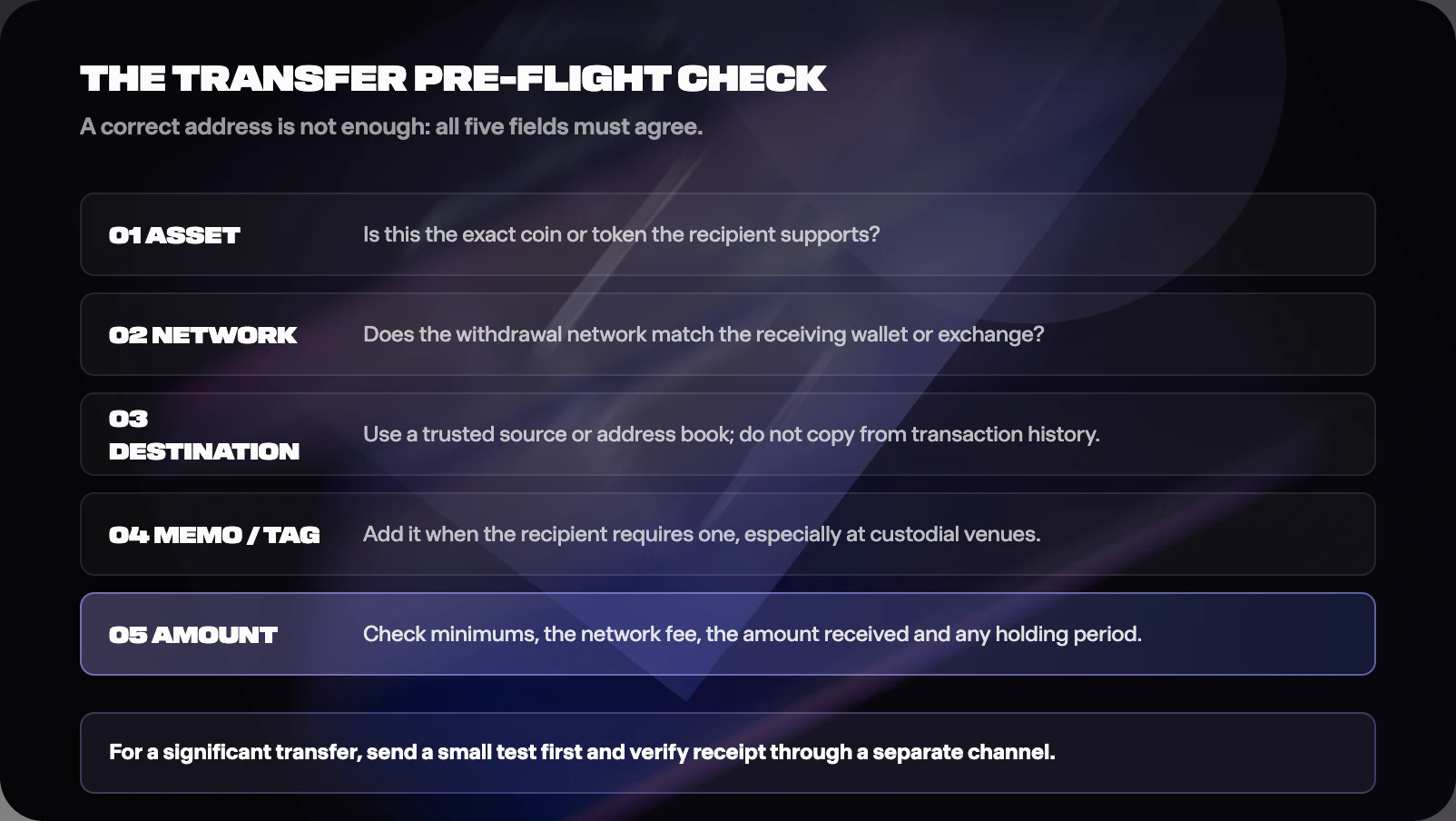
Many assets exist on several networks, and some networks use similar-looking address formats. The receiving wallet or exchange must support the specific asset on the specific network you choose. Sending a token over an unsupported network can require specialist recovery, and recovery may be impossible or refused by a custodian.
Use the address displayed by the intended recipient, an authenticated address book or a verified payment request. Do not copy a destination from transaction history: address-poisoning attacks deliberately place a lookalike address there. For significant transfers, verify the address on the wallet or hardware device screen and confirm it through a second channel. Checking only the first and last characters is inadequate against a targeted lookalike.
Some custodial deposit addresses require a memo, destination tag, payment ID or similar identifier. The blockchain address may belong to the provider as a whole, while the memo credits your account. Omitting it may not destroy the asset. Recovery, however, can be slow, expensive or unavailable.
Step 3: send, confirm and document
- Send the test amount and record the provider withdrawal ID and blockchain transaction hash.
- Wait for the receiving wallet or provider to show the required confirmations. "Broadcast" is not the same as final credit.
- Verify the asset and amount received, not merely that a transaction appeared.
- For a larger follow-up, regenerate or re-open the trusted destination rather than copying the test transaction from public history.
- Recheck the network and fee because a provider can change defaults between withdrawals.
- Do not proceed if support, a pop-up or another person introduces a new "safe" address after the test.
Which scams target first-time buyers?
Quick answer
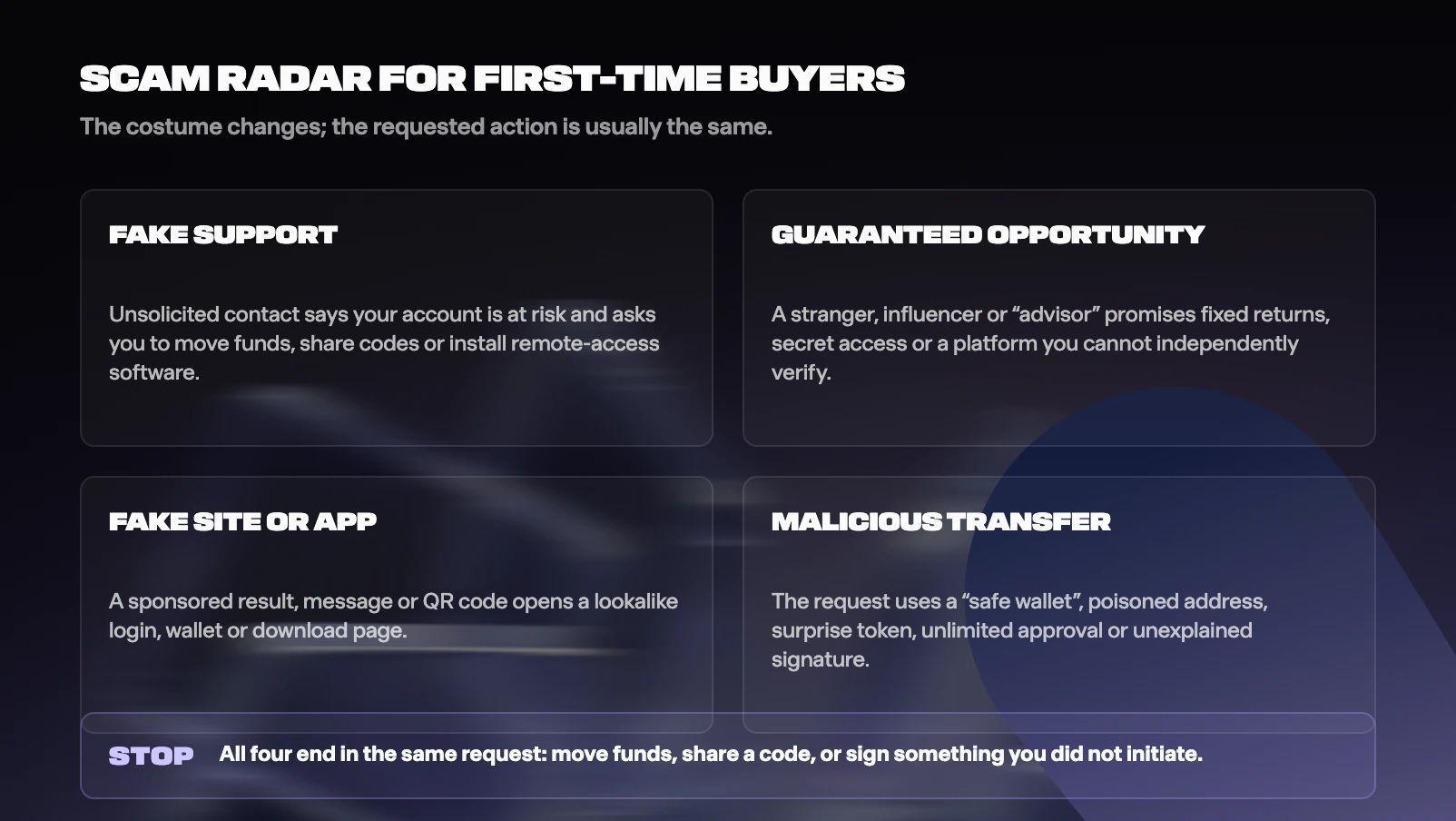
The main traps are fake providers and wallet downloads, impersonated support, relationship or investment fraud, giveaway promises, remote-access requests, poisoned addresses and malicious approvals. The common denominator is pressure to trust an identity, transfer to a supplied destination or reveal/authorise something you do not fully understand.
Fake support and account rescue
A caller or message claims the account is compromised and instructs you to move assets to a "safe wallet", share a code, approve a login or install remote-access software. Close the contact and open the provider through your own bookmark. Support does not need your recovery phrase, private key or authenticator code.
Relationship and investment fraud
A stranger develops trust before introducing a private trading platform, mentor or guaranteed strategy. The dashboard may show fictional profits and permit a small early withdrawal. The fraud becomes obvious when larger withdrawals require tax, verification or unlock payments. Never invest through a platform introduced by an unsolicited contact.
Fake websites, apps and sponsored results
Search advertising, QR codes and social posts can lead to lookalike domains and fake wallet packages. Password managers and passkeys help because credentials are bound to the legitimate site, but the safest habit is reaching the provider through a verified bookmark and confirming the legal entity in the contract.
Malicious wallet actions
Connecting a wallet may expose public addresses and balances; signing can authorise a transfer, token approval, permit or contract action. A hardware wallet cannot protect you from approving malicious content you misunderstand. Reject unexplained signatures, unlimited approvals and surprise airdrop claims, especially when reached through a link or advertisement.
What should you do when something goes wrong?
Quick answer
Stop the transaction or contact, preserve evidence, identify whether the problem affects an exchange account, a wallet key, a token approval or a transfer, and respond to that failure mode. Use only official support channels, secure the email and devices, and report fraud quickly.
| Problem | Immediate action | Do not assume |
|---|---|---|
| Unexpected exchange login or reset | Open the provider from your bookmark; lock or restrict the account; secure email; revoke sessions and API keys; contact official support | That changing only the exchange password removes an attacker who controls email or recovery |
| Authenticator or phone compromised | Use a clean device; replace authenticators; revoke sessions; contact provider; protect carrier account | That SMS or a new phone number alone repairs the account |
| Recovery phrase or private key exposed | Create a fresh wallet through verified software and move remaining assets as soon as safely possible; assume every derived account is compromised | That revoking token approvals fixes a stolen seed or private key |
| Malicious token approval or permit | Revoke the permission using a trusted tool; inspect other approvals and signatures; consider moving valuable assets to a fresh wallet | That the seed is necessarily compromised - but investigate how the approval occurred |
| Wrong address or wrong network | Stop follow-up payments; save the transaction hash; contact the receiving provider or wallet owner through official channels | That a private "recovery expert" can reverse a confirmed blockchain transfer |
| Fake investment platform | Stop all payments; preserve chats, URLs, addresses and transaction hashes; report to provider and national cybercrime/law-enforcement channels | That paying a tax or unlock fee will release the displayed balance |
| Wallet app may be fake | Disconnect the device; do not re-enter recovery words; use a clean environment to create a fresh wallet and move funds if the secret may have been exposed | That deleting the app removes a copied secret |
Recovery scammers target people after a loss. A stranger who promises guaranteed recovery for an upfront payment, asks for your seed phrase or wants remote access is creating a second loss. Legitimate recovery, where possible, usually depends on the receiving service, law enforcement, courts or technically feasible wallet recovery - not a secret blockchain override.
Final checklist
Quick answer
Do not fund the account until every item below has a clear answer. The list is intentionally conservative; the purpose of a first purchase is to learn without creating a single point of catastrophic failure.
Provider and product
☐ I know the exact legal entity named in the contract.
☐ I verified its authorisation or registration in the regulator's own database for the relevant service.
☐ I understand that regulation does not guarantee asset value, provider solvency or reimbursement.
☐ I checked custody, insolvency, insurance, sub-custodian and withdrawal terms.
☐ I know whether I am buying spot crypto, a derivative, a leveraged product, a staking product or something else.
☐ I reviewed the executable price, spread, trading fee, payment fee and withdrawal fee.
Account and device
☐ The provider and primary email use unique credentials.
☐ I enabled a passkey or hardware security key where available, with a safe backup.
☐ If I use an authenticator app, its recovery codes are stored separately and offline.
☐ I reviewed account recovery, active sessions, API keys, withdrawal allowlists and alerts.
☐ I am using a device I control and I did not reach the provider through a message or sponsored result.
Money and records
☐ The total amount is within a loss limit that does not affect essential finances.
☐ The payment method is in my name and I verified the beneficiary details inside the official account.
☐ I saved the date, asset, units, fiat value, fee, order ID and relevant statements.
☐ I know the local tax authority or professional source I will use for current tax guidance.
Optional withdrawal
☐ I independently verified the wallet source and understand its recovery design.
☐ I know the exact asset and network supported by the destination.
☐ I obtained the destination from a trusted source or address book, not public transaction history.
☐ I checked the full or machine-verified destination and any required memo or tag.
☐ I reviewed the minimum, network fee, holding period and amount expected to arrive.
☐ For a significant transfer, I will send a test and confirm receipt through a separate channel.
Frequently asked questions
How much money do I need to buy cryptocurrency?
Many services allow very small purchases because crypto assets are divisible. The sensible first amount is determined by fees and your risk budget, not by a target portfolio size. It should be small enough that complete loss would not affect essential finances.
Which cryptocurrency should a beginner buy?
This guide does not recommend an asset. Which asset to choose is a personal decision, and this guide does not make it for you. Any asset can fall sharply regardless of how well known it is. Evaluate purpose, issuer, custody and your own risk budget, and remember that buying at all is optional.
Can I buy crypto without identity verification?
Possibly, depending on the service, jurisdiction and transaction. Self-hosted wallets and decentralised protocols do not necessarily identify users, while custodial providers are often required to conduct customer due diligence. Avoiding KYC does not eliminate tax, sanctions or other legal obligations and may increase counterparty and fraud risk.
Is a regulated exchange safe?
Regulation can improve disclosure, conduct, safeguarding and supervision, but it is not a guarantee. A regulated provider can still fail operationally or financially, and most crypto assets do not receive the same protection as insured bank deposits. Verify the exact legal entity and understand the applicable regime.
Is a bank transfer safer than a card?
Neither is always safer or cheaper. Compare payment fees, exchange spreads, settlement times, withdrawal holds, chargeback treatment, currency-conversion costs and the security of the funding account. Start with a small deposit through details shown inside the verified provider account.
Do I need a wallet before buying crypto?
Not necessarily. A custodial provider can hold the asset after purchase. A personal wallet becomes necessary only if you want self-custody or on-chain use. Do not create one until you understand its backup and recovery model.
When should I use a hardware wallet?
A hardware wallet can reduce exposure of signing keys to an internet-connected computer, but it adds setup, backup and transaction-verification responsibilities. Use one when its failure modes fit your threat model and you have tested recovery - not merely because a balance passed an arbitrary threshold.
Should I check only the first and last characters of a wallet address?
No. Attackers can generate lookalike addresses with matching prefixes and suffixes. Use a trusted address source or allowlist, compare the destination on the wallet or hardware-device screen, and verify it through a second channel. For significant transfers, send a test first.
Should I ever enter a seed phrase into a device?
Only during a deliberate restoration or migration in wallet software or hardware you independently verified, using an environment you trust. Never enter it because a site, message, support agent, security alert or unexpected pop-up asks you to. Anyone who obtains the phrase can usually control all derived accounts.
Are crypto purchases taxed?
Tax rules vary. In some jurisdictions buying with fiat is not itself a disposal, while later sales, swaps, spending, rewards or income can be taxable. Keep complete records from the first purchase and consult the current guidance for your country.
Can a crypto transaction be cancelled?
A completed on-chain transaction is usually not reversible by a bank or support team. Some pending transactions can be replaced under network-specific rules, and a recipient can voluntarily return funds. Treat the destination and network as final before confirming.
The bottom line
A safer first crypto purchase is not defined by the coin or the size of the exchange. It is defined by a chain of independently verified decisions. You know which legal entity you are using. You understand what its regulation covers. You protect both the account and its recovery path. You see the full cost before buying. You keep records. And, if you withdraw, you verify the asset, network, destination and memo as separate fields rather than treating a pasted address as the whole transaction.
The most important permission is the one you do not give under pressure. No support agent needs a seed phrase, no legitimate investment guarantees a return, and no account emergency requires moving funds to a wallet supplied by the caller. Slow, small and independently verified remains the safest operating style long after the first purchase.
Sources and further reading
Key references for this article, current as of July 2026.
- Crypto-assets explained. https://www.eba.europa.eu/assets/Updated%20Joint%20ESAs%20Factsheet%20on%20crypto-assets/Updated%20Joint%20ESAs%20Factsheet%20on%20crypto-assets_EN.pdf
- Virtual Assets: FATF standards and provider obligations. https://www.fatf-gafi.org/en/topics/virtual-assets.html
- SP 800-63B-4: Authentication and Authenticator Management. https://pages.nist.gov/800-63-4/sp800-63b.html
- Implementing Phishing-Resistant MFA. https://www.cisa.gov/sites/default/files/publications/fact-sheet-implementing-phishing-resistant-mfa-508c.pdf
- CRYPTO10400 - Cryptoassets record keeping. https://www.gov.uk/hmrc-internal-manuals/cryptoassets-manual/crypto10400
- Questions regarding the income tax treatment of specific crypto-assets. https://www.bundesfinanzministerium.de/Content/DE/Downloads/BMF_Schreiben/Steuerarten/Einkommensteuer/2025-03-06-einzelfragen-kryptowerte-englisch.pdf?__blob=publicationFile&v=2
- Address poisoning scams. https://support.metamask.io/stay-safe/protect-yourself/wallet-and-hardware/address-poisoning-scams/
- Ethereum security and scam prevention. https://ethereum.org/security/
- Use Strong Passwords. https://www.cisa.gov/secure-our-world/use-strong-passwords
- Crypto-Asset Reporting Framework monitoring and implementation update. https://www.oecd.org/content/dam/oecd/en/networks/global-forum-tax-transparency/crypto-asset-reporting-framework-monitoring-implementation-update-2025.pdf
Quick quiz: did it stick?
Choose the best answer, then check the explanations below.


You have completed a quiz on “How to Buy Crypto Safely: A Beginner’s Guide”! Share your achievement on social media.
 Was this helpful?