
TL;DR
- Owning crypto means controlling the authority that a blockchain recognises for spending an output, sending from an account or invoking an account policy. The ledger records the asset; the wallet holds, accesses or coordinates the signing material and rules needed to change that record.
- A private key is secret signing material. A public key is mathematically related information that lets others verify signatures. An address is a network-specific identifier for an account, output, script or program rule. On some networks it is derived from a public key; on others it can represent code or a spending condition with no single private key.
- A wallet signs a chain-specific transaction or authorisation payload, not a vague instruction such as "send 1 coin". The signed data can bind inputs or nonce, destination, amount, network, fee parameters, contract call data, expiry and permission changes. What is not covered by the signature may remain changeable.
- The wallet signs and submits the transaction to one or more nodes or private services. A receiving node checks it against consensus rules and local relay policy, may add it to its own pending pool, and relays it to peers. A miner, validator or specialised builder eventually includes it in a valid block. Further blocks or checkpoint votes harden the result.
In one block
Cryptocurrency works by combining cryptographic authorisation with a replicated ledger. A wallet builds an exact transaction and a private key, smart-account policy or signing quorum authorises it. Independent nodes check the transaction, block producers order valid transactions, and consensus rules select a canonical history.
What does it mean to own cryptocurrency?
Quick answer
Owning crypto means controlling the authority that a blockchain recognises for spending an output, sending from an account or invoking an account policy. The ledger records the asset; the wallet holds, accesses or coordinates the signing material and rules needed to change that record.
The familiar phrase "the coins are in your wallet" is a useful interface metaphor and a poor technical description. A blockchain stores state: unspent outputs on Bitcoin, account balances and contract storage on Ethereum, or program-owned accounts on Solana. A wallet reads that state, constructs instructions and produces whatever authorisation the network requires.
For a conventional self-custody account, that authority may reduce to one private key. But the broader rule is more accurate: ownership is control of the valid spending policy. A Bitcoin output can require a script or multiple signatures. An Ethereum contract account can require multisignature approval, a passkey module, a timelock or social recovery. A threshold-signing system can distribute one signing authority across several key shares. A custodian can hold the cryptographic authority while the customer holds only a contractual claim against the custodian.
| Holding model | What the blockchain recognises | What the user actually controls | Main failure mode |
|---|---|---|---|
| Single-key self-custody | A signature or spending condition satisfied by one key. | The private key or recovery material that can recreate it. | One leaked or lost secret can be decisive. |
| Multisig or smart account | A script or contract policy requiring a threshold, module or rule. | Several signers, devices or recovery roles. | Policy, code, co-signer or governance failure. |
| Threshold / MPC signing | One ordinary signature under a shared public key. | Enough independent key shares to meet the threshold. | Threshold-many compromises, collusion or implementation weakness. |
| Custodial account | The custodian controls on-chain authority. | Login credentials and a legal or contractual claim. | Custodian compromise, insolvency, freeze or account takeover. |
| Exchange-traded product | The fund or its custodian controls the underlying asset. | A security in a brokerage account, not a blockchain key. | Market, issuer, custody and brokerage risk. |
This distinction explains why "not your keys, not your coins" is a warning about counterparty exposure rather than a complete security strategy. Holding the keys removes one intermediary and adds direct operational responsibility. Neither custody model is automatically safe merely because it is labelled centralised or self-custodial.
What do private keys, public keys and addresses actually do?
Quick answer
A private key is secret signing material. A public key is mathematically related information that lets others verify signatures. An address is a network-specific identifier for an account, output, script or program rule. On some networks it is derived from a public key; on others it can represent code or a spending condition with no single private key.
Most major chains use public-key cryptography for digital signatures. The wallet generates or accesses secret material, derives public information and creates a signature over a precisely defined message. Verification is fast; deriving the private key from the public key is considered computationally infeasible under the mathematical assumptions of the scheme and with correctly generated keys. "Infeasible" is the correct claim: security is conditional on the algorithm, implementation, random-number generation and current computing capabilities.
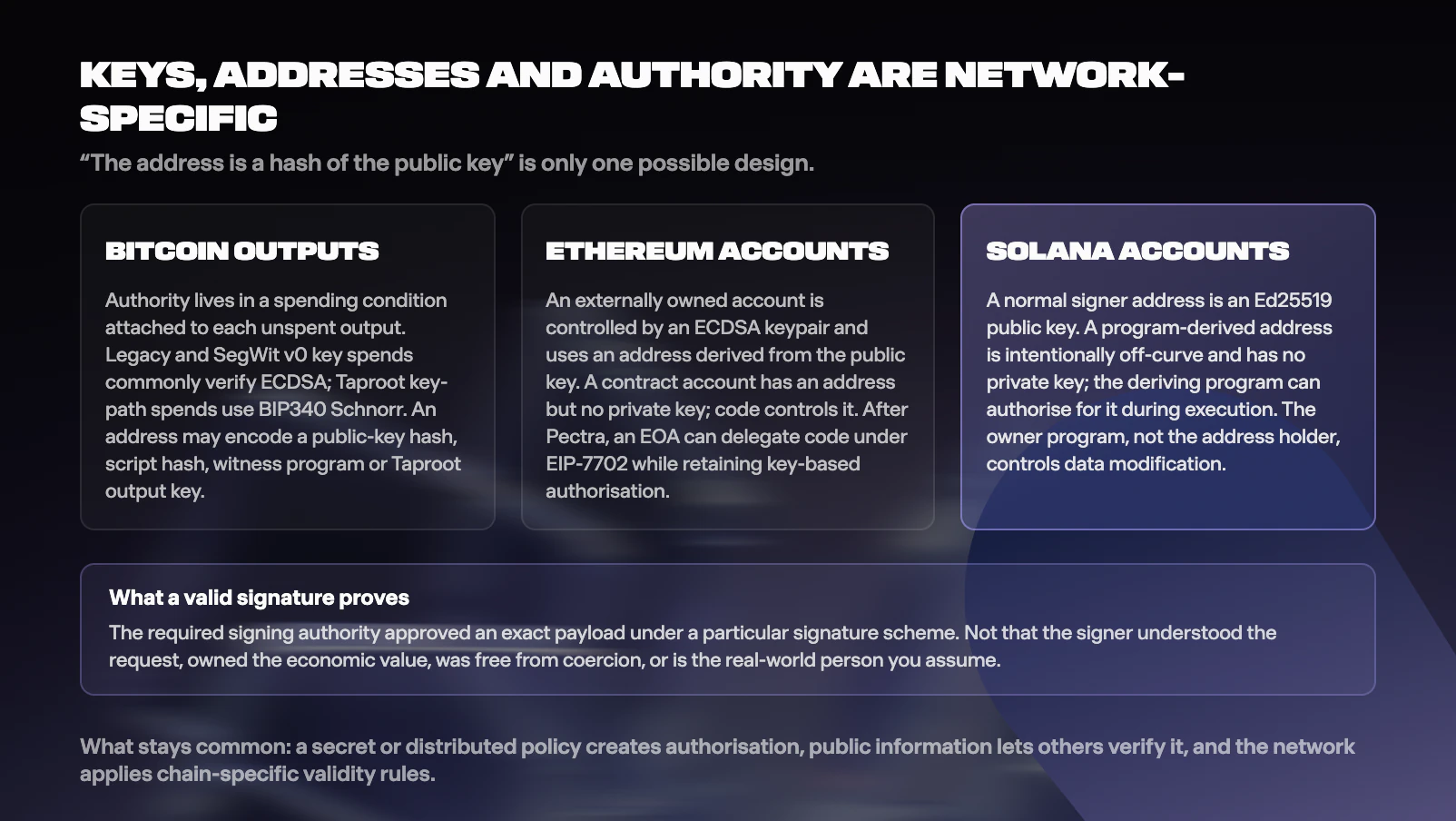
| Network or account type | Authority and signature | What the address represents |
|---|---|---|
| Bitcoin legacy / SegWit v0 key spend | Commonly ECDSA over secp256k1; scripts determine the full spending condition. | May encode a public-key hash, script hash or witness program rather than a raw key. |
| Bitcoin Taproot | BIP340 Schnorr for key-path spends; script paths can reveal alternative conditions. | A Bech32m address encodes a witness v1 program containing the Taproot output key. |
| Ethereum EOA | ECDSA over secp256k1 authorises transactions. | The last 20 bytes of the Keccak-256 hash of the public key, displayed with 0x. |
| Ethereum contract account | Code and storage determine behaviour; the account has no inherent private key. | A 20-byte contract address derived during deployment or deterministic creation. |
| Ethereum validator | BLS keys perform consensus duties; withdrawal authority can be separate. | A validator public key is not the same as a normal EOA address. |
| Solana keypair account | Ed25519 keypair; the secret key signs and the public key is the address. | A base58-encoded 32-byte public key. |
| Solana PDA | No private key exists; the deriving program authorises during program execution. | An off-curve address derived from seeds and a program ID. |
What a signature proves
A valid signature proves that the required secret or signing quorum authorised a particular digest under the specified signature algorithm. It also lets a verifier detect changes to the signed payload. It does not prove that the signer read the wallet screen, understood a token approval, knew the recipient, was not coerced, or owned the funds in a legal sense. That gap between cryptographic authorisation and human intent is where many wallet drainers and impersonation scams operate.
What can undermine signature security?
- Weak or biased key generation that produces guessable secret material.
- Nonce reuse or leakage in ECDSA or Schnorr-style signatures, which can expose a private key.
- Malware, side channels or physical attacks that extract secret material from a device.
- A wallet signing a different payload from the one the user believed it displayed.
- A smart-account, multisig or threshold implementation accepting an invalid or unauthorised policy path.
- Future cryptanalytic or quantum advances that invalidate current hardness assumptions.
Takeaway: Public-key cryptography removes the need to reveal the secret during verification. It does not remove the need for secure key generation, trustworthy signing software and accurate transaction review.
What exactly does a wallet sign?
Quick answer
A wallet signs a chain-specific transaction or authorisation payload, not a vague instruction such as "send 1 coin". The signed data can bind inputs or nonce, destination, amount, network, fee parameters, contract call data, expiry and permission changes. What is not covered by the signature may remain changeable.
The wallet interface turns human intent into a structured message. That translation is security-critical. On Bitcoin, the transaction selects specific unspent outputs as inputs, creates new outputs with spending conditions, specifies amounts and fees, and applies a signature-hash mode that determines which parts each signature commits to. On Ethereum, a normal transaction includes fields such as chain identifier, account nonce, destination, value, gas limit, fee caps and optional data that can invoke a contract.
Contract interactions can encode far more than a payment. A signature may approve a token allowance, trade through a decentralised exchange, delegate an EOA to code under EIP-7702, transfer an NFT, vote in a governance system or call a function whose outcome depends on current on-chain state. The network sees valid bytes; it does not know whether the wallet explained them well.
Before signing, verify at least these fields
- Network and chain: the intended chain, Layer 2 or sidechain, not merely the asset ticker.
- Asset and contract: the correct native asset or token contract, including decimals and token standard.
- Destination: the full recipient, contract, bridge or exchange deposit address and any required memo or tag.
- Amount and scope: exact transfer amount, minimum received amount, spending cap or approval scope.
- Action: transfer, swap, approval, permit, delegation, staking action, contract deployment or arbitrary message signature.
- Fee bounds: Bitcoin feerate and total fee, or Ethereum gas limit, base-fee exposure, priority fee and maximum fee.
- Expiry and replay domain: chain identifier, nonce, deadline and the application or contract for which the signature is valid.
- Policy path: which keys, co-signers, modules or recovery mechanisms are authorising the action.
Hardware wallets help, but they do not understand economics
A hardware wallet can keep a private key away from a general-purpose computer and sign only after confirmation on a trusted display. That protects against many extraction attacks. It cannot make a malicious approval harmless, prove that a contract address is reputable, detect every address-poisoning substitution or guarantee that a shortened display contains enough information. A secure device is most useful when the user can independently interpret what it shows.
What happens after you press Send?
Quick answer
The wallet signs and submits the transaction to one or more nodes or private services. A receiving node checks it against consensus rules and local relay policy, may add it to its own pending pool, and relays it to peers. A miner, validator or specialised builder eventually includes it in a valid block. Further blocks or checkpoint votes harden the result.
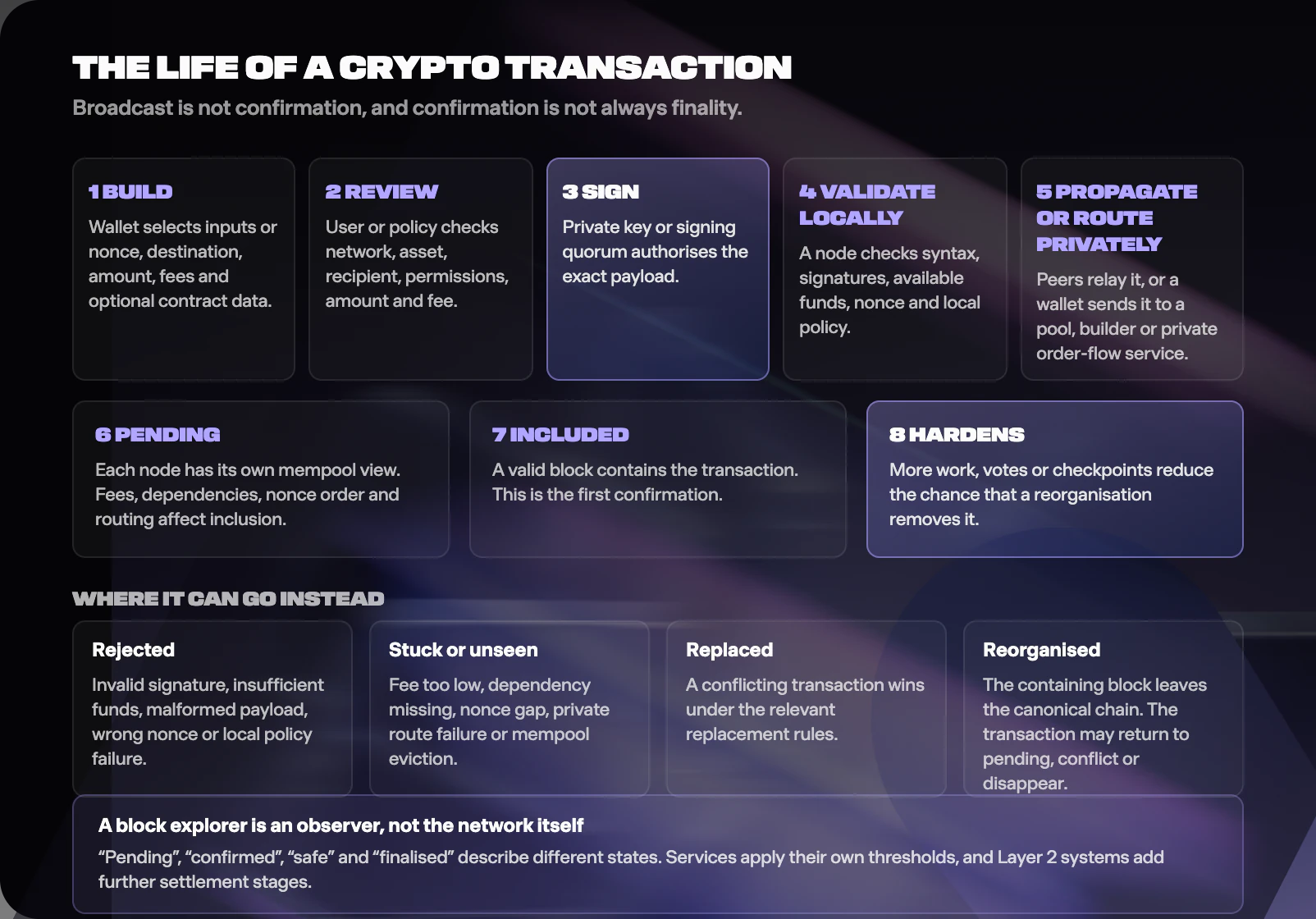
Step 1: local construction and signing
The wallet chooses inputs or the next account nonce, estimates fees, creates the payload and signs it. This can happen on a phone, in a browser wallet, on a hardware device, through a multisignature coordinator or across an MPC signing session. The secret key should not be transmitted to the network; only the transaction and signature are needed for verification.
Step 2: node validation and relay
The first node checks syntax, signatures, available funds or UTXOs, nonce, size, gas and other rules. It also applies local policy: a transaction can be consensus-valid yet not meet a node's relay or mempool requirements. Nodes have independent pending pools and can disagree about what they currently hold. There is no single global mempool that every machine shares.
Step 3: block construction
Bitcoin mining pools build candidate blocks from valid transactions they know about, considering fees, dependencies and their own policies. Ethereum validators may build locally or use specialised builders that optimise transaction ordering and bid for the proposal opportunity. Private order flow can bypass the public mempool, and maximal extractable value can affect ordering.
Step 4: independent block verification
After a block is proposed, other nodes do not accept it because the producer is trusted. They independently verify the block and every relevant state transition. A producer that includes an invalid spend, exceeds limits or violates consensus rules creates a block that honest nodes reject, regardless of its fee revenue or resource weight.
Step 5: inclusion, reorganisation and settlement
Inclusion is the first confirmation. Competing blocks can briefly exist at the chain tip, and the fork-choice rule determines which branch becomes canonical. Transactions from an abandoned block may return to pending, conflict with another transaction or disappear from a node's view. Deeper confirmations or explicit checkpoint finality reduce this risk.
Why do transactions wait, and how do fees work?
Quick answer
Block capacity and execution resources are scarce. Fees signal demand for inclusion, but transaction dependencies, nonce order, private routing, builder strategies and local policy also matter. A high fee improves priority; it cannot make an invalid transaction valid or guarantee a particular ordering.
Bitcoin: paying for virtual block space
Bitcoin transaction fees are the difference between input value and output value. Wallets and Bitcoin Core commonly express the bid as satoshis per virtual byte (sat/vB), which lets miners compare transactions of different virtual sizes. Inputs, outputs and witness data determine size; the amount of bitcoin transferred does not.
Dependencies matter. A low-fee parent and high-fee child may be evaluated together, and current Bitcoin Core mempool logic reasons about connected transaction groups rather than treating every transaction as fully independent. Replace-by-fee and child-pays-for-parent can improve inclusion when the transaction and wallet support them. A replacement is not a guaranteed cancellation: competing transactions race until one confirms.
Ethereum: gas, base fee and priority fee
Ethereum charges for computation and state access in units of gas. A transaction sets a gas limit and fee caps. The protocol calculates a base fee that is burned; the sender can add a priority fee, and the maximum fee limits the per-gas price. Unused gas is not charged. A contract call that reverts can still consume gas, because validators executed the computation.
Ethereum account transactions execute in nonce order. An underpriced or unseen earlier nonce can block later transactions from the same account even when those later transactions offer higher fees. A same-nonce replacement can supersede a pending transaction if the receiving node or wallet policy accepts the higher bid.
Ordering is not only a fee leaderboard
On Ethereum, builders and searchers may order bundles to capture arbitrage, liquidations or other MEV. Users may submit through private channels to reduce public exposure. On Bitcoin, pools can apply custom policies or include transactions received out of band. Fees remain central, but "highest fee always goes first" is an oversimplification.
| Question | Bitcoin | Ethereum |
|---|---|---|
| What is scarce? | Virtual block weight and transaction dependency capacity. | Execution gas, block gas target and data availability resources. |
| How is the bid expressed? | Commonly sat/vB plus the absolute transaction fee. | Base fee + priority fee, bounded by max fee; gas limit bounds execution. |
| Who receives it? | The block producer receives the transaction fee. | Base fee is burned; priority fee and other block value reward the proposer or builder path. |
| What can delay inclusion? | Low feerate, parent dependencies, local policy, replacement conflict or weak propagation. | Low fee caps, nonce gaps, private-route failure, builder policy, MEV or execution limits. |
| Can failure still cost money? | An unconfirmed or rejected transaction normally pays no on-chain fee. | An included transaction whose contract execution reverts can still consume and pay for gas. |
Takeaway: The fee market prices scarce inclusion resources. It does not verify the recipient, guarantee the application's honesty or compensate for a transaction signed under false pretences.
How do Bitcoin, Ethereum and Solana record ownership?
Quick answer
Bitcoin records spendable unspent transaction outputs. Ethereum records account state and contract storage. Solana records data and balances in accounts owned by programs. The state model changes how transactions are constructed and executed, but every model still needs authorisation, validation, canonical ordering and settlement.
Bitcoin: the UTXO model
A Bitcoin wallet balance is a convenient sum of unspent transaction outputs it can satisfy. A transaction consumes existing outputs and creates new ones. Inputs point to earlier outputs; scripts and signatures prove the spending conditions are met. If input value exceeds the intended payment and fee, the wallet normally creates a change output.
Ethereum: account and contract state
Ethereum maintains a global state containing externally owned accounts and contract accounts. An EOA has a balance, nonce and key-based authority; a contract account has code and storage. A transaction from an EOA can transfer ETH, deploy a contract or call code that updates many accounts and token ledgers in one atomic execution.
Solana: program-owned accounts
Solana separates executable programs from the accounts that hold mutable data. Each account has an address and an owner program that controls changes to its data or debits. User signer accounts use public-key addresses, while program-derived addresses let a program authorise for deterministic off-curve accounts without a private key.
| Dimension | Bitcoin | Ethereum | Solana |
|---|---|---|---|
| Primary state model | Unspent transaction outputs. | Accounts, balances, code and contract storage. | Program-owned accounts containing lamports and data. |
| Typical user authority | Satisfy an output script with signatures and other conditions. | EOA signature or smart-account / contract policy. | Ed25519 signer plus program-specific account rules. |
| Ordering control | Inputs identify exact outputs; each UTXO can be spent once. | Per-account nonce orders transactions from an EOA. | Recent blockhash, account locks and runtime scheduling shape execution. |
| Programmability | Scripted spending conditions, intentionally constrained. | General-purpose EVM smart-contract execution. | Programs execute against explicitly supplied accounts. |
| Common beginner confusion | The wallet balance is not one account row. | Tokens are contract state, not native ETH balances. | An address may be a signer, data account, mint, token account or PDA. |
Takeaway: "The blockchain stores balances" is accurate for some systems and misleading for others. The durable idea is that nodes maintain a deterministic state derived from accepted transactions and blocks.
What does blockchain consensus actually include?
Quick answer
Consensus is the complete set of rules and mechanisms that lets independent nodes converge on one canonical state. It includes validity rules, Sybil resistance and proposer selection, networking, fork choice, incentives and finality. Proof of work or proof of stake names only part of that system.
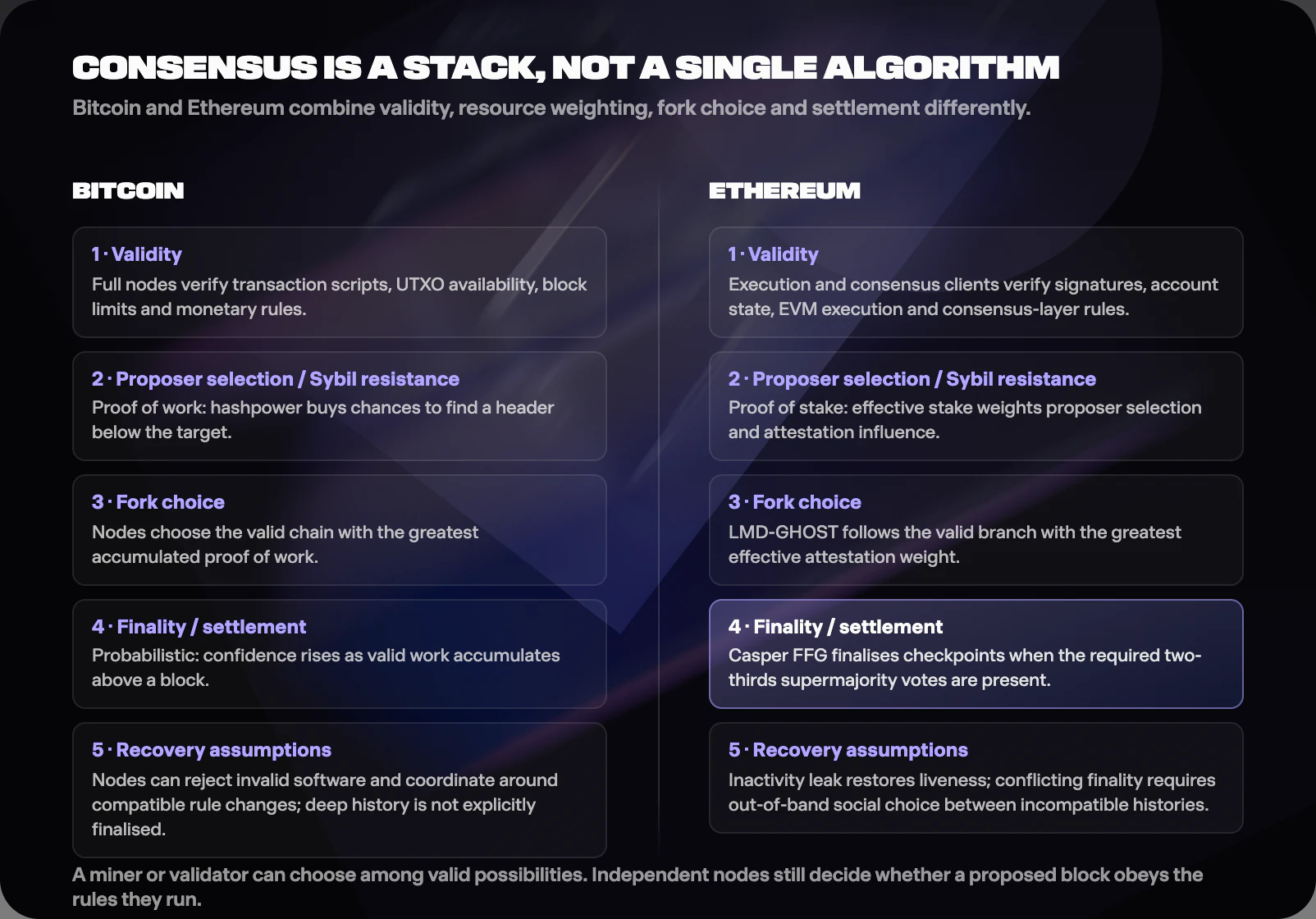
Validity comes first
Every full node evaluates blocks against the rules it runs. Bitcoin nodes verify scripts, UTXO availability, block structure and monetary constraints. Ethereum execution clients verify transactions and state transitions while consensus clients verify proposer and attestation rules. A block that fails validity does not enter the valid-chain competition at all.
Sybil resistance and proposer selection
Open networks need a way to prevent one participant from gaining influence by creating millions of identities. Proof of work ties influence to computational work; proof of stake ties it to bonded capital. Each mechanism allocates block-production or voting opportunities according to a scarce resource.
Fork choice
Temporary disagreement is normal in distributed systems. Bitcoin nodes choose the valid chain with the greatest accumulated proof of work. Ethereum uses LMD-GHOST to follow the valid branch with the greatest effective attestation weight. Fork choice answers which current branch to build on; it is not the same as finality.
Finality and recovery
Bitcoin does not label a block permanently final; confidence increases with depth. Ethereum uses Casper FFG checkpoints to create an explicit finalised state when the required supermajority votes are present. If Ethereum ever produced conflicting finalised histories, protocol messages alone could not choose between them; recovery would require social coordination.
How does proof of work secure Bitcoin?
Quick answer
Bitcoin miners repeatedly hash candidate block headers until one falls below the current target. Nodes accept only valid blocks and choose the valid chain with the greatest accumulated work. Rewriting recent history therefore requires producing an alternative valid chain faster than the honest network continues extending the existing one.
A miner assembles a candidate block, varies header fields and computes SHA-256 hashes. Each hash is a lottery ticket. The protocol adjusts difficulty every 2,016 blocks so that blocks average roughly ten minutes over time. The winning miner receives the block subsidy - 3.125 BTC since the April 2024 halving - plus transaction fees, provided the block is valid and accepted by the network.
The energy cost is not used to compute ordinary transaction validity. It makes producing an alternative chain expensive and gives nodes an objective accumulated-work rule for choosing between valid branches. Once electricity is consumed, it cannot be recovered; specialised hardware may retain resale or mining value. Security therefore depends on the distribution of hashpower, hardware and energy access, pool coordination, network connectivity and the economic value at risk.
What majority hashpower can and cannot do
| A sustained majority may enable | It still does not enable |
|---|---|
| Censorship or delay of selected transactions. | Forging another user's digital signature. |
| Replacement of recent valid blocks with a heavier valid branch. | Spending an output without satisfying its script. |
| Double-spending the attacker's own recent payment. | Creating coins beyond node-enforced issuance rules. |
| Control over recent transaction ordering and some fee or MEV opportunities. | Making honest full nodes accept an invalid block. |
| Damage to confidence and longer settlement requirements. | Free, permanent control without continuing operational cost. |
The phrase "51 percent attack" is shorthand. Below half, an attacker can still have a non-zero chance of replacing shallow history; above half, sustained domination becomes reliable under simplified assumptions. The practical risk depends on duration, network conditions and how quickly recipients respond by delaying settlement.
Takeaway: Proof of work governs competition between valid histories. It does not give miners authority to rewrite signature rules, seize arbitrary coins or redefine supply for nodes that reject those changes.
How does proof of stake secure Ethereum?
Quick answer
Ethereum validators bond ETH, one proposer is selected for each 12-second slot, and committees of validators attest to the chain. LMD-GHOST chooses the branch with the greatest attestation weight, while Casper FFG finalises checkpoints supported by at least two-thirds of effective stake. Provable contradictory votes can be slashed.
Time is divided into 12-second slots and 32-slot epochs. One validator is selected to propose a block in a slot, while committees attest to their view of the chain. Every active validator normally attests once per epoch. After Pectra, 32 ETH remains the activation minimum; validators that opt into compounding credentials can have an effective balance up to 2,048 ETH.
Ethereum uses separate key roles. Validator duties use BLS signing keys so attestations can be aggregated efficiently. Withdrawal authority can be held separately and, after Pectra, execution-layer credentials can trigger exits. A normal Ethereum EOA key is therefore not automatically the same key that performs validator duties.
Attack thresholds describe different capabilities
| Effective stake controlled | Protocol influence under simplified assumptions | Automatic penalty? |
|---|---|---|
| Below one-third | Can disrupt, censor or extract value in some circumstances but cannot alone prevent finality indefinitely. | Only if the behaviour creates slashable evidence or incurs ordinary penalties. |
| At least one-third | Can prevent checkpoint finality by withholding or misdirecting enough votes. | Withholding alone is not necessarily immediately slashable; inactivity leak can reduce absent weight. |
| More than one-half | Can dominate normal fork choice, enabling strong censorship and short-range reorganisation power. | Not every fork-choice attack is automatically slashable. |
| At least two-thirds | Can finalise selected checkpoints. Conflicting finality requires overlapping contradictory votes. | If conflicting histories are finalised, at least one-third of total stake is provably slashable. |
Slashing and inactivity are different
Slashing punishes specific contradictory signatures such as double proposals, double votes or surround votes. The immediate loss for an isolated validator is not necessarily its entire balance; correlated mass slashing can impose far larger losses. Validators that are merely offline usually incur smaller penalties. If finality stops for more than four epochs, the inactivity leak gradually reduces inactive effective balances until the remaining active validators can regain a two-thirds supermajority.
Takeaway: Proof of stake places capital inside the protocol's penalty system, but "an attack burns all stake" is false. Capabilities, evidence and penalties differ by attack, and catastrophic safety recovery includes a social layer.
When is a crypto transaction final?
Quick answer
A transaction is confirmed when it is included in a canonical block. Bitcoin confidence then grows probabilistically with each additional block. Ethereum separately reports latest, safe and finalised states; under normal participation, checkpoint finality usually arrives after roughly two epochs, around 13 minutes, but it can be delayed.
Bitcoin: confirmation depth
The block containing a transaction is confirmation number one. Each later block increases the accumulated work an attacker would need to replace it. Six confirmations, about an hour on average, is a common convention for high-value settlement, not a universal rule or a guarantee. Small payments may be accepted sooner; extremely valuable or adversarial transactions may justify more depth.
Ethereum: latest, safe and finalised
Ethereum clients can distinguish the newest canonical head from a safe view and a finalised view. Finality means reverting the block would require a critical consensus failure and make at least one-third of total staked ETH provably slashable and burnt from the validators responsible, with the exact penalty scaling with how many are slashed together. It is a cryptoeconomic guarantee, not a claim that software, governance or social recovery are metaphysically incapable of changing history.
Layer 2 systems add more clocks
A transaction on a rollup or other Layer 2 can be accepted by the sequencer before its data or proof is posted to the base layer. Optimistic systems may have challenge periods; validity-proof systems wait for proof generation and verification; bridges and exchanges may add their own thresholds. "Confirmed on the Layer 2" and "settled on Ethereum" are not always the same event.
| State | What it means | Residual risk |
|---|---|---|
| Signed | The required authority produced a signature. | May never propagate; may be malicious, invalid or replaced. |
| Broadcast / submitted | At least one peer or service received the transaction. | Other nodes may reject it or never see it. |
| Pending | One or more nodes or services consider it eligible for inclusion. | Fee, dependencies, nonce or policy can delay or evict it. |
| Included / first confirmation | A canonical block currently contains it. | A shallow reorganisation can remove the block. |
| Bitcoin depth threshold | The recipient accepts accumulated work as sufficient for the value at risk. | Reversal probability is reduced, not mathematically zero. |
| Ethereum safe | The block is expected not to reorg under stated honest-majority and network assumptions. | Not yet the strongest protocol checkpoint state. |
| Ethereum finalised | A two-thirds checkpoint supermajority has made reversal slashable at systemic scale. | Critical consensus failure, client bugs or social recovery remain outside the simple model. |
| Layer 2 settled | The system's own base-layer data, proof or challenge requirements are satisfied. | Bridge, sequencer, proof-system and base-layer assumptions vary. |
Takeaway: Finality is network-specific and recipient-specific. The correct threshold depends on the chain, transaction value, adversary model and whether another settlement layer is involved.
Where does crypto security actually fail?
Quick answer
Failures occur at several layers: key generation and signing, client and protocol software, smart contracts and bridges, custody and account recovery, interfaces and social engineering, and market or legal assumptions. Strong cryptography protects only the claims it was designed to protect.
The source article framed the protocol as essentially unbroken and the key layer as the location of nearly every loss. That is too absolute. Major signature schemes have resisted practical forgery under their intended assumptions, and Bitcoin and Ethereum have strong production records. But blockchain software has contained serious consensus and inflation vulnerabilities, applications have lost assets through contract and bridge failures, custodians have failed, and users have authorised malicious transactions.
| Layer | What the layer is supposed to guarantee | Representative failures | Primary defences |
|---|---|---|---|
| Cryptographic primitive | Unforgeability, collision resistance or secret derivation under stated assumptions. | Weak randomness, nonce reuse, side channels, algorithmic or future quantum break. | Reviewed primitives, secure hardware, deterministic nonces, migration planning. |
| Client and consensus software | Correct validation, networking, fork choice and state transition. | Inflation bug, divergent implementations, denial of service, incorrect edge-case handling. | Client diversity, audits, disclosure, testing, rapid patching and independent nodes. |
| Smart contract, bridge and oracle | Application-specific rules and cross-system messaging. | Logic error, admin-key abuse, oracle manipulation, proof or bridge compromise. | Minimal trusted surface, audits, limits, monitoring, timelocks and diversified exposure. |
| Custody and signing policy | Only authorised parties can move assets and access survives expected failures. | Seed leak, lost backup, co-signer collusion, custodian insolvency, threshold implementation bug. | Independent shares or signers, tested recovery, hardware isolation, governance and legal controls. |
| Wallet interface and human decision | The user understands and approves the intended action. | Phishing, address poisoning, malicious approvals, fake support, blind signing, coercion. | Independent verification, readable simulation, limits, transaction policies and privacy. |
| Economic and legal layer | The asset retains usefulness, liquidity and lawful access. | Price collapse, depegging, censorship, tax or regulatory change, counterparty dispute. | Risk limits, due diligence, records, jurisdictional advice and no assumption of guaranteed value. |
Where ordinary users are most exposed
For plain self-custody, the signing path is often the decisive operational risk: a stolen recovery phrase or malicious signature can authorise a valid transfer that the blockchain executes exactly as designed. Across the wider ecosystem, however, losses also arise from exchanges, custodians, smart contracts, bridges, oracles, governance and operational compromise. Security effort should match the actual system being used, not one slogan.
Robustness is conditional, not magical
A network can be difficult to rewrite and still host a fraudulent token. A transaction can be final and still be sent to the wrong address. A hardware wallet can keep the key secret and still sign a malicious permit. A decentralised protocol can depend on a centralised front end or bridge. The correct question is always: which property is protected against which adversary, under which assumptions?
What does cryptocurrency not guarantee?
Quick answer
A blockchain can verify signatures, deterministic state transitions and canonical ordering under its rules. It does not automatically guarantee privacy, truth of off-chain data, contract safety, asset value, decentralisation, lawful use, recoverability or informed human consent.
| Not guaranteed | Why not |
|---|---|
| Privacy | Public ledgers are often pseudonymous, not anonymous. Addresses, timing, amounts, exchange records and network data can link activity to people. |
| Truth at entry | Consensus can preserve an oracle report or token record without proving that the external claim was true when submitted. |
| Application safety | Valid bytecode can contain exploitable logic, malicious upgrade controls or economic assumptions that fail. |
| Asset quality or value | Scarcity and finality do not create demand, cash flow, legal rights or a stable price. |
| Reversibility | Base-layer settlement normally has no consumer chargeback. Recovery, when possible, depends on recipient cooperation, account policy, custodians or legal action. |
| Decentralisation | A network can have distributed nodes while mining pools, staking providers, builders, clients, governance or interfaces remain concentrated. |
| Availability | Congestion, outages, censorship, software bugs or lost keys can prevent timely access even when ownership records remain intact. |
| Human understanding | The network validates the signed payload, not the story a website told the signer. |
| Legal ownership | Control of a key is strong technical control, but courts, contracts, sanctions, inheritance and fiduciary duties can create separate legal claims. |
Takeaway: Blockchains are specialised verification systems. Their strength comes from narrow, explicit rules; treating them as universal truth machines creates the very misunderstandings that attackers exploit.
How can keys and wallets be held?
Quick answer
Keys can be held by a custodian, one software or hardware wallet, several on-chain signers, a programmable smart account, or a threshold-signing system. The right question goes beyond who has the key: it is how authorisation, backup, compromise, recovery and succession work across the whole lifecycle.
Recovery phrases and deterministic wallets
Many self-custody wallets use a hierarchical deterministic design. A BIP39-style phrase encodes entropy and, together with an optional passphrase, derives a binary seed from which a wallet can generate many private keys and addresses. It is therefore not literally "one private key written as words". Wallet standards, derivation paths and passphrase use must match during restoration.
Single-key software and hardware wallets
A software wallet keeps signing material on an internet-connected device or protected operating-system enclave. A hardware wallet isolates signing in a dedicated device and can reduce extraction risk. Both can fail through bad backups, malicious firmware or software, weak transaction review, physical compromise or user error.
On-chain multisignature and smart accounts
Multisig scripts and smart-contract accounts can require several approvals, enforce spending limits, add timelocks or support recovery roles. Their rules are visible and enforced on-chain, but security depends on code, signer independence, upgrade authority and the recovery process. Ethereum's EIP-7702 expands the ability of EOAs to use delegated wallet code without changing address, which increases both capability and policy complexity.
Threshold cryptography and MPC
Threshold signing distributes the ability to produce one signature across key shares. In a properly designed distributed-key-generation lifecycle, the complete private key need never exist in one place. This can reduce single-device failure, but it adds interactive protocol, coordinator, implementation, availability and share-independence assumptions. It is not simply "multisig without fees".
| Model | Main advantage | Main trade-off | Recovery question |
|---|---|---|---|
| Custodial service | Familiar access recovery and delegated operations. | Counterparty, freeze, insolvency and account-takeover risk. | What legal, operational and technical process restores access? |
| Software wallet | Low cost and direct control. | Internet-connected device and backup exposure. | Can the wallet be restored on clean software with verified recovery material? |
| Hardware wallet | Key isolation and trusted-display confirmation. | Device, firmware, supply-chain and backup risk; malicious actions can still be signed. | Is there a tested backup and a plan for device loss or failure? |
| On-chain multisig | Independent keys and transparent quorum enforcement. | More coordination, chain-specific policy and public governance footprint. | Can remaining signers rotate or replace a lost signer without unsafe shortcuts? |
| Smart account | Programmable limits, recovery, batching and alternative authentication. | Contract bugs, module risk, upgrades and governance complexity. | Who can change the policy, and under what delay or oversight? |
| Threshold / MPC | One on-chain signature with distributed signing authority. | Protocol and implementation complexity; threshold-many compromise remains fatal. | Can shares be refreshed or replaced without reconstructing or moving funds? |
Questions every custody design should answer
- What exact signature, script or contract action can move the assets?
- Which people, devices, services or code paths can satisfy that authority?
- What happens if one device is stolen, one person is unavailable or one provider fails?
- What happens if recovery material leaks but no transaction has yet been signed?
- Can a malicious transaction be limited by value, destination, time delay or policy review?
- How are software updates, signer replacement, share refresh and emergency response governed?
- How will heirs or authorised successors recover access without giving one person a standing theft path?
- Has the recovery process been tested with small amounts before it is needed under pressure?
Takeaway: The key is one component of an authorisation and recovery system. Good custody designs survive foreseeable loss, compromise and human unavailability without creating an easier theft path.
Frequently asked questions
How does cryptocurrency work in simple terms?
A wallet creates and signs a transaction, independent nodes verify it, a miner or validator includes it in a block, and consensus rules determine which valid block history becomes canonical. More blocks or checkpoint votes reduce the chance of reversal until the recipient treats the transaction as settled.
Does a crypto wallet actually hold coins?
Usually no. The blockchain records spendable outputs, account balances or token state. The wallet manages addresses, transaction construction and the keys or policies that can authorise changes to that state.
Is a wallet address the same as a public key?
Not universally. An Ethereum EOA address is derived from a public key; a standard Solana signer address is the public key; Bitcoin addresses can encode key hashes, scripts or Taproot output keys; contract and program-derived addresses can exist without a corresponding private key.
Can someone steal my crypto from my public address alone?
A public address normally grants no spending authority. However, it can reveal balances and transaction history, attract phishing or address-poisoning attacks, and help an attacker identify a valuable target. Theft still requires a valid authority path, such as a stolen key, malicious signature, contract bug or compromised custodian.
Can a blockchain itself be hacked?
Cryptographic forgery and deep consensus attacks are only part of the risk. Major networks have strong security records, but client software has contained critical bugs, applications and bridges have been exploited, and custodians and users have been compromised. "The blockchain was hacked" is often imprecise; identify the actual failed layer.
Are crypto transactions irreversible?
A pending transaction can be replaced or dropped under some conditions, and a shallow confirmed transaction can be removed by a reorganisation. After an appropriate settlement threshold, protocol reversal becomes extremely difficult, but account recovery, recipient cooperation, custodial intervention or legal seizure can still change the practical outcome in some systems.
How long does a crypto transaction take?
It depends on the network, fee, congestion, routing and settlement threshold. Bitcoin targets roughly ten-minute blocks; Ethereum uses 12-second slots and normally reaches checkpoint finality after about two epochs. Layer 2 systems and exchanges add their own clocks.
Do miners or validators control the blockchain?
They influence block production and ordering, but they do not have unilateral authority over validity. Full nodes independently reject blocks that violate the rules they run. Governance over rule changes is distributed across software maintainers, node operators, resource providers, applications, businesses and users.
What happens if I lose my private key?
If no backup, co-signer, custodian or recovery policy can satisfy the account's authority, the assets remain recorded but become unspendable. Smart accounts, multisig and custodial systems can have different recovery paths; a conventional single-key address does not have a network password reset.
Why do crypto fees change?
Demand for scarce block or execution capacity changes. Bitcoin bids for virtual block space; Ethereum prices gas with a protocol base fee and priority fee. Dependencies, nonce order, private order flow, builder strategies and local policy also affect inclusion.
Is cryptocurrency anonymous?
Usually not. Many public chains are pseudonymous: addresses are public and transaction history is permanent, while identity links can be inferred from exchanges, network data, counterparties and behavioural patterns.
What does "not your keys, not your coins" mean?
It means that when a custodian controls the on-chain keys, the customer depends on that custodian to honour withdrawals and remain secure and solvent. It does not mean self-custody is automatically safe; direct key control adds backup, signing and recovery responsibilities.
The bottom line
Cryptocurrency works because several narrow mechanisms cooperate. A signing policy turns authority into verifiable cryptographic evidence. A transaction encodes an exact proposed state change. Nodes verify that proposal against deterministic rules. Block producers order valid proposals, and consensus determines which valid history the network follows. Settlement rules then tell recipients when reorganisation risk is low enough for the value at stake.
The strongest mental model is not "mathematics replaces trust". Trust is redistributed and made more explicit. Users trust cryptographic assumptions, software implementations, hardware, network participation, smart-contract code, wallet interfaces and their own recovery design. Public verification reduces dependence on one record keeper; it does not remove every dependency or every form of governance.
That is also why security advice must name the layer. Protecting a recovery phrase does not audit a bridge. Waiting for finality does not make a token valuable. A hardware wallet does not explain a malicious permit. A decentralised validator set does not guarantee a decentralised front end. Crypto is powerful precisely because its guarantees are specific. Use those guarantees where they apply, and do not silently extend them to problems they were never designed to solve.
Sources and further reading
Key references for this article, current as of July 2026.
- Bitcoin: A Peer-to-Peer Electronic Cash System. https://bitcoin.org/bitcoin.pdf
- Bitcoin Developer Guide - Transactions. https://developer.bitcoin.org/devguide/transactions.html
- Bitcoin Developer Guide - Block Chain. https://developer.bitcoin.org/devguide/block_chain.html
- Bitcoin Developer Guide - Mining. https://developer.bitcoin.org/devguide/mining.html
- BIP 340 - Schnorr Signatures for secp256k1. https://bips.dev/340/
- BIP 341 - Taproot. https://bips.dev/341/
- Ethereum.org - Accounts. https://ethereum.org/developers/docs/accounts/
- Ethereum.org - Transactions. https://ethereum.org/developers/docs/transactions/
- Ethereum.org - Gas and fees. https://ethereum.org/developers/docs/gas/
- Ethereum.org - Consensus mechanisms. https://ethereum.org/developers/docs/consensus-mechanisms/
- Ethereum.org - Proof of stake. https://ethereum.org/developers/docs/consensus-mechanisms/pos/
- Ethereum.org - Gasper. https://ethereum.org/developers/docs/consensus-mechanisms/pos/gasper/
Quick quiz: did it stick?
Choose the best answer, then check the explanations below.


You have completed a quiz on “How Does Crypto Actually Work? Keys, Consensus, and Transactions”! Share your achievement on social media.
 Was this helpful?