
TL;DR
- Proof of work makes influence costly by requiring verifiable computation. Proof of stake makes influence costly by requiring bonded capital. Both help decide who may propose blocks and how much weight participants receive, but a complete consensus system also needs deterministic validity rules, a way to choose between valid branches and a settlement or finality model.
- Bitcoin miners assemble candidate blocks and repeatedly hash an 80-byte block header until one result falls below the network target. A successful miner broadcasts the block; full nodes accept it only if every rule also passes. Nodes normally follow the valid chain with the most accumulated proof of work.
- Ethereum divides time into 12-second slots and 32-slot epochs. A validator is pseudo-randomly selected to propose a block in each slot, while committees attest to their view of the chain. LMD-GHOST selects the head and Casper FFG adds checkpoint finality.
- Attack cost is not one number. It includes the cost of acquiring or controlling the resource, the operating cost during the attack, foregone honest rewards, market and liquidity effects, the portion that can be recovered afterwards, and the response of nodes, exchanges, applications and the wider community.
In one block
Proof of work and proof of stake are mainly Sybil-resistance and block-proposer mechanisms inside larger consensus systems. Bitcoin links block production to computational work and selects the valid chain with the most accumulated work. Ethereum links proposal and voting weight to bonded ETH, uses LMD-GHOST fork choice and finalises checkpoints with Casper FFG.
What is the difference between proof of work and proof of stake?
Quick answer
Proof of work makes influence costly by requiring verifiable computation. Proof of stake makes influence costly by requiring bonded capital. Both help decide who may propose blocks and how much weight participants receive, but a complete consensus system also needs deterministic validity rules, a way to choose between valid branches and a settlement or finality model.
The popular shorthand - "proof of work is mining, proof of stake is staking" - is useful but incomplete. A decentralised network must solve several separate problems. It must reject invalid transactions, resist an attacker who creates thousands of fake identities, choose a block producer, resolve temporary competing branches, and decide when users can treat an older block as settled. Ethereum's own documentation explicitly notes that proof of work and proof of stake are primarily Sybil-resistance and block-author selection mechanisms rather than complete consensus protocols.
The distinction matters because it limits what miners and validators can do. A Bitcoin miner may find a valid proof-of-work header, but every full node independently checks the block. An Ethereum validator may control substantial stake, but execution and consensus clients still re-execute transactions and reject invalid state transitions. Economic influence selects among valid possibilities; it does not grant permission to rewrite the validation rules unilaterally.
| Consensus layer | Bitcoin example | Ethereum example |
|---|---|---|
| Validity rules | Full nodes verify signatures, UTXO rules, block format, proof of work and monetary limits. | Execution and consensus clients verify signatures, execution results, block structure and consensus rules. |
| Sybil resistance and proposer selection | Hashpower determines the probability of finding the next valid block. | Effective staked ETH influences proposer selection and attestation weight. |
| Fork choice | The valid chain with the most accumulated proof of work is preferred. | LMD-GHOST selects the valid branch with the greatest effective attestation weight. |
| Finality | Probabilistic confidence increases with additional valid work. | Casper FFG justifies and finalises checkpoint blocks with two-thirds stake support. |
| Direct economic discipline | Energy, hardware depreciation, opportunity cost and foregone block rewards. | Missed rewards, inactivity penalties and slashing for specific provable offences. |
Takeaway: When comparing proof of work and proof of stake, compare the entire consensus design. Treating either resource mechanism as if it alone validates transactions, governs software or guarantees finality leads to inaccurate security claims.
How does Bitcoin proof of work operate?
Quick answer
Bitcoin miners assemble candidate blocks and repeatedly hash an 80-byte block header until one result falls below the network target. A successful miner broadcasts the block; full nodes accept it only if every rule also passes. Nodes normally follow the valid chain with the most accumulated proof of work.
A miner begins with valid transactions, builds a candidate block and constructs a block header containing commitments to the previous block and the transaction set. The miner changes fields such as the nonce and coinbase data, hashes the header with SHA-256 twice, and repeats. Each attempt is independent. More hashpower buys more attempts per second and therefore a larger probability of finding a valid result, but it does not reveal a shortcut.
When a header satisfies the current target, the miner sends the complete block to peers. Verification is deliberately cheap relative to production: nodes check the proof of work, block size and structure, every transaction and every consensus rule. If any rule fails, the block is rejected regardless of how much electricity was spent creating it. Valid blocks may temporarily compete when miners find them at similar times; Bitcoin Core identifies the active tip as the most-work fully validated chain.
Difficulty, cadence and rewards
Bitcoin retargets mining difficulty every 2,016 blocks so that, over time, blocks average about ten minutes. Individual intervals remain highly variable: two blocks may arrive close together, or the network may wait much longer than ten minutes. The successful block includes a coinbase transaction paying the block subsidy - 3.125 BTC since the 2024 halving - plus the transaction fees in that block. Pools combine the work of many miners and share revenue, reducing the income variance that an individual miner would otherwise face.
What proof of work is buying
The useful output is not the hash itself. The value is a public, cheaply verifiable record that someone committed real computation before proposing the block. To replace recent history, an attacker must create an alternative sequence with more accumulated work than the honest branch while the honest network continues mining. The bill continues for as long as the contest continues.
Takeaway: Bitcoin proof of work is an open probabilistic race whose result is easy for every node to verify. The miner earns a temporary right to propose; full nodes retain the final say on validity.
How does Ethereum proof of stake operate?
Quick answer
Ethereum divides time into 12-second slots and 32-slot epochs. A validator is pseudo-randomly selected to propose a block in each slot, while committees attest to their view of the chain. LMD-GHOST selects the head and Casper FFG adds checkpoint finality.
To activate a validator, a participant deposits at least 32 ETH and runs an execution client, a consensus client and validator software. The 32 ETH requirement applies to block-proposing and attesting duties; anyone can run a non-validating Ethereum node without staking ETH. After the Pectra upgrade, validators using opt-in compounding withdrawal credentials can increase their effective balance in one-ETH increments up to 2,048 ETH, while legacy validators remain capped at a 32 ETH effective balance.
For each slot, one active validator is selected to propose. Other validators are divided into committees and submit attestations that contain both a head vote and checkpoint votes. Across an epoch, each active validator is expected to attest once. An execution client re-executes the transaction payload; a consensus client checks consensus-layer rules. A stake-weighted vote cannot make an invalid execution result valid.
Fork choice and finality work together
Ethereum's fork-choice rule, LMD-GHOST, identifies the branch with the greatest weight of recent attestations. Casper FFG separately evaluates checkpoint votes. A checkpoint becomes justified after the required supermajority link, and an earlier justified checkpoint becomes finalised when the next qualifying link is established. This combination is commonly called Gasper.
Rewards, ordinary penalties and slashing
Validators receive protocol rewards for timely, correct attestations and proposals. Missing duties creates ordinary penalties. Slashing is different: it applies only to evidence of specific contradictory signatures, and it forces exit plus additional losses. The distinction is central to attack analysis because harmful behaviour such as withholding votes may delay finality without immediately satisfying a slashing condition.
Takeaway: Ethereum proof of stake is not simply "random rich people make blocks". It is a structured voting system with independent execution checks, stake-weighted fork choice, checkpoint finality and different penalty classes for downtime and provable equivocation.
What does the "cost of attack" actually include?
Quick answer
Attack cost is not one number. It includes the cost of acquiring or controlling the resource, the operating cost during the attack, foregone honest rewards, market and liquidity effects, the portion that can be recovered afterwards, and the response of nodes, exchanges, applications and the wider community.
Simplified comparisons often say a proof-of-work attack "costs electricity" while a proof-of-stake attack "burns the attacker's coins". Both statements contain truth and hide important details. A credible security analysis separates at least five components:
- Acquisition or control: buying, manufacturing, renting or compromising hashpower; or acquiring, borrowing, custodially controlling or coercing stake.
- Running cost: electricity, facilities and maintenance for proof of work; infrastructure, coordination, financing and opportunity cost for proof of stake.
- Irreversible loss: energy already consumed cannot be recovered. PoS stake is lost only when the behaviour is slashable or when inactivity penalties accumulate.
- Residual value: mining hardware may be resold or returned to honest use; unslashed stake remains an asset, although an attack may damage its market value.
- System response: nodes may reject invalid blocks, counterparties may halt deposits, miners or validators may coordinate defensively, and a catastrophic PoS safety failure may trigger social recovery.
| Question | Proof of work | Proof of stake |
|---|---|---|
| What must be controlled? | Enough effective hashpower to outpace or strategically disadvantage the honest branch. | Enough effective stake or validator control to influence fork choice, finality or availability. |
| What is spent continuously? | Electricity, cooling, operations and hardware depreciation. | Infrastructure, financing and opportunity cost; ordinary participation uses comparatively little electricity. |
| What is automatically unrecoverable? | Consumed electricity and foregone honest revenue. | Only protocol penalties already assessed; unslashed principal remains unless market value falls. |
| What may retain value? | ASICs, facilities and energy contracts, subject to resale and redeployment limits. | Unslashed ETH and infrastructure, subject to liquidity, custody and price risk. |
| What can stop the attack? | More honest work, delayed settlement, miner/pool reallocation and node rejection of invalid blocks. | Honest attestations, inactivity leak, slashing evidence, client coordination and, in extreme cases, social recovery. |
Takeaway: A dollar figure based only on current hash rental prices or the market value of staked ETH is not a complete attack budget. Control, coordination, liquidity, duration, detectability and recovery determine whether an attack is feasible and profitable.
What can a Bitcoin majority-hashpower attack do?
Quick answer
A sustained majority gives an attacker a reliable advantage in producing the most-work valid chain. The attacker can censor transactions, reorder recent valid blocks and reverse its own recent payments. It cannot forge signatures, seize unrelated coins, create blocks that violate the supply rules or make full nodes accept invalid transactions.
"51 percent attack" is convenient shorthand, not a magical on-off switch. An attacker below 50 percent can still have some probability of replacing shallow history, and strategic mining can create advantages under particular assumptions. A sustained majority makes domination of recent chain growth reliable rather than merely possible. Bitcoin's developer documentation explicitly notes that even less than half of hashpower can retain a non-zero chance of revising history, while a majority enables reliable attacks.
| A majority-hashpower attacker may be able to | A majority-hashpower attacker still cannot |
|---|---|
| Temporarily prevent selected valid transactions from confirming. | Create a valid signature for someone else's private key. |
| Build a private valid branch and release it to replace recent blocks. | Spend outputs that the consensus rules do not authorise. |
| Reverse the attacker's own recent payment and attempt a double-spend. | Increase the 21 million supply or change validation rules for honest nodes. |
| Influence which valid transactions appear first and capture ordering value. | Guarantee reversal of arbitrarily deep history at zero ongoing cost. |
| Destabilise confidence and force services to increase confirmation requirements. | Silently alter old blocks without rebuilding the proof of work above them. |
Why confirmations help
Every additional block adds honest work above a transaction. Replacing it requires the attacker to catch and overtake a longer branch while honest miners continue extending it. The appropriate waiting period depends on the transaction value, adversary assumptions, current network conditions and the receiving service's risk tolerance. Six confirmations is a widely used convention for high-value settlement, not a mathematical guarantee that fits every payment.
Takeaway: Hashpower governs the contest between valid branches, not the validity rules themselves. The most important defence against a majority attack is depth plus independent validation, not faith in a single miner or pool.
What do Ethereum's one-third, one-half and two-thirds thresholds mean?
Quick answer
At least one-third of effective stake can prevent checkpoint finality. More than half can dominate normal LMD-GHOST fork choice, enabling censorship and short-range reorganisation. At least two-thirds can finalise selected checkpoints. Producing conflicting finalised histories necessarily makes at least one-third of total stake provably slashable.
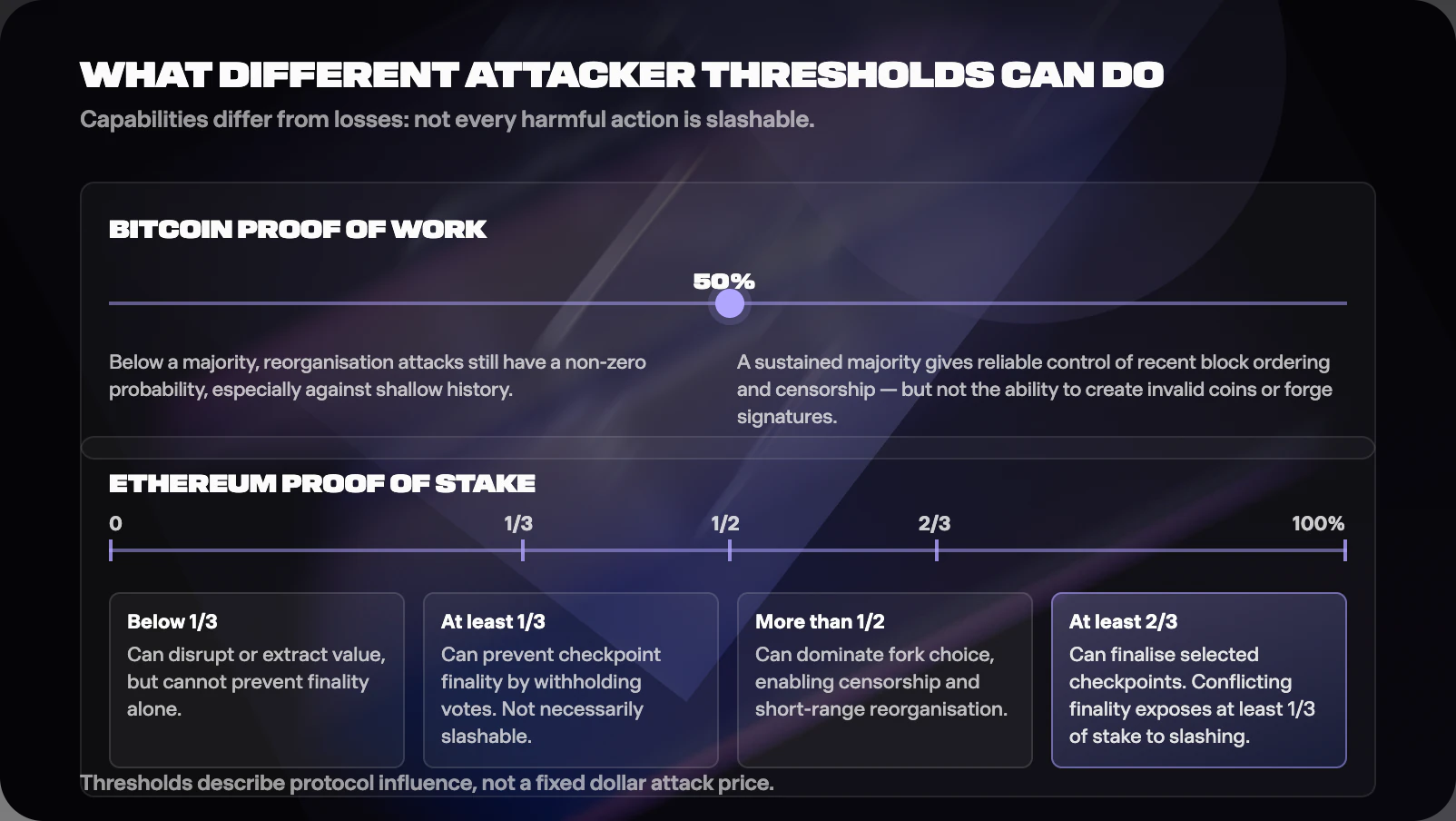
The thresholds answer different questions. One-third is a liveness threshold: because finality needs at least two-thirds support, one-third can withhold enough weight to prevent the required supermajority. If finality remains absent for more than four epochs, Ethereum activates the inactivity leak, gradually reducing the effective balance of validators that are not participating correctly until the active side can regain two-thirds.
More than half of effective stake can dominate the normal fork-choice calculation. Ethereum's official FAQ states that this can enable censorship, short-range reorganisations and ordering advantages. It still does not let the attacker finalise alone or make invalid execution pass honest verification.
At least two-thirds can create the checkpoint votes required for finality on a chosen branch. That does not mean two-thirds is automatically destroyed. If the attacker finalises one branch and there is no conflicting finalised branch, the act may not itself prove a slashing offence. The accountable-safety guarantee applies when conflicting finality is produced: any two two-thirds quorums overlap by at least one-third, so at least one-third of total stake must have signed incompatible votes and can be identified for slashing.
Takeaway: "A proof-of-stake attack burns all of the attacker's coins" is false. Different attacks cross different thresholds; only specific evidence triggers slashing; and catastrophic safety recovery ultimately includes a social layer.
What does slashing punish - and what does it not punish?
Quick answer
Ethereum slashes specific, objectively provable contradictory signatures: proposing two blocks for one slot, double-voting for different checkpoint targets in one epoch, or casting a vote that surrounds another vote. Ordinary downtime causes smaller penalties, and current protocol rules do not automatically slash every form of censorship or selfish behaviour.
The three main slashing conditions
- Double proposal: one validator signs two different beacon blocks for the same slot.
- Double vote: one validator signs two distinct attestations with the same target epoch.
- Surround vote: one attestation's source and target epochs surround those of another attestation from the same validator.
A slashed validator is forced to exit. The immediate penalty for an isolated event is only a portion of effective balance, followed by further deductions. A correlation penalty scales with the amount of stake slashed in the surrounding window; a coordinated mass offence can drive losses toward the full effective balance. Ethereum's documentation therefore distinguishes an isolated operational mistake from a large coordinated safety attack.
What is not automatically slashed
Missing attestations, being offline or failing to propose a block normally creates ordinary penalties rather than slashing. Deliberately withholding votes can delay finality and trigger inactivity leak losses without producing contradictory signatures. Transaction censorship is harmful but is not, by itself, one of today's simple slashing conditions. Protocol proposals may strengthen censorship resistance, but the present article should not treat future defences as already deployed.
Takeaway: Slashing provides accountable safety, not universal behavioural enforcement. A robust PoS design still needs fork choice, inactivity handling, client diversity, monitoring and social coordination.
How does transaction finality differ?
Quick answer
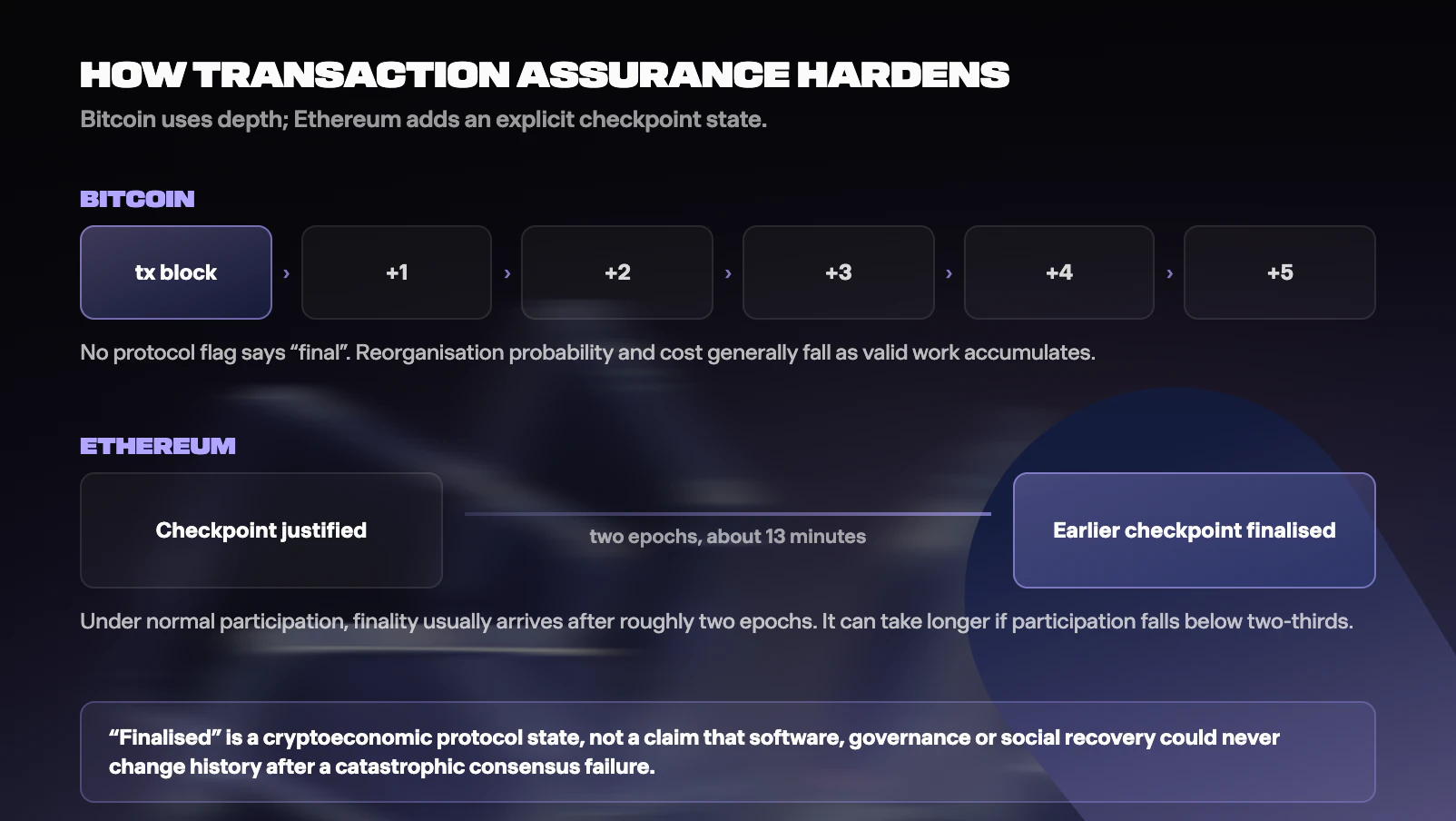
Bitcoin has no protocol flag that turns a block permanently final; confidence strengthens as more proof of work accumulates. Ethereum marks checkpoints justified and finalised through stake-weighted votes. Under normal participation, Ethereum finality usually arrives after about two epochs - roughly 13 minutes - but finality can pause.
Bitcoin: probabilistic depth
A Bitcoin transaction receives its first confirmation when it is included in a valid block. Each additional block makes a reorganisation past it more expensive and generally less likely. The probability never becomes exactly zero under the model; users and services choose a depth suitable for the value and threat assumptions. This is why "six confirmations" is a convention rather than a protocol state.
Ethereum: justified, safe and finalised
Ethereum clients expose several assurance concepts. The head is the current fork-choice tip. A "safe" block has strong attestation support but is not yet finalised. A checkpoint becomes justified through a two-thirds supermajority link, and the prior justified checkpoint becomes finalised with the next qualifying link. In normal operation this takes roughly two epochs, often described as about 13 to 15 minutes depending on where in the epoch a transaction lands.
Why finality can be delayed
Slots can be empty, attestations can arrive late and client or network faults can reduce participation. If less than two-thirds of effective stake provides the required votes, the chain can continue producing blocks without finalising. Ethereum experienced temporary finality interruptions in May 2023 during a client-related incident, illustrating that explicit finality depends on healthy software and participation.
Weak subjectivity
A new Ethereum node, or one returning after being offline for a long period, should obtain a recent weak-subjectivity checkpoint from one or more trusted public sources. This prevents long-range histories built with old validator keys from misleading the node. The trust is limited and cross-checkable, but it is a real difference from a pure "recompute from genesis by accumulated work" model.
| Property | Bitcoin proof of work | Ethereum proof of stake |
|---|---|---|
| First inclusion | A transaction is in a valid block. | A transaction is in the fork-choice head or another recent valid block. |
| How assurance grows | Additional blocks add accumulated work above it. | Attestations strengthen the head; checkpoint votes justify and finalise. |
| Explicit final flag | No. Users choose a confirmation threshold. | Yes. Clients expose finalised checkpoints. |
| Normal high-assurance wait | Often about six blocks for high-value settlement, but policy varies. | Usually about two epochs, roughly 13 minutes, when participation is healthy. |
| Failure mode | A higher-work valid branch can replace recent history. | Finality can pause; conflicting finality is a critical consensus failure. |
| Bootstrap assumption | Validate the most-work chain, commonly with implementation optimisations and checkpoints in software. | Use a recent weak-subjectivity checkpoint when joining or returning after a long absence. |
Takeaway: "Final" means different things. Bitcoin offers continuously increasing confidence; Ethereum offers an explicit cryptoeconomic state whose safety depends on quorum intersection, slashing and a limited social bootstrap assumption.
How do energy and hardware requirements compare?
Quick answer
Proof of work intentionally makes competitive block production resource-intensive, so Bitcoin mining consumes substantial electricity and specialised hardware. Proof of stake replaces the hashing race with ordinary servers and bonded capital. Ethereum estimates that The Merge reduced its electricity use by about 99.95 percent.
Bitcoin has no protocol-set electricity target. Miners expand or contract until expected revenue, power prices, hardware efficiency, financing and operational risk reach an economic balance. A rising price or block reward can support more hashpower; more efficient machines can lower energy per hash while competition increases the total number of hashes. The result is dynamic, which is why a fixed energy figure ages quickly.
The energy is not a perfect synonym for security. Security depends on how much effective hashpower an attacker can control, where equipment and power are concentrated, how quickly honest miners can respond, and whether nodes continue enforcing the same rules. The same electricity consumed under one highly concentrated operator does not provide the same resilience as comparable work distributed across independent operators.
Ethereum validators do not need to perform trillions of expendable hashes. They run networking, signature verification, state execution and database workloads on conventional hardware. The Merge therefore removed nearly all consensus-related electricity demand from the former mining system. The current Ethereum energy page cites an even larger estimated reduction under a different methodology, but "about 99.95 percent" remains the stable official headline figure.
| Dimension | Proof of work | Proof of stake |
|---|---|---|
| Primary scarce resource | Ongoing computation backed by electricity and hardware. | Bonded capital plus reliable online operation. |
| Typical proposer hardware | Specialised ASIC mining equipment for Bitcoin. | Commodity server-class hardware; separate execution and consensus software. |
| Resource reuse | Energy is consumed; hardware may be redeployed or resold. | Capital remains owned if not penalised; server hardware is reusable. |
| Environmental profile | Substantial and market-dependent electricity demand; hardware turnover also matters. | Far lower consensus electricity demand; infrastructure and data-centre impacts remain. |
| Security trade | External physical cost and a long operating history. | Lower energy, explicit accountability and finality, with greater protocol complexity. |
Takeaway: Proof of stake is decisively more energy-efficient for block consensus. That answers the environmental comparison; it does not, by itself, settle the separate questions of security, governance or decentralisation.
Where can each design centralise?
Quick answer
Proof of work can concentrate around ASIC manufacturing, access to low-cost power, industrial facilities, firmware and mining pools. Proof of stake can concentrate around stake ownership, custodial platforms, liquid-staking protocols, cloud hosting, consensus clients, block builders and relays. No single node, miner, pool or validator count captures the whole picture.
Proof-of-work concentration
Mining benefits from scale in procurement, power negotiation, cooling, maintenance and revenue smoothing. Specialised equipment creates supply-chain bottlenecks. Pools coordinate work and construct block templates for many independent miners, so pool share measures coordination power more directly than ownership of all participating hardware. Miners can switch pools, but switching is not instantaneous or guaranteed during a crisis.
Proof-of-stake concentration
Stake can be pooled through exchanges, custodians and liquid-staking systems. A large number of validator indices may still be controlled by a small number of operators or governance systems. Hosting concentration, client monoculture and common key-management software can create correlated failure. Ethereum block production also interacts with specialised builders and relays, so proposer decentralisation alone does not describe transaction-ordering power.
Pectra and validator consolidation
Pectra allows compounding validators to hold up to 2,048 ETH of effective balance and permits consolidation of multiple 32 ETH validators. This can reduce consensus-message overhead and operational complexity. It does not change the amount of stake one organisation owns; however, raw validator-count comparisons become even less useful after consolidation. Measure independent operators, stake control and failure domains instead.
Independent nodes still matter
Bitcoin users can run validating nodes without mining. Ethereum users can run nodes without depositing 32 ETH. These nodes do not win block rewards. They do, however, independently verify what the chain is allowed to do. A decentralisation analysis that counts only block producers misses the people and organisations enforcing validity at the edge.
Takeaway: Both systems trade one set of concentration pressures for another. The relevant question is how many independent failure domains and credible exit options exist, rather than which chart has more dots.
How do rewards and the security budget work?
Quick answer
Bitcoin miners receive the block subsidy plus transaction fees, and their expected revenue supports ongoing expenditure on hashpower. Ethereum validators receive protocol issuance for duties plus priority fees and possible ordering revenue; the base transaction fee is burned. Neither reward stream is a guaranteed investment return.
Bitcoin: subsidy and fees
The Bitcoin block subsidy halves every 210,000 blocks and is currently 3.125 BTC per block. Transaction fees supplement it. In broad economic terms, expected miner revenue places an upper bound on sustainable industry-wide expenditure, although financing, hedging, equipment cycles and regional power contracts create long lags. As the subsidy declines, the long-term security model relies increasingly on transaction-fee demand or a higher value per unit of reward.
Ethereum: issuance, fees and penalties
Ethereum consensus rewards depend on effective balance, total active stake and correct participation. The EIP-1559 base fee is burned and does not pay validators; priority fees and block-building revenue go to the proposer or its configured recipient. Returns vary with network activity, stake participation, operator fees, downtime, slashing risk and the market price of ETH. Calling the result "interest" can mislead because there is no guaranteed borrower or fixed principal value.
| Economic element | Bitcoin proof of work | Ethereum proof of stake |
|---|---|---|
| Protocol issuance | Fixed subsidy schedule, halving approximately every four years. | Dynamic issuance tied to active stake and validator participation. |
| User fees | Transaction fees in the block pay the miner/pool. | Base fee is burned; priority fee goes to the proposer. Additional ordering revenue may exist. |
| Main operating cost | Electricity, hardware, facilities, financing and maintenance. | Bonded capital, reliable infrastructure, operations, key security and provider fees. |
| Main protocol penalty | Failed work, stale blocks and foregone rewards; no stake balance exists to slash. | Missed rewards, inactivity penalties and slashing for defined equivocation. |
| Long-term question | Whether fee revenue can support the desired hashpower as subsidy declines. | Whether stake and service-provider concentration remain acceptably distributed. |
Takeaway: Incentives are part of security, not free yield. A mechanism must pay enough for honest participation while limiting concentration, over-issuance, censorship incentives and correlated operational risk.
Which mechanism is more secure?
Quick answer
Neither mechanism is universally more secure. Proof of work offers a longer production history, a comparatively simple resource test and chain selection based on accumulated external work. Proof of stake offers far lower energy use, explicit finality and identifiable slashable safety failures. Each carries distinct assumptions and concentration risks.
| Evaluation question | Stronger case for proof of work | Stronger case for proof of stake |
|---|---|---|
| Operating history | Bitcoin has used PoW continuously since 2009. | Ethereum PoS has operated at global scale since September 2022. |
| Energy efficiency | PoS avoids the competitive hashing race and uses dramatically less electricity. | |
| Explicit finality | Casper FFG provides an observable finalised state with accountable safety. | |
| Objective chain comparison | Accumulated work offers a simple resource metric for valid competing histories. | Recent checkpoints and attestations provide fast chain selection, but long-offline nodes use weak subjectivity. |
| Provable punishment | Contradictory validator signatures identify parties whose balances can be slashed. | |
| Protocol simplicity | Bitcoin PoW and probabilistic finality are conceptually simpler. | PoS adds committees, stake accounting, slashing, inactivity leak and checkpoint logic. |
| Commodity participation | Validators can operate on ordinary hardware, although proposing requires bonded ETH. | |
| Physical external anchor | Security is tied to hardware and power outside the native asset. | Security is internal to the asset and can be coordinated and penalised by the protocol. |
A mechanism cannot be evaluated apart from its deployment. Bitcoin Core has disclosed serious software vulnerabilities, including the 2018 inflation bug, even though it was patched before exploitation. Ethereum temporarily lost finality in 2023 because a client issue reduced participation, although block production continued and finality recovered. These incidents did not prove the mechanisms useless; they proved that software diversity, testing and operations are part of consensus security.
A useful comparison asks: What is the value at risk? How concentrated is the resource? Can ordinary users verify independently? How easily can participants switch providers? How diverse are the clients and implementations? What happens under partition, software error or mass key compromise? How is catastrophic recovery coordinated? The answers are chain-specific and change over time.
Frequently asked questions
Is proof of stake less secure than proof of work?
Not as a general rule. It uses a different security model. Proof of work prices recent-history attacks in external computation; proof of stake prices influence in bonded capital and makes certain safety failures attributable and slashable. Security depends on the network's implementation, resource distribution, client diversity and recovery assumptions.
Does a 51 percent Bitcoin attack let someone steal every coin?
No. Majority hashpower can influence the ordering of valid blocks, censor transactions and attempt to reverse the attacker's own recent payments. It cannot generate another user's signature, spend unauthorised outputs, or force independently validating nodes to accept invalid monetary rules.
Can one-third of Ethereum stake take over the network?
One-third can prevent normal checkpoint finality by denying the required two-thirds supermajority. It cannot finalise a conflicting chain by itself. The inactivity leak gradually reduces inactive or non-participating stake so the remaining active side can eventually regain finality.
Is all of a validator's stake destroyed after one mistake?
No. Ordinary downtime causes smaller penalties. A slashable contradiction forces exit and deductions, but an isolated slashing is much smaller than the full effective balance. The correlation penalty becomes severe when many validators are slashed together and can approach the whole balance in a coordinated event.
Do I need 32 ETH to run an Ethereum node?
No. Anyone can run an execution and consensus node without staking. The 32 ETH minimum applies to activating a validator that proposes and attests. Delegated and pooled staking have different trust and custody assumptions.
Why does proof of work use so much electricity?
Mining is an open lottery in which more hashes buy more chances to find the next valid block. Competitive miners spend on electricity and hardware while expected revenue justifies it. The protocol does not set a fixed energy target, so total use changes with prices, rewards, efficiency and power costs.
Is six Bitcoin confirmations completely final?
No. It is a common high-value settlement convention. Bitcoin has probabilistic finality, so reversal risk generally falls with depth but does not become a protocol-defined zero. Services should choose thresholds according to value and threat assumptions.
How long does Ethereum finality take?
Under normal participation, roughly two epochs - about 13 minutes, often rounded to 15 minutes. A transaction proposed near an epoch boundary can finalise sooner or later than another, and finality can pause if less than two-thirds of stake supplies the required checkpoint votes.
What is weak subjectivity?
It is Ethereum's requirement that a new or long-offline node obtains a recent finalised checkpoint from a trusted, cross-checkable source. That checkpoint protects the node from long-range alternative histories created with old validator keys.
Could Bitcoin switch to proof of stake?
Software could be forked to create a different network, but changing Bitcoin itself would require broad adoption of incompatible consensus rules by users, miners, businesses and infrastructure. Proof of work is deeply embedded in Bitcoin's identity and no such change has credible consensus.
Could Ethereum switch back to proof of work?
A new fork could implement different rules, but Ethereum mainnet has used proof of stake since September 2022 and its roadmap, economics and client architecture now build around it. A return would require a disruptive network-wide rule change rather than a routine upgrade.
The bottom line
Proof of work and proof of stake solve the same broad coordination problem with different scarce resources. Bitcoin asks block producers to prove that they spent computation, then lets independently validating nodes follow the valid history with the most accumulated work. Ethereum asks validators to bond capital, assigns proposal and voting duties by effective stake, chooses a head by attestation weight and finalises checkpoints when a two-thirds supermajority forms.
The easy slogans are the least reliable part of the comparison. Energy is not literally equal to security. Stake is not automatically destroyed by every attack. Fifty-one percent hashpower does not unlock other people's keys. Thirty-three percent stake does not finalise a hostile chain. Two-thirds stake can create finality, but reversing existing finality exposes at least one-third to slashable contradictions and may trigger social recovery. Full nodes still enforce validity in both systems.
For users, the practical difference is settlement. Bitcoin confidence deepens block by block without a final flag. Ethereum adds a finalised checkpoint state, usually after roughly 13 minutes, in exchange for a more complex protocol and a weak-subjectivity bootstrap for nodes returning after long absences. For network designers, the choice is a package of assumptions: physical expenditure and probabilistic depth, or bonded capital, accountable safety and explicit finality.
The most defensible conclusion is therefore conditional. Proof of stake is dramatically more energy-efficient. Proof of work is simpler and has the longer record. Proof of stake makes catastrophic safety faults identifiable. Proof of work anchors chain selection in an external resource. Neither is secure because of a label; each is secure only while its software, economics, operator distribution and verification culture continue to satisfy the model.
Sources and further reading
Key references for this article, current as of July 2026.
- Ethereum.org - Consensus mechanisms. https://ethereum.org/developers/docs/consensus-mechanisms/
- Bitcoin: A Peer-to-Peer Electronic Cash System. https://bitcoin.org/bitcoin.pdf
- Bitcoin Developer Guide - Block Chain. https://developer.bitcoin.org/devguide/block_chain.html
- Bitcoin Developer Guide - Mining. https://developer.bitcoin.org/devguide/mining.html
- Ethereum.org - Proof of stake. https://ethereum.org/developers/docs/consensus-mechanisms/pos/
- Ethereum.org - Gasper. https://ethereum.org/developers/docs/consensus-mechanisms/pos/gasper/
- Ethereum.org - Proof-of-stake rewards and penalties. https://ethereum.org/developers/docs/consensus-mechanisms/pos/rewards-and-penalties/
- Ethereum.org - Weak subjectivity. https://ethereum.org/developers/docs/consensus-mechanisms/pos/weak-subjectivity/
- Ethereum.org - Pectra MaxEB and withdrawal credentials. https://ethereum.org/roadmap/pectra/maxeb/
- Ethereum.org - The Merge. https://ethereum.org/roadmap/merge/
- Ethereum.org - Proof-of-stake attack and defence. https://ethereum.org/developers/docs/consensus-mechanisms/pos/attack-and-defense/
- Bitcoin Core - Disclosure of CVE-2018-17144. https://bitcoincore.org/en/2018/09/20/notice/
- Ethereum.org - Why build on Ethereum. https://ethereum.org/latest/why-build-on-ethereum/
Quick quiz: did it stick?
Six questions. Choose an answer, then check the explanations below.


You have completed a quiz on “Proof of Work vs Proof of Stake: How Blockchains Reach Consensus”! Share your achievement on social media.
 Was this helpful?