
TL;DR
- A private key creates signatures and must remain secret. Its public key is derived from it and verifies those signatures. The address you share is a separate, network-specific identifier that may be derived from a public key, a script or contract logic. A recovery phrase is a backup source from which a wallet may derive many private keys.
- A private key is secret cryptographic input used by a signature algorithm. In common elliptic-curve systems it is represented as a large secret number or generated from a 32-byte secret seed. Wallet software should generate it with a cryptographically secure source of randomness; users should not invent one.
- A public key is mathematical verification data derived from a private key. It lets anyone test whether a signature matches the corresponding secret without learning that secret. Publishing a public key does not grant the ability to sign. It can, however, reveal account relationships or activity depending on the network.
- Sometimes, but not generally. A wallet address is a network-specific identifier. It may encode a public key, a hash of a public key, a script hash, a witness program, a contract address or a program-derived address with no private key. Always use the rules of the specific network and address type.
In one block
A private key is secret signing material that can authorise actions under a blockchain account or spending policy. A public key is mathematically derived from it and lets the network verify signatures without learning the secret. A wallet address is a network-specific identifier derived from a key, script, contract or program rule.
What is the difference between a private key and a public key?
Quick answer
A private key creates signatures and must remain secret. Its public key is derived from it and verifies those signatures. The address you share is a separate, network-specific identifier that may be derived from a public key, a script or contract logic. A recovery phrase is a backup source from which a wallet may derive many private keys.
Public-key cryptography creates an intentional asymmetry. One piece of information stays secret and authorises actions; another can be distributed widely and lets anyone check the resulting proof. Blockchains use that asymmetry to validate spending without asking a bank or account administrator to identify the customer.
The beginner shorthand - "public key receives, private key spends" - points in the right direction but is technically too broad. A public key normally verifies signatures; an address, output or account receives value. A private key may be the sole authority for a simple account, one signer in a multisignature policy, a share in a threshold system, or irrelevant to a contract address whose code defines control.
| Item | Primary job | Can it be shared? | What happens if compromised or lost? |
|---|---|---|---|
| Private key | Create signatures under one keypair. | No. Keep secret from people, websites and untrusted devices. | Compromise may allow unauthorised signing. Loss is fatal only if no backup or alternative authority exists. |
| Public key | Verify signatures and sometimes help derive an address. | Normally yes from a spending-security perspective. | Disclosure grants no signing power, but may reduce privacy or expose future cryptographic migration risk. |
| Address / output identifier | Tell the network where value or state is assigned. | Yes; this is normally what users exchange. | Disclosure can reveal history or attract targeted scams. Sending to the wrong address is usually irreversible. |
| Recovery phrase | Regenerate a deterministic wallet seed and its key hierarchy. | Never. | Compromise can expose many current and future accounts. Loss can block recovery if no other backup exists. |
| Wallet password or PIN | Unlock or decrypt a local wallet interface or device. | No, but it is not usually the blockchain authority itself. | Often resettable by restoring from the recovery method; product design varies. |
| Wallet | Manage key material, signers, policies, addresses and transactions. | The software can be public; its secrets cannot. | A wallet may contain one key, many keys, no exportable key or a distributed signing policy. |
What exactly is a private key?
Quick answer
A private key is secret cryptographic input used by a signature algorithm. In common elliptic-curve systems it is represented as a large secret number or generated from a 32-byte secret seed. Wallet software should generate it with a cryptographically secure source of randomness; users should not invent one.
A private key is not a username, account password or support code. It is the secret mathematical input that allows a signer to create a proof matching a public key. Bitcoin and Ethereum use the secp256k1 elliptic curve for ordinary user signatures. A valid secp256k1 private key is a scalar in the curve group, commonly stored in 32 bytes. Ed25519 systems such as Solana commonly begin with a 32-byte secret seed and derive the signing scalar and public key according to EdDSA rules.
Descriptions such as "a random 256-bit number" are useful for secp256k1 but should not be treated as a universal wallet definition. Keys also appear in different encodings: hexadecimal, Wallet Import Format, encrypted keystores, hardware-backed key objects or non-exportable operating-system credentials. The encoding is a container or representation; the signing authority is the underlying secret.
Generation quality matters
The keyspace is enormous, but only if the wallet uses trustworthy randomness and correct cryptographic code. A human-chosen phrase, memorable number or improvised "brainwallet" has far less entropy and can be searched. BIP39 explicitly describes a way to transport computer-generated randomness; it is not a method for turning user-created sentences into secure wallets.
Signature implementations must also handle the per-message nonce correctly. In ECDSA, reusing or badly biasing that secret nonce can reveal the private key even when the long-term key was generated perfectly. Deterministic ECDSA procedures such as RFC 6979 reduce dependence on fresh random nonces, while implementations still need side-channel and fault protections.
A private key does not always equal the whole account
For a simple Ethereum externally owned account, possession of the key is sufficient to sign any transaction permitted by the protocol. For a Bitcoin output, the key is useful only if it satisfies the output script. A multisignature output may require several keys. An Ethereum contract account has no private key of its own; code determines which calls or signatures are accepted. A Solana program-derived address has no private key at all.
Takeaway: "Whoever has the private key has the funds" is accurate for a single-key account, but it is not a universal definition of blockchain ownership. The actual authority is whatever the account, output script or program validates.
What exactly is a public key?
Quick answer
A public key is mathematical verification data derived from a private key. It lets anyone test whether a signature matches the corresponding secret without learning that secret. Publishing a public key does not grant the ability to sign. It can, however, reveal account relationships or activity depending on the network.
In elliptic-curve cryptography, deriving the public key involves multiplying a standard curve point by the secret scalar. Forward computation is efficient. Recovering the scalar from the resulting point is the elliptic-curve discrete logarithm problem, which is computationally infeasible for properly chosen modern parameters using known classical methods. This one-way relationship is the security assumption behind ECDSA, Schnorr and EdDSA.
Public keys have several encodings. Bitcoin secp256k1 keys may appear as 33-byte compressed points, older 65-byte uncompressed points or 32-byte x-only keys for BIP340 Schnorr. Ethereum tools usually derive an uncompressed secp256k1 public key internally even though users interact with a 20-byte address. Solana Ed25519 public keys are 32 bytes and normally displayed in base58.
What a public key does not prove
A public key is not automatically a legal name or human identity. A signature proves control of the corresponding signing authority at the time of signing; it does not prove who physically held the device, whether malware initiated the request, whether the signer understood the payload or whether the key had been stolen. Identity comes from the surrounding system - certificates, account registration, social verification or other evidence - not from the bare keypair alone.
Is a wallet address the same as a public key?
Quick answer
Sometimes, but not generally. A wallet address is a network-specific identifier. It may encode a public key, a hash of a public key, a script hash, a witness program, a contract address or a program-derived address with no private key. Always use the rules of the specific network and address type.
The phrase "an address is a shortened public key" is an overgeneralisation. Addresses are designed for a network's account or output model, checksum and spending rules. Two addresses on the same chain can even represent different kinds of authority.
| Network / type | What the user-facing address represents | Does a matching private key necessarily exist? |
|---|---|---|
| Bitcoin P2PKH / P2WPKH | An encoding of a hash of a secp256k1 public key. | A private key is required to produce the relevant signature, but the address itself is not the public key. |
| Bitcoin P2SH / P2WSH | An encoding of a script hash or witness-script hash. | Not necessarily one key; the script can require several keys or other conditions. |
| Bitcoin P2TR | A SegWit v1 witness program containing a tweaked x-only Taproot output key. | A key-path spend may use a private key or aggregate/threshold authority; a script path can use other conditions. |
| Ethereum EOA | The final 20 bytes of the Keccak-256 hash of the uncompressed secp256k1 public key. | Yes, for the EOA signing authority. |
| Ethereum contract account | An address created by contract-deployment rules. | No inherent private key; contract code defines control. |
| Solana on-curve signer | The 32-byte Ed25519 public key, commonly base58-encoded. | Yes, a corresponding secret key exists. |
| Solana PDA | An off-curve address derived from a program ID and seeds. | No. The designated program can authorise for it through runtime rules. |
Bitcoin developer documentation often speaks generically about distributing public keys, while noting that wallets commonly distribute public-key hashes or script hashes instead. Ethereum distinguishes externally owned accounts from contract accounts. Solana explicitly supports both Ed25519 public-key addresses and off-curve program-derived addresses.
Address format is not enough
An address must be paired with the intended network, asset and, where required, memo or tag. The same hexadecimal EVM address can exist across several networks, but assets sent on the wrong network may not be accessible through the recipient's expected service. Address validity also does not prove ownership by the intended person: verify the destination through an independent channel.
How do digital signatures work - and what do they prove?
Quick answer
A wallet serialises an exact transaction or message, applies the network's signing rules and produces a signature with the private key. Nodes or applications verify that signature with the public key. Changing the signed payload invalidates the proof, but a valid signature does not guarantee that the requested action was safe or understood.
Digital signatures are the operational bridge between a secret key and a public blockchain. The signer does not transmit the private key. It transmits a signature and enough context for verifiers to reconstruct the signed payload and identify the relevant public key or address. NIST describes digital signatures as mechanisms for detecting unauthorised modification and authenticating a signatory under the key-management system around them.
| A valid signature can establish | A valid signature cannot establish by itself |
|---|---|
| The signature matches the specified public key or recoverable signer. | The legal or human identity behind the key. |
| The signed bytes have not been changed after signing. | That the wallet display accurately explained those bytes. |
| The required signing authority participated according to the algorithm. | That the key was not stolen, remotely controlled or used by malware. |
| The transaction or message satisfies signature-level authorisation. | That the recipient address, smart contract or economic result is safe. |
| The signer approved that exact cryptographic payload. | That the signer understood every permission, approval, permit or delegation embedded in it. |
Signing is not encryption
Most public blockchain transactions are visible. A signature authenticates a transaction; it does not conceal the amount, recipient or contract call. Some systems also use public-key cryptography for encryption or key agreement, but that is a separate operation with separate algorithms and assumptions.
A gas-free signature can still move value later
Wallets may sign off-chain messages such as token permits, marketplace orders, login challenges or typed-data authorisations. Some signatures merely authenticate a session; others authorise a third party or contract to spend assets later. The absence of a network fee at signing time does not make the request harmless. Read the domain, chain, spender, asset, amount, expiry and action before approving.
Where do crypto keys come from?
Quick answer
A trustworthy wallet obtains computer-generated randomness, creates secret material and derives one or more keypairs according to the network's algorithms. Modern wallets commonly use hierarchical deterministic derivation, allowing one root seed to generate many accounts and addresses without storing an independent random backup for each one.
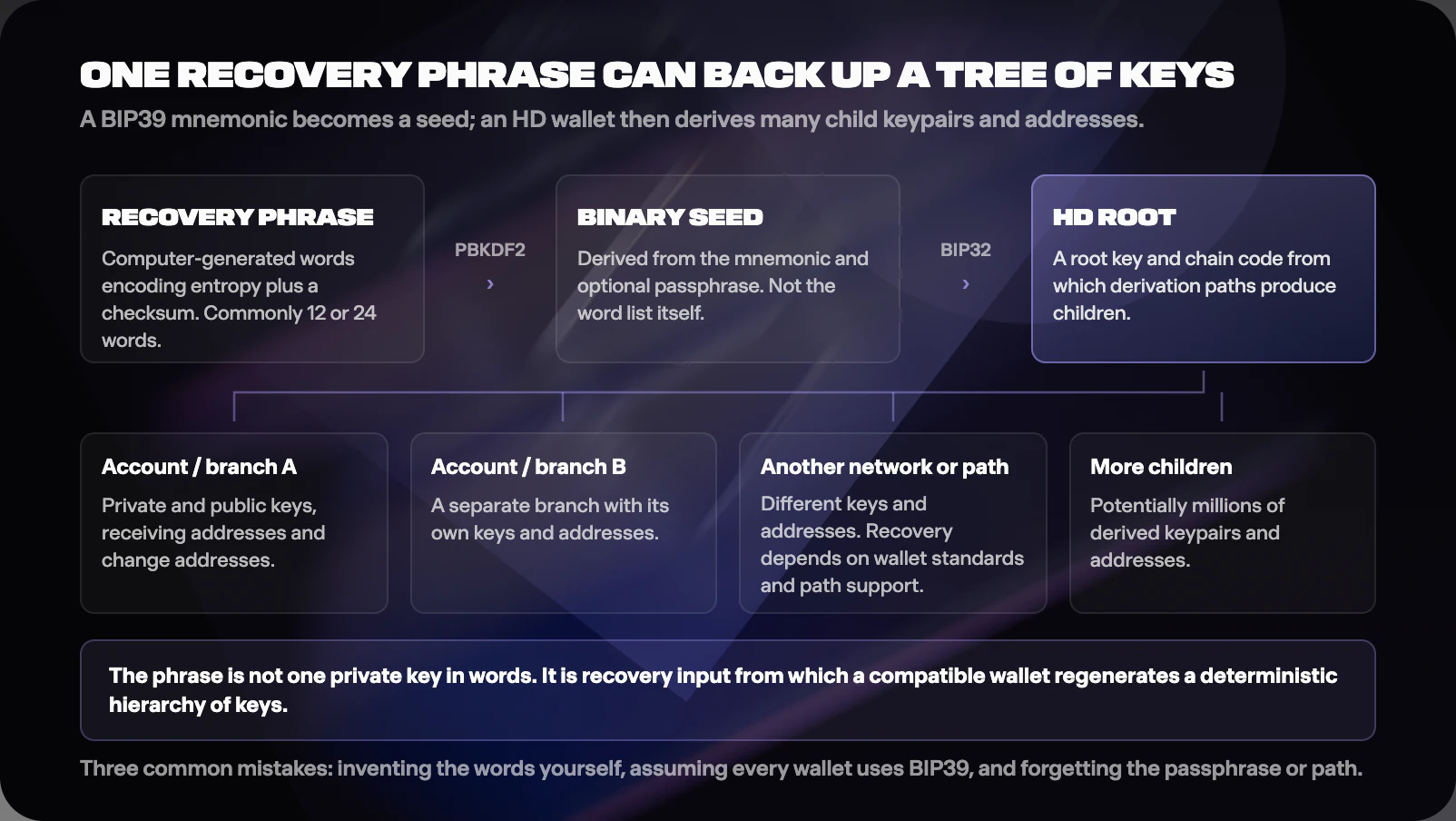
Early wallets generated and backed up many unrelated private keys. Hierarchical deterministic wallets changed the model: a root seed and chain code derive a tree of child keys. BIP32 standardised this approach for Bitcoin-compatible systems, including public-only branches that can generate receiving addresses without exposing spending keys.
Wallets then use derivation paths to separate accounts, networks, receiving addresses and change addresses. BIP44 and related standards define common conventions, but implementation choices still vary. A phrase restored into a different product may show an empty wallet until the correct derivation scheme, account index and network are selected.
Key generation should be verifiable and repeatable
The wallet should use a cryptographically secure random generator, preserve enough backup information and clearly explain recovery. Hardware wallets may generate and keep the secret inside a dedicated device. Mobile wallets may rely on operating-system secure storage. Threshold wallets may generate shares jointly so that no complete private key is ever assembled. These are different custody designs, not merely different interfaces.
Is a recovery phrase the same as a private key?
Quick answer
No. Under BIP39, the words encode wallet entropy plus a checksum. The mnemonic and an optional passphrase are processed into a binary seed, and a deterministic-wallet standard such as BIP32 derives many private keys from that seed. Anyone with the complete recovery inputs can usually reproduce the whole wallet hierarchy.
Calling the phrase "the private key in words" is memorable but technically misleading. A typical deterministic wallet contains many private keys. The phrase is a human-readable backup input for the root from which those keys are derived. BIP39 allows 12, 15, 18, 21 or 24 words depending on entropy size, although 12 and 24 are the common consumer formats. Not every wallet uses BIP39, and some custodial or smart-account systems expose no mnemonic at all.
| Credential | What it normally controls | Recovery consequence |
|---|---|---|
| One raw private key | One keypair or one signer role. | Restores only authority associated with that key; other wallet accounts may use different keys. |
| Recovery phrase / mnemonic | A deterministic wallet seed and potentially many accounts. | Restoration also depends on the optional passphrase, wallet standard, derivation paths and supported networks. |
| BIP39 passphrase | Changes the seed derived from the same words. | Every passphrase produces a valid but different wallet. There is no "incorrect passphrase" warning at the cryptographic level. |
| Wallet password or device PIN | Local encryption or device access. | Usually does not regenerate blockchain keys. A seed or recovery policy may restore the wallet if the password is forgotten. |
| Extended public key (xpub) | Derives a branch of public keys and addresses without spending. | Does not normally sign. Highly privacy-sensitive, so it should never be published casually. |
Do not forget the optional passphrase
A BIP39 passphrase is sometimes marketed as a "25th word", but it can be any supported string and is not stored inside the mnemonic. Losing it can make the intended wallet unrecoverable even when the words are correct. Recording the words without the wallet type, passphrase policy and recovery instructions can therefore create a backup that looks complete but is not.
Does one wallet contain only one keypair?
Quick answer
Usually not. A modern wallet may derive many accounts and addresses from one root seed, manage imported keys, coordinate several signers or control a smart account whose policy can change. "Wallet", "account", "address" and "keypair" are different layers.
A Bitcoin wallet often derives new receiving and change addresses to reduce address reuse and manage the UTXO model. Each address may correspond to a different child key or script. An Ethereum wallet commonly displays several externally owned accounts derived from one phrase, each with its own private key and address. A Solana wallet can manage multiple keypairs and token accounts. An exchange account may show a balance without giving the customer any blockchain private key at all.
| Term | Practical meaning |
|---|---|
| Wallet application | Software or hardware interface that constructs transactions, manages signers and tracks balances. |
| Wallet file / keystore | Stored key material or encrypted metadata used by a wallet application. |
| Account | A network or application-level record. It may be key-controlled, contract-controlled or custodial. |
| Address | A network-specific identifier for an account, output, script, contract or program-derived location. |
| Keypair | One private signing key and its corresponding public verification key. |
| Seed / recovery material | Input used to regenerate a deterministic hierarchy of keypairs. |
| Signer policy | The rule defining which keys, shares, passkeys or contracts must authorise an action. |
Takeaway: Saying "my wallet has one private key" is often wrong. Security planning should identify every root secret, signer, device, backup and recovery path that can authorise or regenerate the wallet.
How do Bitcoin, Ethereum and Solana differ?
Quick answer
They use the same broad public-key idea but different signature algorithms, account models and address rules. Bitcoin mixes ECDSA and Schnorr across output types; Ethereum EOAs use ECDSA while contracts use code-defined control; Solana standard keypairs use Ed25519 and programs can control addresses with no private key.
| Property | Bitcoin | Ethereum | Solana |
|---|---|---|---|
| Common user signature | ECDSA over secp256k1 for legacy and SegWit v0 key spends; BIP340 Schnorr over secp256k1 for Taproot. | ECDSA over secp256k1 for externally owned account transactions and EIP-7702 authorisations. | Ed25519 / EdDSA for standard keypair signatures. |
| What "address" means | Encoding of an output type: key hash, script hash, witness program or Taproot output key. | 20-byte EOA or contract identifier. EOA addresses derive from public keys; contract addresses do not. | 32-byte account address: often an Ed25519 public key, or an off-curve program-derived address. |
| Ledger model | UTXOs locked by scripts. | Account state: EOAs and contracts. | Accounts containing lamports, data, owner program and other fields. |
| Can one address require several signers? | Yes, through script policy, Taproot script paths or aggregate/threshold constructions. | Yes, through a smart-contract account or wallet policy. | Yes, through program logic or multisignature programs. |
| Can an address have no private key? | Yes, script commitments need not map to one key. | Yes, contract accounts have no private key. | Yes, PDAs are deliberately off-curve. |
Ethereum after Pectra: delegation is not key replacement
EIP-7702 allows an Ethereum EOA to delegate execution to code, enabling smart-account-like features. The EOA private key nevertheless retains full authority and can replace or remove the delegation. Delegating an EOA to multisig-style code does not turn the underlying EOA key into a true threshold requirement.
Why algorithm names matter
ECDSA, Schnorr and EdDSA all produce digital signatures, but their encodings, nonce rules, aggregation properties and verification procedures differ. A key or signature for one scheme cannot be assumed compatible with another merely because both use 32-byte values. Network software decides exactly which algorithms and encodings are valid.
What should you do if a private key or recovery phrase is exposed?
Quick answer
Treat the affected authority as permanently compromised. From a clean, trusted environment, create genuinely fresh recovery material or a new account policy and move or reassign assets as quickly as safely possible. Do not import the exposed phrase into another wallet and call it a new wallet.
The response depends on what leaked. One child private key may compromise only the associated accounts, although reuse across chains and advanced HD relationships can broaden the damage. A recovery phrase normally compromises every account derived from it, including accounts not yet displayed. A signer key in a multisig or smart account may be replaceable if enough uncompromised signers remain.
Immediate response sequence
- Stop using the possibly compromised device or browser session. Do not follow recovery links sent by anyone who contacts you.
- On a clean device, initialise a new wallet or signer policy with fresh secret material. Verify the software, network and recovery backup independently.
- Move valuable assets or rotate the signer according to the account design. A compromised key creates a race; prioritise assets and native fee tokens carefully.
- For Ethereum token approvals, remember that revocation alone does not solve a leaked private key: the attacker can sign new transactions. Move authority or assets.
- Check every network on which the same key or phrase was used, including test accounts, Layer 2 networks and less-visible token balances.
- Preserve transaction hashes, addresses, messages and device evidence. Report theft promptly to relevant custodians, exchanges and law enforcement.
- Reject anyone promising guaranteed recovery for an upfront fee. Recovery scammers systematically target known victims.
What happens if a private key is lost?
Quick answer
For a simple self-custody account, losing the only private key and every valid backup makes the funds inaccessible. The blockchain can still display the balance, but it has no identity office or password-reset mechanism. Other custody models may allow account recovery, signer rotation or threshold reconstruction.
The network does not know whether a key was lost, destroyed or intentionally abandoned. It only knows whether a valid authorisation is presented. Without one, the locked value remains part of the ledger indefinitely. This is why backup design is part of ownership rather than an optional convenience.
| Custody model | If one credential is lost |
|---|---|
| Single-key self-custody | Recover from a valid backup or recovery phrase. Without one, access is normally lost permanently. |
| Custodial exchange or service | The provider may restore account access after identity and security checks because it holds the blockchain keys. |
| On-chain multisig | Remaining signers may still satisfy the threshold and move funds or establish a new policy. |
| Smart-contract account | Recovery modules, guardians, passkeys, timelocks or administrator rules may replace a signer if designed in advance. |
| Threshold / MPC wallet | Remaining shares may continue signing or run a resharing process if the protocol and threshold allow it. |
| EIP-7702 delegated EOA | The original EOA key remains authoritative; losing it is still a fundamental failure unless another pre-arranged mechanism can act before loss. |
Succession and incapacity
A recovery plan should cover death, incapacity and loss - not only theft. The plan must give authorised people enough information to recover without creating an easy single target today. Depending on value and jurisdiction, that may involve multisignature, professional custody, sealed instructions, legal documentation or a carefully tested smart-account recovery policy. Technical recovery and legal entitlement are separate questions.
Can a private key be changed, split or replaced?
Quick answer
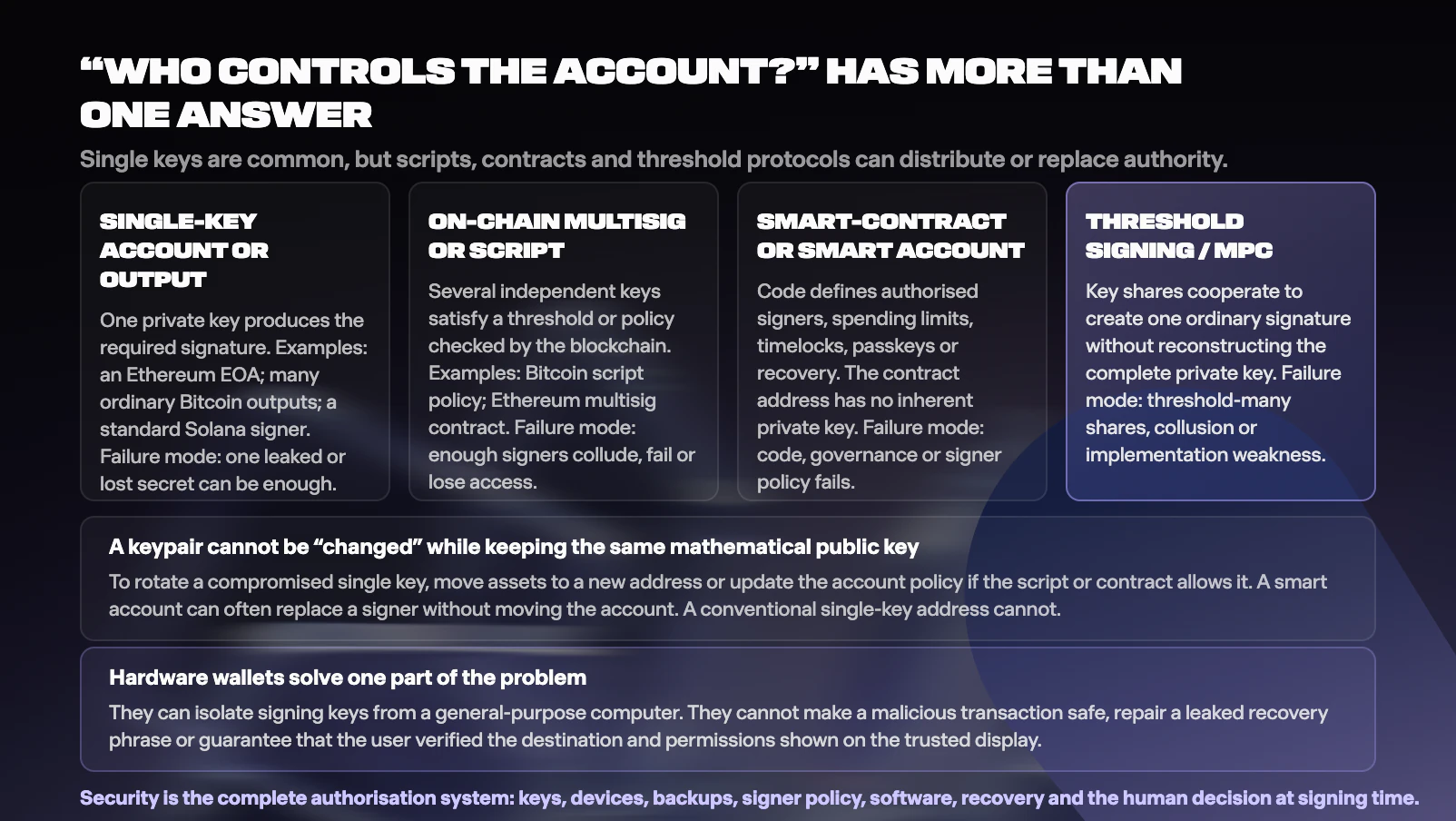
You cannot operationally rotate a conventional single-key account to an independent new secret while preserving the same keypair. Create a fresh keypair and move the assets. Scripts, multisignature contracts, smart accounts and threshold systems can instead distribute authority or replace signers while keeping an account or policy.
For practical wallet security, an independently generated replacement key has a different public key, and finding a different key that preserves a truncated address identifier is computationally infeasible under the intended security assumptions. For an ordinary single-key Bitcoin output or Ethereum EOA, key rotation therefore means transferring funds to a fresh destination. An upgradable smart-account policy may replace an authorised signer without changing the account address. A multisignature policy may require a transaction to establish a new signer set.
On-chain multisignature
The blockchain validates a policy requiring several independent signatures or contract approvals. The policy may be visible on-chain, although Taproot can hide unused script paths until spending. Multisig provides transparent rule enforcement and chain-specific recovery options, but it can cost more and expose operational structure.
Threshold signatures and MPC
A threshold protocol distributes signing shares so that a required subset cooperates to produce one ordinary signature. In a proper distributed-key-generation design, the complete private key never has to exist in one memory. The blockchain may see a normal signature rather than a multisig policy. Security then depends heavily on protocol choice, independent share environments and implementation quality.
Smart accounts and passkeys
Contract-based accounts can validate several signature schemes, passkeys, spending limits, sessions, guardians or delayed recovery. This can improve usability and key rotation, while adding code, upgrade and governance risks. A contract address is therefore controlled by policy, not by an inherent public-private keypair.
What do hardware wallets protect?
Quick answer
A hardware wallet is a signing device designed to keep private key material away from a general-purpose computer and to show transaction details on a trusted display. It reduces remote key-extraction risk, but it does not protect an exposed recovery phrase or stop the owner from authorising a malicious transaction.
The strongest hardware-wallet benefit is separation. The computer or phone can prepare an unsigned transaction while the device holds the secret and performs signing internally. Even if the host is compromised, the attacker should still need the user to approve on the device. This only works when the user verifies the destination, amount, network and relevant contract permissions on the trusted screen.
Limits that matter
- Recovery phrase compromise bypasses the device. Anyone with the phrase can recreate the keys elsewhere.
- Blind or unreadable signing can authorise malicious approvals, permits or contract calls even when the key never leaves the device.
- A substituted destination on the computer can succeed if the user confirms it without checking the hardware display.
- Firmware, supply chain, physical access and backup procedures remain part of the threat model.
- A single hardware wallet plus one phrase can still be a single point of failure. Multisig or threshold designs address a different problem.
- No device protects against asset price risk, fraudulent counterparties, compromised smart contracts or a mistaken network choice.
Takeaway: Hardware isolation is valuable, but "keys stayed offline" is not the same as "the transaction was safe". The trusted display and the user's verification decision are part of the security boundary.
What do quantum computers mean for crypto keys?
Quick answer
ECDSA, Schnorr and Ed25519 are not designed to resist a sufficiently large fault-tolerant quantum computer. Such a machine could in principle use Shor's algorithm to recover elliptic-curve private keys from public keys. No publicly known quantum computer can do this today, and practical risk depends on future hardware, protocol migration and when public keys are exposed.
NIST's FIPS 186-5 explicitly notes that its classical signature algorithms are not expected to resist a large-scale quantum computer. NIST has separately standardised post-quantum signatures including ML-DSA and SLH-DSA. These standards do not automatically upgrade a blockchain: each network needs compatible addresses, signature validation, wallet support and a migration path for existing funds.
The often-repeated claim that "unused addresses are quantum safe because only the hash is public" is not universally reliable. Address types differ; Taproot output keys and Solana signer public keys are visible, Ethereum public keys can often be recovered from signatures after use, and funds may be moved or exposed in different ways. Hashing can delay some forms of public-key exposure, but it is not a complete migration strategy.
What users should do now
- Do not panic or move funds to an unreviewed "quantum-safe" product marketed through urgency.
- Keep wallet software and signing devices supported so they can adopt future network migration tools.
- Avoid unnecessary address reuse where the network's wallet model recommends fresh addresses.
- Follow official protocol and wallet guidance if a migration is announced; verify destinations and deadlines independently.
- For long-lived institutional custody, include cryptographic agility and migration authority in governance planning.
Frequently asked questions
What is a private key in one sentence?
A private key is secret cryptographic material used to create signatures that satisfy an account or output's authorisation rules. It must remain secret because possession may be enough to move assets in a single-key design.
What is a public key in one sentence?
A public key is verification data derived from a private key. It lets anyone check matching signatures without learning the private key or gaining the ability to sign.
Is a wallet address the same as a public key?
Not generally. An address may encode a public key, a public-key hash, a script or witness program, a contract identifier, or a program-derived address. On Solana, a standard signer address is the public key itself; on Ethereum, contract addresses have no corresponding private key.
Can someone steal crypto with only my wallet address?
Normally no. An address grants no signing authority. It can reveal balances and transaction history, enable targeted scams or be used in address-poisoning attempts, so it is public but not always privacy-neutral.
Can someone calculate my private key from my public key?
Not with known practical classical methods when a secure supported curve and correct implementation are used. The problem is computationally infeasible at current security levels. A future large fault-tolerant quantum computer would change that assumption, which is why migration planning matters.
Is a seed phrase the same as a private key?
No. A recovery phrase normally encodes entropy used to derive a seed, and a deterministic wallet derives many private keys from that seed. The phrase is often more powerful than one raw private key because it can recreate the whole wallet hierarchy.
What is the difference between a wallet password and a private key?
A wallet password or PIN usually unlocks local software, decrypts a keystore or authorises a device. The private key is the blockchain signing authority. Forgetting a password may be recoverable with the wallet's backup; losing the only signing key is not.
Can I change my private key without changing my address?
Not for a conventional mathematical keypair. A different private key produces a different public key. A smart-contract wallet or other policy-controlled account may replace an authorised signer while retaining the same account address.
Why does my Bitcoin wallet generate a new address?
Hierarchical deterministic Bitcoin wallets derive many receive and change addresses from one root seed. Using fresh addresses reduces simple address reuse and helps the wallet manage separate UTXOs without requiring a new independent backup each time.
Should I share an extended public key?
Only with a trusted system when you understand the privacy consequences. An extended public key can allow monitoring and derivation of an entire public branch of addresses even though it normally cannot spend funds.
Does a hardware wallet store my coins?
No. The blockchain records the assets. A hardware wallet stores or protects signing material and approves transactions. Its recovery phrase or other backup can recreate the authority on another compatible device.
The bottom line
Private keys, public keys, addresses and recovery phrases are connected, but they are not interchangeable. The private key or signing share creates authority. The public key verifies it. The address identifies a network destination or spending condition. The recovery system regenerates or replaces the authority when the original device fails. Confusing these layers produces both bad explanations and expensive mistakes.
The durable security habit is to protect the whole signing system rather than one string. Generate keys with trusted software or hardware. Keep recovery material private and tested. Verify the exact transaction on a trusted display. Treat signatures as powerful authorisations, including off-chain ones. Use a custody model whose recovery and failure modes you actually understand.
Sources and further reading
Key references for this article, current as of July 2026.
- NIST FIPS 186-5 - Digital Signature Standard. https://csrc.nist.gov/pubs/fips/186-5/final
- Bitcoin Developer Guide - Wallets. https://developer.bitcoin.org/devguide/wallets.html
- Bitcoin Developer Guide - Transactions. https://developer.bitcoin.org/devguide/transactions.html
- BIP 340 - Schnorr Signatures for secp256k1. https://bips.dev/340/
- BIP 341 - Taproot: SegWit version 1 spending rules. https://bips.dev/341/
- BIP 32 - Hierarchical Deterministic Wallets. https://bips.dev/32/
- BIP 39 - Mnemonic code for generating deterministic keys. https://bips.dev/39/
- Ethereum.org - Ethereum accounts. https://ethereum.org/developers/docs/accounts/
- Ethereum.org - Security and scam prevention. https://ethereum.org/security/
- Ethereum.org - Pectra EIP-7702 guidelines. https://ethereum.org/roadmap/pectra/7702/
- Solana documentation - Account structure. https://solana.com/docs/core/accounts
- Solana documentation - Program Derived Addresses. https://solana.com/docs/core/pda
- RFC 8032 - Edwards-Curve Digital Signature Algorithm. https://www.rfc-editor.org/info/rfc8032/
- NIST FIPS 204 - Module-Lattice-Based Digital Signature Standard. https://csrc.nist.gov/pubs/fips/204/final
Quick quiz: did it stick?
A few questions to check the fundamentals landed. Answers with explanations follow, and nobody is grading you except your future portfolio.


You have completed a quiz on “Private Keys vs Public Keys Explained”! Share your achievement on social media.
 Was this helpful?