TL;DR
- It is a human-writable encoding of your wallet's root entropy, standardised so that one phrase, written once, together with the wallet's settings, backs up the keys the wallet derives. It exists because raw keys were unwritable and early wallets lost people's money.
- Because the phrase is complete, portable and final: one reader gains everything, one loss with no copy forfeits everything, and no authority exists to undo either. Both catastrophic outcomes route through the same single object.
- Keep it physical, never digital; store copies in separated places; consider durable media and, for larger sums, a passphrase or threshold splitting; tell your estate where instructions are without telling anyone the words. Discipline cannot remove the structure, and it can price the risk down substantially.
- They refuse to let a single complete secret exist: key shares split across devices and parties, guardian quorums for recovery, and multisignature arrangements each ensure that no one object, person or sentence can either steal or strand the wallet. The single point of failure is removed structurally rather than managed bravely.
In one block
A seed phrase, also called a recovery phrase, is a sequence of words, twelve to twenty-four under the BIP39 standard, that encodes the entropy from which a wallet mathematically derives its private keys.
What is a seed phrase, and why do wallets use one?
Quick answer
It is a human-writable encoding of your wallet's root entropy, standardised so that one phrase, written once, together with the wallet's settings, backs up the keys the wallet derives. It exists because raw keys were unwritable and early wallets lost people's money.
The problem it solved is worth a paragraph, because the design makes no sense without it. A private key is a very large number; humans cannot write hundreds of digits reliably, and early wallets generated a fresh key for every address, so a backup made on Monday missed the keys created on Tuesday. People lost funds to exactly that gap.
The fix arrived in two open standards: BIP32 in 2012 defined hierarchical deterministic wallets, and BIP39 in 2013 defined the mnemonic. Generate entropy and encode it as words drawn from a fixed list of 2,048, in lengths of 12, 15, 18, 21 or 24 words, with a built-in checksum so most copying mistakes are caught; the mnemonic is then transformed, through the PBKDF2 function together with any optional passphrase, into a 512-bit seed from which keys are derived deterministically, meaning the same seed and settings always produce the same keys. Now one backup, made once, covers the wallet's keys for life, and because the standards are open, the phrase can restore your funds in other compliant software, even if the company that made your wallet disappears.
Genuinely admire this before we criticise it. The seed phrase made self-custody survivable for ordinary people, freed them from proprietary backup formats, and has carried trillions of dollars of value on handwriting. The words themselves are ordinary, "ripple", "canyon", "lecture", deliberately common so they can be written and read without error, and the order matters, because the sequence, never the individual words, is the secret.
One mechanical consequence sets up everything that follows: the phrase does not "unlock" your wallet the way a password unlocks an account. It is the wallet's root secret. Restoration asks no questions, needs no permission, and works for whoever types it, wherever they are. One practical caveat belongs here rather than in the small print: full restoration also depends on settings the phrase itself does not carry, the optional passphrase, derivation paths, and address types, so a serious backup records those alongside the words, and the safest restoration is into the same wallet software or one documented as compatible.
Why is one phrase a single point of failure?
Quick answer
Because the phrase is complete, portable and final: one reader gains everything, one loss with no copy forfeits everything, and no authority exists to undo either. Both catastrophic outcomes route through the same single object.
Take the two failure directions one at a time, as this cluster's other articles do.
Theft first. The phrase is the wallet, so exposure equals transfer. A photograph synced to a cloud album, a phrase typed into a "wallet verification" page, a note found in a drawer by the wrong visitor, a "support agent" who asks you to read the words out: each is the complete heist, no malware required. Attackers know this, which is why phishing for phrases is an industry, documented in this academy's scam guides, and why the coercion scenarios in the physical security article centre on one recitable sentence. Copies multiply this surface: every backup you make against loss is another object a thief can find.
Loss second, and quieter only because nobody reports it. Paper burns, floods and fades; safe places are forgotten; house moves throw out shoeboxes; and people die without telling anyone what the words were for, a failure the inheritance article treats at length. With no phrase and no surviving device, the assets are not frozen or confiscated; they simply become unspendable entries on a public ledger. River's 2025 analysis estimates roughly 1.57 million bitcoin as likely permanently lost, with the caveat that dormancy cannot prove the amount or identify causes; the failures documented case by case are of this ordinary kind.
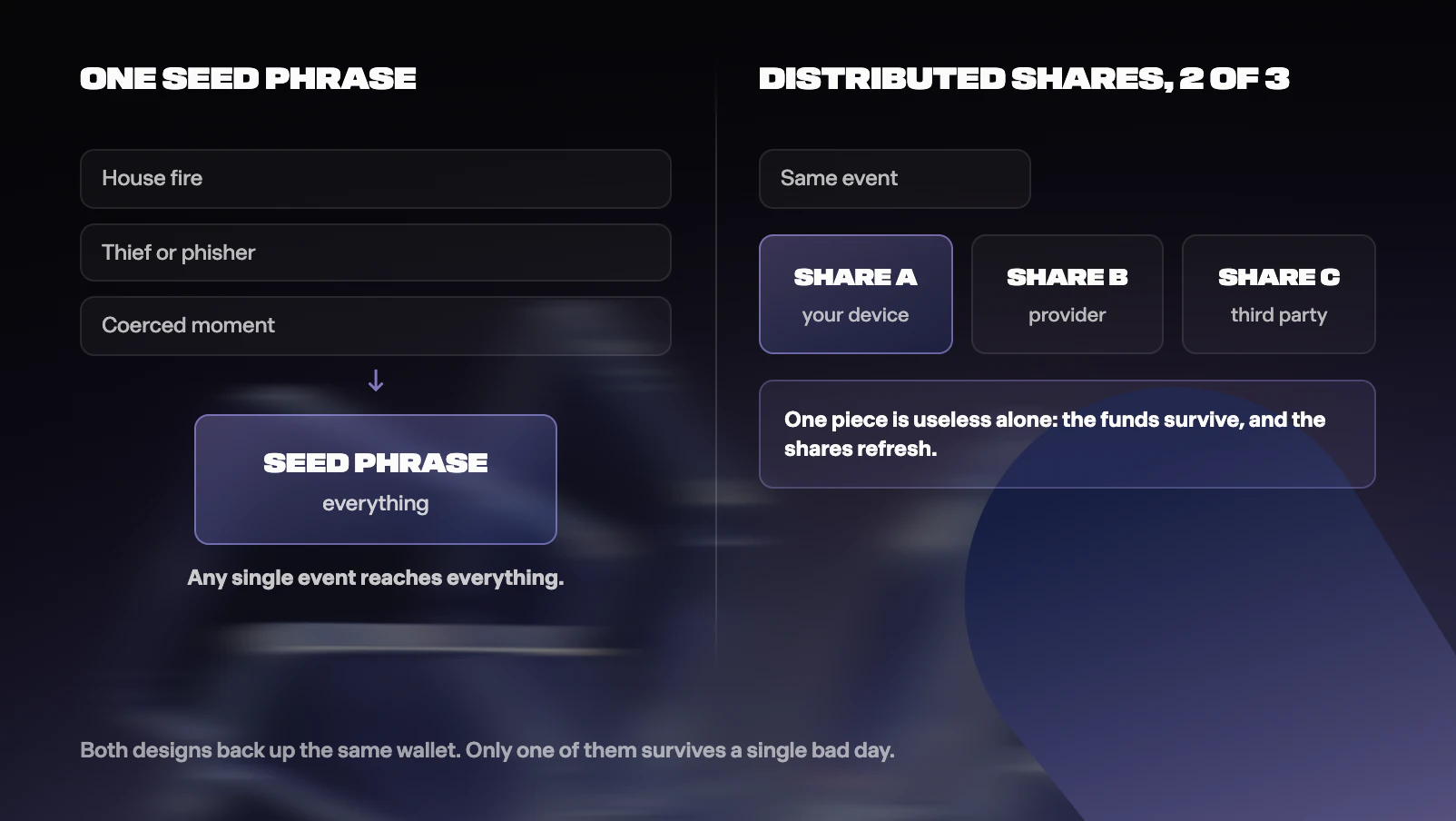
Now put the two directions together, because that is the actual trap. Every action that reduces loss risk, more copies, more accessible storage, a trusted person told, increases theft risk; every action that reduces theft risk, fewer copies, better hiding, telling no one, increases loss risk. With a single object there is no move that improves both. That is what engineers mean by a single point of failure, and why the phrase's weakness is structural rather than a matter of carelessness. Careful people fail at this too; the design gives care only one place to stand.
How do you handle a seed phrase well, if you have one?
Quick answer
Keep it physical, never digital; store copies in separated places; consider durable media and, for larger sums, a passphrase or threshold splitting; tell your estate where instructions are without telling anyone the words. Discipline cannot remove the structure, and it can price the risk down substantially.
These practices are the settled consensus of this academy's sources, and they matter for the millions of wallets that run on phrases today.
Never digital, in any form. No photographs, no cloud notes, no password managers holding the raw phrase, no typing it into any website or app except a wallet you are deliberately restoring. Digital copies inherit every breach, sync and malware risk of wherever they live, and phrase-phishing is one of the most common documented ways holders are robbed. A wallet that asks for your phrase outside of restoration is an attack, every time.
Physical, durable and separated. Handwrite legibly, or use metal backup plates sold for the purpose, fire and flood outlast paper. Keep at least two copies in genuinely separate locations, so no single event reaches both, and check them on a schedule; an unreadable backup discovered during an emergency is not a backup. Verify the phrase once by restoring a trivial balance, the rehearsal rule this cluster repeats everywhere.
Escalate protections with value, and understand the mechanics before trusting them. An optional BIP39 passphrase, often marketed as a "25th word" though it is in fact any text you choose, means the phrase alone restores the base wallet, which a careful user can fund lightly and present as a decoy, while phrase plus passphrase restores the separate hidden wallet holding the real balance: real protection against theft and coercion, with two sharp edges. Every passphrase, including a mistyped one, silently produces a valid, empty-looking wallet with no error message, and a passphrase that dies with its only holder strands the funds, so it demands exactness and its own succession plan. Threshold splitting under the SLIP39 standard takes a different route: it encodes a master secret directly as mnemonic shares, where, say, any two of three restore and one alone reveals nothing. It is chiefly an alternative to BIP39 rather than a way of cutting an existing phrase into pieces, so moving an existing wallet to it means migrating to a new seed, with the trade-offs that implies.
And connect the phrase to your mortality: the inheritance article covers the designs, and the minimum is an instruction letter with your estate papers saying what exists and how heirs should proceed, containing no secret words itself.
What do designs without a seed phrase do instead?
Quick answer
They refuse to let a single complete secret exist: key shares split across devices and parties, guardian quorums for recovery, and multisignature arrangements each ensure that no one object, person or sentence can either steal or strand the wallet. The single point of failure is removed structurally rather than managed bravely.
The phrase's dilemma, every copy fights loss and feeds theft, has a structural exit: make the thing that restores the wallet plural, so that useful power exists only in combination. This cluster covers each design in depth; here is how they retire the phrase.
MPC wallets built on threshold signing produce signatures without reconstructing a whole key. Where their setup uses distributed key generation the shares are created independently and no complete key exists even at the start; some setups instead use a trusted dealer that makes the key and then splits it, so this is a property to confirm for a given product rather than assume. In the common consumer shape the key material is held as shares, often two-of-three across your device, the provider's infrastructure and an independent party, and signing is a cooperation that produces one normal signature without the shares assembling. Either way there is no seed phrase, because no single master secret is kept for one to encode. Lose your phone and the remaining shares restore you, with helpers, often called guardians, whose only power is confirming your identity; shares are then refreshed so the lost one dies. A thief with any single share, including the provider with its own, holds mathematical noise. The custody article in this cluster locates this design on the spectrum: in sound implementations it functions as self-custody, with the famous fragility engineered out, the signer and recovery arrangement being what to verify.
Multisignature arrangements reach a similar property with several complete keys and an m-of-n rule enforced by the blockchain itself: two-of-three keys, held on separate devices in separate places, mean one stolen key moves nothing and one lost key strands nothing. The multisig article details the craft; the relevant point here is that each key's backup can be simpler precisely because no single backup is total.
Guardian-based social recovery, in smart account wallets, lets a quorum of parties you chose restore access if you lose everything, with delays and notifications so misuse is visible. Recovery becomes a governed process rather than a hidden sentence.
The fair summary for a novice deciding today: the seed phrase remains a sound, universal standard, and handled with the discipline above it serves millions well. What has changed is that its central trade-off is now optional. Designs in ordinary consumer wallets let self-custody work without any single secret to guard, lose or surrender, and the rest of this cluster is the map of how they do it.
Frequently asked questions
Is a seed phrase the same as a password?
No, and the difference is the whole point. A password gates an account held by someone who can reset it; a seed phrase IS the wallet, restoring it for anyone, anywhere, with no reset, no support desk and no undo. Treat the two categories completely differently: passwords are for accounts, and the phrase is the asset itself in written form.
My wallet never gave me a seed phrase. Should I be worried?
Probably the opposite: check what design it uses. Reputable MPC and smart account wallets deliberately have no phrase because their designs avoid a single master secret, and provide a different, documented recovery path, shares, guardians or backups, instead. The step to take is reading and rehearsing that recovery path now. Be cautious only if a wallet has neither a phrase nor any explained recovery design at all.
Can I store my seed phrase in a password manager if it has strong encryption?
The consensus of this academy's sources is no for the raw phrase: you would concentrate the master secret inside one online account whose breach, sync and recovery behaviour you do not control, and phrase theft is among the most commonly documented robberies in self-custody. If a phrase must exist, keep it physical and separated, or split it under a proper threshold standard rather than storing it whole anywhere digital.
Someone asked for my phrase to "validate" or "sync" my wallet. What is happening?
An attempted theft, with complete certainty. No legitimate wallet, exchange, support agent or official will ever need your words: possession lets anyone sign and move the funds, so the request is the attack. Disengage, and if you have already entered the phrase somewhere, treat the wallet as compromised and move remaining funds to a fresh one immediately, as the incident response article in this academy details.
If I switch to a wallet without a seed phrase, what happens to my old one?
Nothing automatic: assets move only when you send them. The clean migration is to set up and rehearse the new wallet, transfer a small test amount, then move the balance and retire the old wallet. The old phrase remains able to restore the old, now empty, wallet forever, so either destroy its copies or keep treating them as sensitive until you do.
Sources and further reading
Key references for this article, current as of July 2026. Volatile figures are re-checked at each quarterly review.
- BIP39 (2013), Mnemonic code for generating deterministic keys: word lengths, checksum, PBKDF2 seed derivation and passphrase behaviour. https://github.com/bitcoin/bips/blob/master/bip-0039.mediawiki
- RFC 9591 (FROST threshold signatures): threshold signing need not reconstruct the key, and setup may use a trusted dealer or distributed key generation. https://www.rfc-editor.org/rfc/rfc9591.html
- BIP32 (2012), Hierarchical deterministic wallets. https://github.com/bitcoin/bips/blob/master/bip-0032.mediawiki
- SLIP39, Shamir's secret sharing for mnemonic codes: master-secret shares and BIP39 migration limitations. https://github.com/satoshilabs/slips/blob/master/slip-0039.md
- Investopedia, seed phrases explained. https://www.investopedia.com/what-is-a-seed-phrase-7098772
- River, Bitcoin Custody Report 2025: dormancy-based loss heuristics and stated limitations. https://river.com/content/bitcoin-custody-report-2025
- Chainalysis, 2026 Crypto Crime Report: phishing and theft context. https://www.chainalysis.com/blog/2026-crypto-crime-report-introduction/
- ScamSniffer, phrase-phishing and drainer reporting. https://drops.scamsniffer.io/
- NIST, Threshold Cryptography project. https://csrc.nist.gov/projects/threshold-cryptography
- Vitalik Buterin, Why we need wide adoption of social recovery wallets. https://vitalik.eth.limo/general/2021/01/11/recovery.html
- ethereum.org, account abstraction and smart accounts. https://ethereum.org/en/roadmap/account-abstraction/
- Wikipedia, deterministic wallet. https://en.wikipedia.org/wiki/Deterministic_wallet
- FBI IC3, theft reporting channels. https://www.ic3.gov
Quick quiz: did it stick?
A few questions to check the fundamentals landed. Answers with explanations follow, and nobody is grading you except your future portfolio.


You have completed a quiz on “What Is a Seed Phrase, and Why Is It a Single Point of Failure?”! Share your achievement on social media.
 Was this helpful?