
TL;DR
- Cryptocurrency is a digital asset recorded and transferred using a blockchain or similar cryptographically secured ledger. Public cryptocurrencies can operate without one institution controlling the ledger, but the degree of decentralisation, governance and legal rights varies widely.
- A transaction is created and reviewed, authorised with a private key or signing policy, submitted to the network, checked against protocol rules, ordered into a block or ledger update, and then confirmed or finalised. The exact mechanics vary by blockchain and wallet model.
- A blockchain is an ordered ledger whose updates are grouped into blocks linked to prior history by cryptographic commitments. Hash links make tampering detectable; validation, consensus and finality make an altered history difficult or economically costly to establish as the accepted one.
- Fiat money is issued under public law and usually moves through regulated institutions. Crypto assets follow protocol or issuer rules and may settle on public networks. The differences concern issuance, ledger control, access, reversibility, privacy, legal claims and consumer protection - not simply "bank versus no bank."
In one block
Cryptocurrency is a class of digital assets whose ownership and transfer are recorded on a cryptographically secured distributed ledger. A wallet or custodian uses private keys to authorise transactions, while network participants validate and order them under shared rules.
What is cryptocurrency in simple terms?
Quick answer
Cryptocurrency is a digital asset recorded and transferred using a blockchain or similar cryptographically secured ledger. Public cryptocurrencies can operate without one institution controlling the ledger, but the degree of decentralisation, governance and legal rights varies widely.
The word cryptocurrency is often used as if every crypto asset were a new form of money. That is too narrow. Bitcoin was designed as peer-to-peer electronic cash, while Ether is also used to pay for computation and secure Ethereum. Stablecoins aim to track a national currency. Other tokens may provide voting rights, access to software, a claim on off-chain assets, or no enforceable right at all.
A useful working definition is therefore broader: a crypto asset is a digitally represented asset or right that is issued, stored or transferred using a blockchain or similar distributed-ledger system. The ledger records the state of the system - for example, which addresses control particular balances, tokens or permissions. The rules for updating that state are enforced by software run by network participants or by authorised operators, depending on the design.
Public blockchains such as Bitcoin and Ethereum are open for anyone to inspect and, subject to protocol rules, use. They have no single database administrator with unilateral power over the ledger. That does not mean "nobody controls anything." Developers propose software changes; miners or validators order transactions; node operators choose which software to run; issuers may control stablecoin reserves or token contracts; and communities sometimes coordinate during emergencies. Decentralisation is a spectrum, not a magic switch.
The simplest comparison is with ordinary digital money. Most bank money is already a database entry. A payment changes records held by banks and payment networks. Crypto changes the record-keeping model: the accepted state can be checked against public rules by many independent participants rather than being maintained only inside one institution. Whether that trade-off is useful depends on the job.
How does cryptocurrency work, step by step?
Quick answer
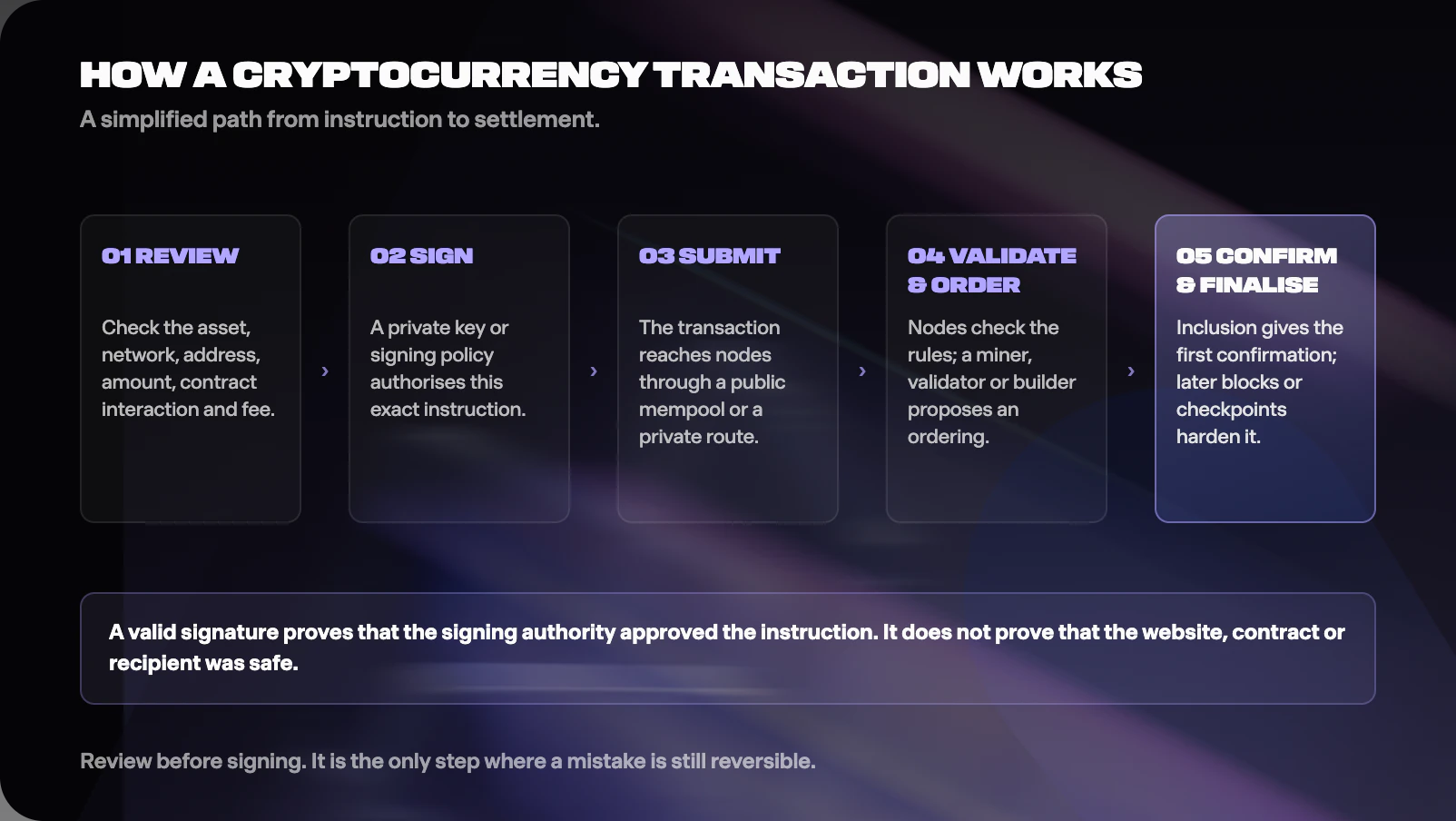
A transaction is created and reviewed, authorised with a private key or signing policy, submitted to the network, checked against protocol rules, ordered into a block or ledger update, and then confirmed or finalised. The exact mechanics vary by blockchain and wallet model.
Consider a self-custody transaction. You choose an asset, recipient, network, amount and fee. The wallet converts that intent into a structured instruction. On Ethereum, the instruction can transfer ETH or call a smart contract; on Bitcoin, it spends one or more unspent transaction outputs and creates new outputs. A custodial platform may instead update its own internal database and only use the blockchain when deposits or withdrawals occur.
Review the instruction
The transaction should identify the correct asset and network, the recipient or contract, the amount, the maximum fee and any permissions being granted. This is the human safety checkpoint. A wallet can faithfully sign a harmful instruction, so "the signature is valid" is not the same as "the transaction was wise."
Authorise it
A private key creates a digital signature tied to the transaction data. Nodes can verify that the matching signing authority approved the instruction without learning the private key. Some wallets use a single key; others use multisignature rules, smart accounts, hardware devices or threshold systems. In a custodial account, the service normally controls the signing keys and acts after authenticating the user.
Submit and propagate it
The signed transaction is sent to one or more nodes. Many public transactions enter node mempools - local queues of valid, unconfirmed transactions - and propagate peer to peer. There is no single global mempool, and some transactions travel through private relays or directly to block builders. Fee level, dependencies, network policy, private order flow and maximal extractable value can all affect inclusion.
Validate and order it
Nodes check signatures and protocol rules. Bitcoin nodes verify that referenced outputs exist and have not already been spent. Ethereum nodes execute the transaction against the current account and smart-contract state. A miner, validator or specialised block builder proposes an ordering, but every validating node independently checks whether the resulting block is valid.
Confirm or finalise it
Inclusion in a block is the first confirmation, not an absolute guarantee. Networks can briefly disagree at the chain tip, and a shallow reorganisation can replace a recent block. Bitcoin assurance increases probabilistically as more proof of work accumulates. Ethereum uses proof-of-stake checkpoints: finality requires support from at least two-thirds of staked ETH and reversing a finalised block would trigger severe economic penalties. Exact waiting thresholds depend on the chain, service and value at risk.
What is a blockchain, and why are records hard to change?
Quick answer
A blockchain is an ordered ledger whose updates are grouped into blocks linked to prior history by cryptographic commitments. Hash links make tampering detectable; validation, consensus and finality make an altered history difficult or economically costly to establish as the accepted one.
A block is not a universal container with one fixed anatomy. Bitcoin and Ethereum blocks contain different fields, and other networks use different structures. At a high level, a block commits to a set or sequence of transactions, a previous block or state, and additional data required by that protocol. A cryptographic hash acts like a compact fingerprint: even a small change to the underlying data produces a different result.
Hash links alone do not make a database immutable. Anyone can copy old blocks, edit them and recalculate hashes on their own computer. The security question is whether that altered history can satisfy the network's validation rules and overtake or replace the history accepted by honest participants. Proof of work makes replacement require enormous ongoing computation; proof of stake combines validator voting, penalties and finality checkpoints. Permissioned ledgers may instead rely on identified operators and governance agreements.
Public blockchains can also experience temporary forks. Two valid blocks may appear close together, different nodes may briefly see different tips, and a fork-choice rule resolves the disagreement. That is why recent transactions are described in confirmations or finality states rather than as instantly irreversible.
The strongest accurate claim is not that a blockchain "cannot be changed." It is that settled history on a well-secured network is designed to be computationally, economically or institutionally difficult to replace under stated assumptions. Those assumptions include correct cryptography, robust software, sufficiently independent participants and no attacker controlling the relevant security threshold.
How is cryptocurrency different from regular money?
Quick answer
Fiat money is issued under public law and usually moves through regulated institutions. Crypto assets follow protocol or issuer rules and may settle on public networks. The differences concern issuance, ledger control, access, reversibility, privacy, legal claims and consumer protection - not simply "bank versus no bank."
Both systems are mostly digital, and both depend on records, software and institutions. The useful comparison is therefore not whether one is "real." It is which rules govern the asset, who maintains the ledger, what legal claim the holder has, who can authorise movement, and what happens when something goes wrong.
| Dimension | Regular money and finance | Crypto assets and public blockchains |
|---|---|---|
| Issuer or monetary authority | Governments and central banks issue fiat currency; commercial banks create deposits under regulation. | Varies: protocol issuance, a private issuer, collateralised token, tokenised legal claim or no issuer. |
| Ledger and operators | Banks, central banks, payment networks and market infrastructures maintain private or permissioned records. | Public networks may be validated by independent nodes; permissioned ledgers and token contracts may have administrators. |
| Access and control | Account credentials plus institutional identity and recovery processes. | Private keys, smart-account rules or a custodian's signing system. |
| Settlement and reversibility | Card and bank-payment layers may permit recalls, chargebacks or legal reversal; final settlement timing varies. | Public-chain transactions become increasingly difficult to reverse; application or issuer-level intervention may still exist. |
| Availability | Consumer interfaces may be 24/7, while some banking and securities settlement windows remain limited. | Public networks generally operate continuously, although exchanges, bridges and issuers can pause or restrict services. |
| Privacy | Institutions normally know customer identities; transaction data is not public by default. | Public-chain activity is often transparent and pseudonymous; privacy varies by network and service. |
| Supply | Managed through monetary and banking policy. | Defined by protocol or issuer rules and may be fixed, variable, inflationary, deflationary or discretionary. |
| Protections | Deposit protection, fraud processes, disclosure and legal recourse may apply, depending on product and jurisdiction. | Protections vary widely and may be limited or absent; regulation does not guarantee solvency or recovery. |
Crypto does not necessarily remove intermediaries. Many users rely on exchanges, wallet providers, stablecoin issuers, bridge operators, custodians, oracles, validators and internet infrastructure. What public blockchains can remove is the need for one exclusive ledger keeper to approve every valid state transition. That is a narrower and more useful claim.
Where does cryptocurrency get its value?
Quick answer
Crypto assets have different value drivers: scarcity and monetary policy, demand for network use and block space, claims on reserves or off-chain assets, governance or access rights, network effects, liquidity and speculation. No single explanation applies to every token.
Price is set by marginal buyers and sellers, but a serious value analysis asks what creates durable demand and what constrains supply. Those answers differ sharply across asset types.
Bitcoin and monetary assets
Bitcoin's supply rules cap issuance at approximately 21 million units, subject to the network continuing to enforce the same consensus rules. Many holders therefore view bitcoin as a scarce, portable bearer asset or "digital gold." That description is an investment thesis based on scarcity, security, liquidity and social acceptance - not an objective guarantee that price will rise or remain stable.
Ether and network assets
Ether is used to pay transaction fees on Ethereum and can be staked to participate in network security. Demand can be influenced by application use, block-space demand, staking economics and monetary policy. Ether is not equity in Ethereum, and holding it does not create a legal claim on a company's profits.
Stablecoins
Stablecoins aim to track a reference asset, most often the US dollar. Fiat-backed designs depend on the quality, custody, liquidity and legal treatment of reserves and on the issuer's redemption process. Crypto-collateralised designs depend on smart contracts, collateral and liquidation mechanisms. Algorithmic designs rely more heavily on incentives and market confidence. A stable price target does not make a token equivalent to insured bank cash.
Utility, governance and tokenised claims
Some tokens grant access to software, influence protocol governance or represent a contractual claim on assets such as fund shares or debt instruments. The legal and economic rights must be read from the relevant documents and jurisdiction. A ticker symbol and active market do not, by themselves, create intrinsic value.
Network effects and speculation matter across every category. Liquidity, exchange access, developer activity, brand recognition and expectations can support demand; hype and leverage can also detach price from any durable use. Rather than asking why crypto is worth anything, the sharper question is what rights, utility, scarcity and risks support this particular asset.
What can cryptocurrency be used for?
Quick answer
Common uses include transferring value on public networks, accessing dollar-linked tokens, settling tokenised assets, using blockchain applications, participating in network security, and gaining investment exposure. Each use adds specific legal, technical, market and custody risks.
Payments and cross-border transfers
Public networks can move value continuously across borders without both parties using the same bank. Stablecoins reduce exchange-rate volatility relative to unpegged assets and can be useful where conventional dollar access or settlement is limited. Total cost still includes network fees, exchange spreads, on- and off-ramp fees, compliance checks, issuer risk and the risk of using the wrong network or address.
Access to stable-value assets
People in some markets use dollar-linked stablecoins for commerce or savings. That can reduce exposure to a weak local currency, but it replaces local-currency risk with stablecoin, custodian, technology and regulatory risk. Redemption rights and reserve protections vary, and a stablecoin is not automatically a bank deposit.
Decentralised applications and finance
Smart-contract networks support trading, lending, borrowing, derivatives, games, identity systems and other applications. "Decentralised" does not mean risk-free or company-free: applications may depend on administrator keys, front-end websites, oracles, bridges, governance votes and legal entities. Code can execute exactly as written and still contain a vulnerability or produce an outcome the user did not understand.
Tokenisation and settlement
Funds, bonds, deposits, commodities and other claims can be represented as tokens. The blockchain can improve transferability, auditability or settlement coordination, but the token's value ultimately depends on enforceable off-chain rights, asset custody and the issuer's obligations. The ledger can prove that a token moved; it cannot by itself guarantee that the underlying asset exists or that a court will recognise the claim.
Investment exposure
Some people buy crypto assets directly; others use exchange-traded products or other regulated wrappers. In the United States, the SEC approved the listing and trading of spot bitcoin exchange-traded products in January 2024. These products remove personal key management but introduce product fees, intermediary and tracking considerations, and they do not remove the underlying asset's volatility.
Where crypto remains a poor fit
A normal database is usually faster, cheaper and easier to govern when one trusted organisation already owns the process. Volatile assets are awkward units of account for everyday pricing. Public ledgers can expose sensitive activity. Irreversible settlement is dangerous when fraud resolution matters. A blockchain is useful when shared verification and constrained control justify the added complexity - not because the word blockchain is attached.
What are the main types of crypto assets?
Quick answer
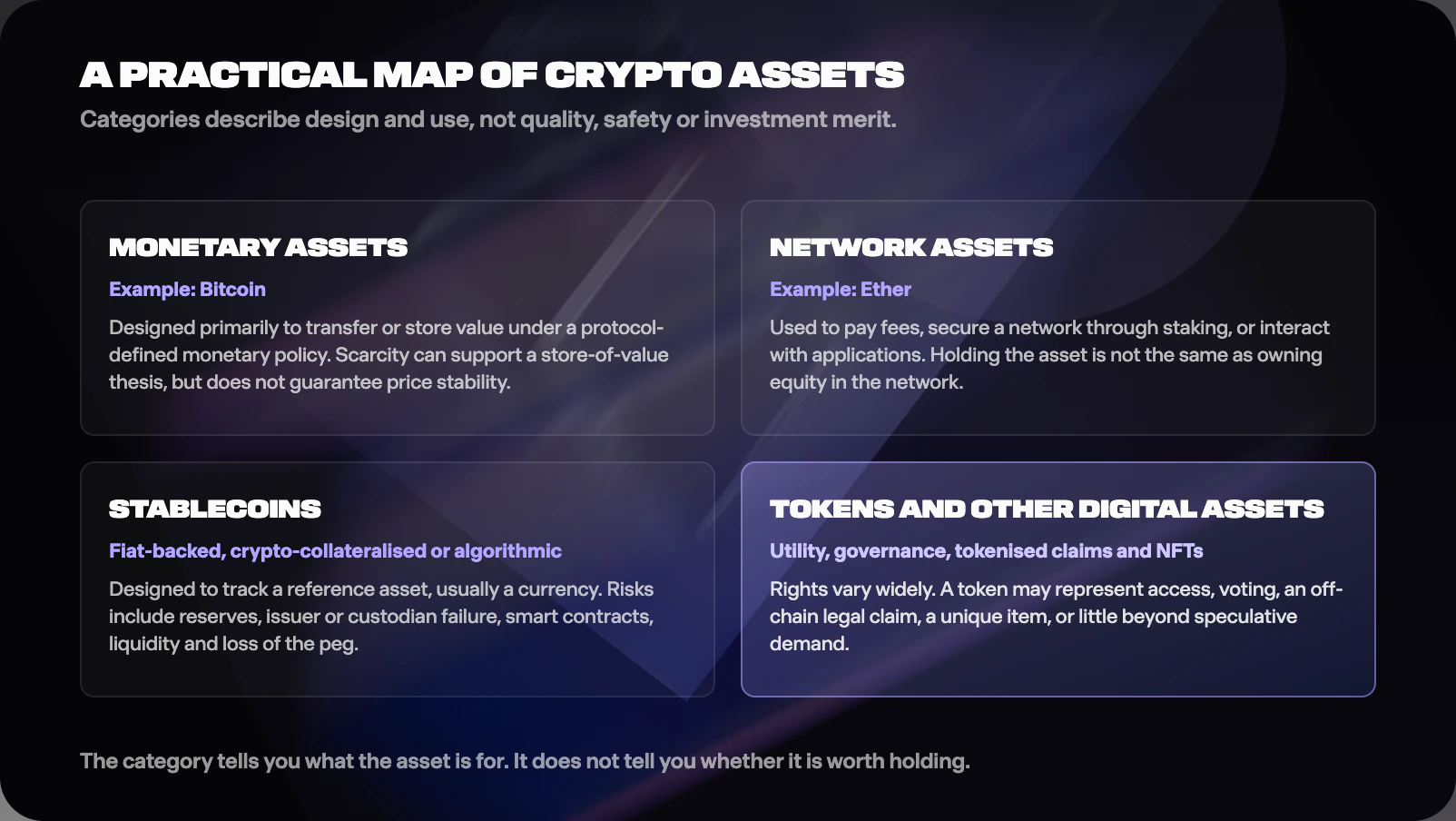
Four broad groups cover most of the landscape: monetary assets such as bitcoin; network assets such as ether; stablecoins designed to track another asset; and a wide range of tokens representing access, governance, legal claims or unique items.
Bitcoin and other monetary assets
Bitcoin is the first widely adopted decentralised cryptocurrency and is mainly used today as a transferable bearer asset and speculative store of value. Other assets may imitate monetary scarcity, but security, distribution, liquidity and governance differ. "Fixed supply" alone does not create Bitcoin's network effects or security history.
Network or platform assets
Assets such as ether are native to programmable networks. They may pay fees, secure consensus through staking, serve as collateral or support application activity. Economic design varies, and the same token can perform several functions.
Major layer-1 networks
Bitcoin and Ethereum are the two most established base networks, often called layer-1 blockchains because they settle transactions on their own consensus rather than relying on another chain. They are not the only ones, and the design choices between them illustrate the trade-offs that define this category. Bitcoin prioritises simplicity and security over programmability. Ethereum popularised general-purpose smart-contract execution on a major public blockchain and, after moving to proof of stake in 2022, now settles much of its activity through layer-2 rollups that batch transactions and post compressed data back to the main chain.
Several other layer-1 networks take different positions on the trade-off between decentralisation, security and throughput, a tension often summarised as the blockchain trilemma. Solana, launched in 2020, pursues high throughput on a single chain by pairing proof of stake with a sequencing method it calls Proof of History, which timestamps transactions before consensus so validators can process many in parallel. In normal operation it settles a few thousand transactions per second at fees typically well under a cent, though its theoretical ceiling is much higher than sustained real-world throughput, and the network experienced repeated outages in 2021 and 2022 that later engineering work aimed to address. Other widely used networks include the BNB Chain, Cardano, Avalanche and Tron, each with its own consensus design, fee model, degree of decentralisation and validator set. Some newer designs also separate the layer that orders transactions from the layer that stores data, which is why a simple ranking by speed rarely captures the real differences.
Two cautions matter for a newcomer. First, headline transactions-per-second figures are often theoretical maximums measured under ideal conditions rather than sustained real-world rates, so they should be read sceptically. Second, higher throughput usually reflects a deliberate trade-off, commonly fewer or more demanding validators, so faster is not automatically better; it depends on what a network is optimising for and what security assumptions it makes.
Stablecoins
Stablecoins target a reference price through reserves, collateral, redemption rights or algorithmic incentives. They are often issued as tokens on several networks. Users must distinguish the token issuer from the blockchain that carries it: a stablecoin can fail even when the underlying chain works correctly.
Tokens, tokenised assets and NFTs
A token can represent application access, governance, loyalty points, a regulated security, a fund share, a claim on a commodity, a game item or a unique identifier. "Coin" usually refers to the native asset of a blockchain, while "token" commonly refers to an asset created using another network's smart-contract system. The distinction is useful but not legally decisive.
How do wallets, keys and custody work?
Quick answer
A wallet manages the information and policies used to access crypto assets. It does not normally store the assets themselves. Custody describes who controls the signing authority and how access can be recovered if a device, person or provider fails.
A private key is secret data used to create digital signatures. A public key allows signatures to be verified. A receiving address is derived according to the network's rules; it is not universally just a shortened public key. Some addresses represent scripts or smart contracts rather than a single person's key.
Many self-custody wallets are hierarchical deterministic wallets: a master secret generates many private keys and addresses. A seed phrase is usually a human-readable backup for that master secret. It is not literally one private key, and not every wallet uses or exposes a conventional seed phrase. Custodial, smart-account and threshold systems may use different recovery models.
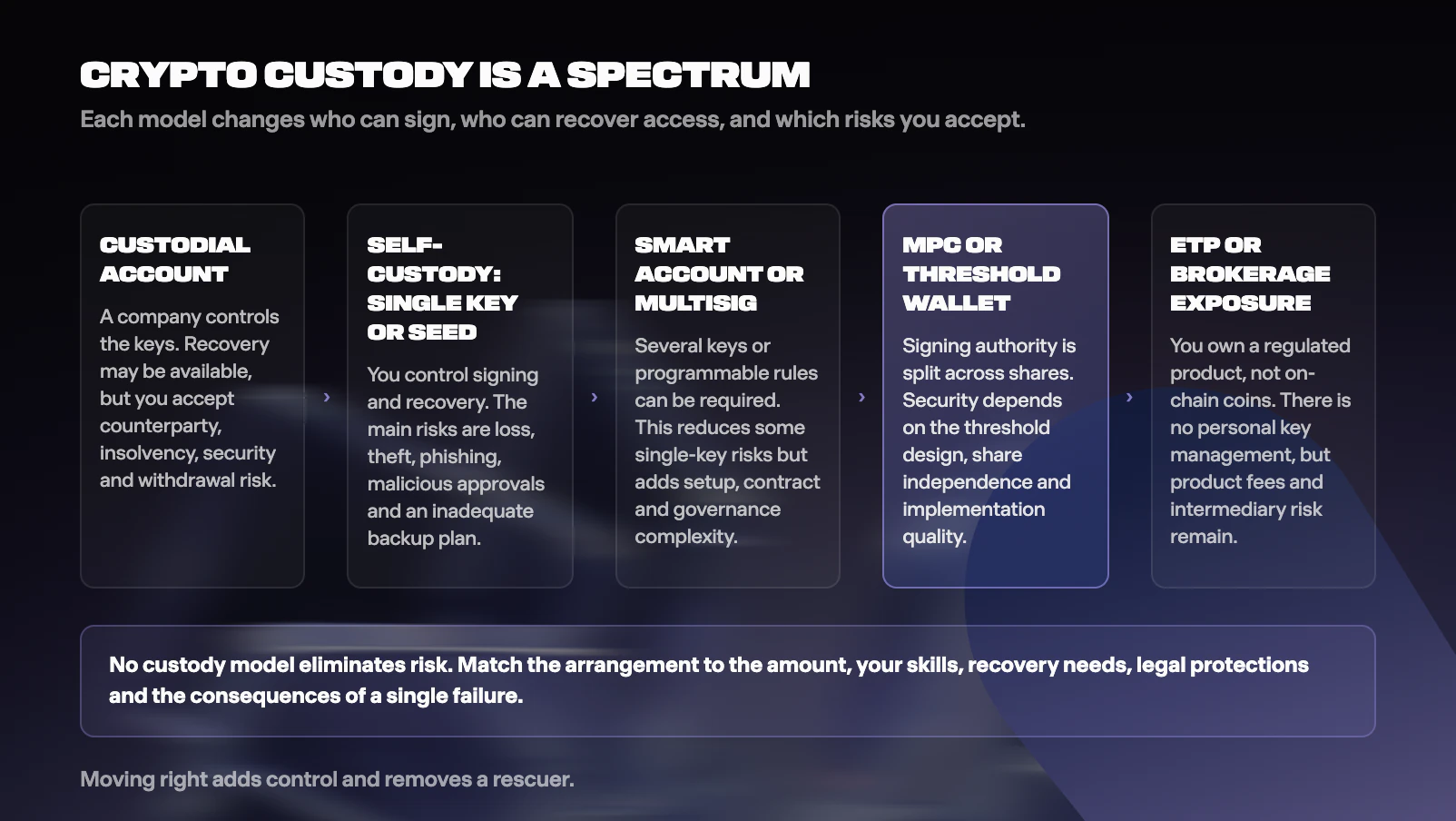
Whoever can satisfy the current signing policy can usually move the assets. That may be one private key, several keys, a smart-contract rule, a threshold of secret shares, or a custodian's internal authorisation process. This is why custody cannot be reduced to a simple exchange-versus-seed-phrase binary.
Custodial accounts
An exchange or custodian controls the on-chain keys and records your entitlement in an account. Password recovery and customer support may be available, but you depend on the provider's solvency, security, legal structure and withdrawal policies. Regulation can improve standards and recourse; it does not guarantee that assets are insured or recoverable.
Self-custody
You control the signing authority and bear the recovery burden. A hardware wallet can keep keys isolated from a general-purpose computer, reducing some malware risks. It cannot tell whether a recipient is trustworthy, prevent every supply-chain or firmware problem, or save you from approving a malicious transaction that appears on its screen.
Multisignature, smart accounts and threshold systems
Multisignature and smart-account designs can require several keys, spending limits, delays or recovery guardians. Threshold cryptography and multi-party computation can split signing authority so that no complete key exists in one place. These approaches can reduce single-point failures but add protocol, implementation, governance and operational complexity.
Seed phrase safety
Never reveal a recovery phrase because of an email, message, support request, link or unexpected prompt. A phrase may legitimately be entered during a deliberate wallet restoration in a verified, trusted wallet environment, but that is a controlled recovery action - not something support personnel should request. Anyone who obtains the phrase can usually recreate the wallet's keys.
Is cryptocurrency safe and legal?
Quick answer
There is no single "crypto risk." Security depends on the protocol, applications, bridges, issuers, custody, signing process and market. Legality and regulation vary by jurisdiction and asset. A regulated service can still fail, and a technically valid transaction can still be fraudulent.
Protocol and cryptography risk
Major networks such as Bitcoin and Ethereum have long operating histories, and their core signature and consensus mechanisms have resisted sustained attack. That does not make them invulnerable. Bitcoin had serious early software incidents, including the 2010 value-overflow bug, and all networks continue to depend on correct client software, cryptographic assumptions, network participation and governance. The accurate claim is "robust under current assumptions," not "unhackable."
Application and infrastructure risk
Smart contracts, bridges, wallets, browser extensions, front ends, oracles and exchange infrastructure can fail even when the base blockchain continues normally. A token can be frozen by an issuer, a bridge asset can lose backing, and an application can contain admin controls or upgrade keys. Users should understand which layer they are trusting.
Custody and human risk
Self-custody losses often arise from stolen recovery material, compromised devices, malicious approvals, address substitution or social engineering. Custodial losses can arise from fraud, insolvency, poor segregation, cyberattacks or withdrawal freezes. Across the wider ecosystem, no single category explains every loss.
Market and issuer risk
Crypto prices can move sharply and liquidity can disappear. Stablecoins can depeg; token issuers may misrepresent reserves or rights; and a project can fail without being a deliberate scam. Borrowing or using leverage turns volatility into forced liquidation risk.
Legal and regulatory position
Rules differ by country and by the legal classification of the asset or service. In the European Union, the Markets in Crypto-Assets Regulation entered fully into application on 30 December 2024, creating harmonised requirements for many issuers and service providers while not eliminating market risk. In the United States, the GENIUS Act was signed into law on 18 July 2025, creating a federal framework for payment stablecoins. Other crypto activities remain governed by multiple federal and state regimes. Always check current local rules and tax treatment.
What mistakes do beginners make?
Quick answer
The costliest mistakes are treating crypto as reversible banking, trusting a brand or regulator as a guarantee, exposing recovery material, signing without understanding, using the wrong address or network, concentrating custody risk, and investing more than can be lost.
- Sharing a private key or seed phrase. No support agent, government body or exchange needs it. Treat unexpected requests as theft attempts.
- Checking only the first and last address characters. Targeted address poisoning can imitate both. Use a verified address book, compare the full address on the signing device when practical, confirm the network and token contract, and use a test transfer for material amounts.
- Blind signing or granting unlimited token approvals. Read the effect, recipient and allowance. Use transaction simulation where available and revoke permissions that are no longer needed.
- Sending the right asset on the wrong network. The same ticker can exist on multiple chains, and a recipient may not support the chosen network.
- Assuming a hardware wallet makes every transaction safe. It protects key material better than ordinary software in many scenarios; it does not validate the economic intent for you.
- Leaving all assets with one custodian or putting every self-custody backup in one location. Concentration turns one failure into a total loss.
- Treating audits, high yields, famous investors or regulation as guarantees. Each is one signal with a limited scope.
- Ignoring privacy. Public addresses can reveal balances and transaction history, and linking them to your identity can create phishing or physical-security risk.
- Poor tax and transaction records. Transfers, trades, rewards and spending can have reporting consequences that vary by jurisdiction.
- Borrowing, using leverage or committing money needed for living expenses. Volatility can force a loss before any long-term thesis has time to play out.
Where does crypto stand in 2026?
Quick answer
Crypto is more integrated with regulated finance than it was a few years ago, while public-chain settlement, stablecoins and tokenisation continue to develop. At the same time, volatility, scams, software failures, fragmented regulation and custody risk remain central rather than solved.
Three developments define the current position. First, regulated market access has expanded. US spot bitcoin exchange-traded products have traded since January 2024, allowing brokerage exposure without personal key management. Second, stablecoin regulation has become more concrete: MiCA is fully applicable in the EU, and the United States enacted the GENIUS Act in 2025. Third, financial institutions and technology companies continue to experiment with tokenised assets and blockchain settlement.
None of these developments converts crypto into one mature, homogeneous market. Bitcoin, stablecoins, smart-contract platforms, tokenised securities and speculative tokens have different economic and legal structures. A regulated wrapper around bitcoin is not the same product as bitcoin held in self-custody; a fiat-backed stablecoin is not the same as an algorithmic token; a tokenised fund share is not the same as a memecoin.
The most reliable way to describe "mainstream" is therefore specific: some crypto assets and services now sit inside established regulatory and financial channels, while the underlying technology remains open, global and fast-changing. Integration has increased; risk has not disappeared.
How can someone learn about crypto safely?
Quick answer
Start with education, and treat any hands-on practice as learning rather than investing. The safe first step is understanding, not a purchase or a price prediction. Decide what problem you are trying to solve, research the legal and custody structure, secure the account or wallet, practise with a small amount, and create a recovery and record-keeping plan.
- Learn the basic vocabulary: blockchain, private key, wallet, address, transaction fee, confirmation, custody and stablecoin.
- Define the purpose. Buying speculative exposure, making a payment, using a stablecoin and interacting with an application require different tools and risk controls.
- Set a strict loss budget. Do not use rent, emergency savings, borrowed money or funds needed on a fixed date.
- Research the access provider and legal protections. Verify the official website or app, regulatory status, fees, asset segregation, withdrawal rules and what happens if the provider fails.
- Secure the account before funding it. Prefer passkeys or hardware security keys where supported, otherwise use an authenticator app; use a unique password and keep recovery codes offline.
- Practise with a small amount. Review the network, address and fee; send a test transaction before a material transfer; confirm receipt through an independent channel.
- Choose custody deliberately. Document how access will be recovered after device loss, incapacity or death, and test the recovery process without exposing live secrets.
- Keep complete records from the first transaction. Save dates, amounts, fees, wallet addresses, transaction hashes and acquisition values for tax and security purposes.
Buying crypto is entirely optional, and many people never need to. Reading, practising on free test networks, or exploring a block explorer can teach the mechanics without spending anything or taking investment risk. The objective of any first step is competence, never urgency, and deciding not to buy is a valid outcome.
Frequently asked questions
What is cryptocurrency in one sentence?
Cryptocurrency is a class of digital assets transferred and recorded using cryptographically secured ledger rules, often on a public blockchain, with ownership controlled by private keys, smart-account policies or custodians.
Is cryptocurrency the same as money?
Some crypto assets are designed to function as money or payment instruments, but many primarily secure networks, provide application access, represent governance rights, track another asset or support speculation. "Crypto asset" is the broader term.
Is Bitcoin the same thing as cryptocurrency?
No. Bitcoin is the first widely adopted decentralised cryptocurrency and one member of a much larger category that includes Ether, stablecoins and many different token designs.
How does cryptocurrency work in simple terms?
A wallet or custodian signs an instruction, nodes verify that it follows the rules, a miner or validator orders it into the ledger, and confirmations or finality make the accepted result increasingly difficult to reverse.
What is a blockchain?
A blockchain is an ordered distributed ledger in which blocks commit to prior history using cryptographic hashes. Hashes expose tampering; validation, consensus and finality determine which history participants accept.
Is crypto anonymous?
Usually not. Most public blockchains are pseudonymous: addresses are visible instead of legal names, but transactions and balances may be public and can often be linked to real identities through exchanges, analytics or user behaviour. Privacy-focused systems differ.
Can cryptocurrency be hacked?
Different layers can fail. Core cryptography on major networks has proved robust, but client software, smart contracts, bridges, exchanges, wallets and users can be compromised. "The blockchain was not hacked" does not mean the loss was avoidable or recoverable.
Can a crypto transaction be reversed?
A pending transaction may sometimes be replaced, and a very recent confirmed transaction can occasionally be affected by a shallow reorganisation. After sufficient confirmations or explicit finality, reversal usually requires an extraordinary network attack or intervention at another layer, such as an issuer freeze.
Is cryptocurrency legal?
Legality depends on the country, activity, asset and service. Holding or trading may be permitted while issuance, promotion, custody, payments or tax reporting are separately regulated. Check current local law rather than relying on a global answer.
Is a stablecoin the same as cash in a bank?
No. A stablecoin may target the same unit of account, but the holder's rights, reserves, redemption process, custody, insurance and legal protections can differ materially from a bank deposit.
Do I need a lot of money to start?
No. Many assets are divisible, and education does not require buying anything. A small, controlled test is more useful than taking a large position before understanding fees, custody and recovery.
What happens if I forget my wallet password?
An app password may only lock the local device. Access can often be restored with the wallet's recovery method, such as a seed phrase or guardian process. Without the required recovery material or signing threshold, self-custodied assets may become permanently inaccessible.
The bottom line
Cryptocurrency is not one product and not one risk. It is a family of digital assets that use cryptography and ledger rules to define ownership, authorise transfers and coordinate settlement. The important questions are specific: What does the asset represent? Who issues or governs it? Who can change the rules? What gives it demand? Who controls the signing authority? What happens if a person, device, smart contract, issuer or custodian fails?
Public blockchains can make records independently verifiable and allow value to move without one exclusive ledger operator. They cannot guarantee that an asset has value, that a contract is safe, that an issuer is solvent, that a transaction reflects your true intent, or that a lost key can be recovered. The technology changes where trust and responsibility sit; it does not abolish either.
For a beginner, the durable strategy is unglamorous: understand the asset before the price, understand the transaction before signing, understand the custody model before depositing, and keep every first experiment small enough that a mistake remains a lesson rather than a disaster.
Sources and further reading
Key references for this article, current as of July 2026.
- Satoshi Nakamoto, Bitcoin: A Peer-to-Peer Electronic Cash System, 2008. https://bitcoin.org/bitcoin.pdf
- Bitcoin Developer Guide: Transactions. https://developer.bitcoin.org/devguide/transactions.html
- Ethereum.org developer documentation: Transactions. https://ethereum.org/en/developers/docs/transactions/
- Ethereum.org developer documentation: Proof of stake. https://ethereum.org/en/developers/docs/consensus-mechanisms/pos/
- Bitcoin: A Peer-to-Peer Electronic Cash System (Nakamoto, 2008). https://bitcoin.org/bitcoin.pdf
- ESMA: Markets in Crypto-Assets Regulation (MiCA). https://www.esma.europa.eu/esmas-activities/digital-finance-and-innovation/markets-crypto-assets-regulation-mica
- SEC: Statement on the approval of spot bitcoin exchange-traded products, 10 January 2024. https://www.sec.gov/newsroom/speeches-statements/gensler-statement-spot-bitcoin-011023
- GENIUS Act, Public Law 119-27 (official text, GovInfo). https://www.govinfo.gov/app/details/PLAW-119publ27
Quick quiz: did it stick?
Seven questions to check the fundamentals landed. Answers with explanations follow, and nobody is grading you except your future portfolio.


You have completed a quiz on “What Is Cryptocurrency? The Complete Guide”! Share your achievement on social media.
 Was this helpful?