
TL;DR
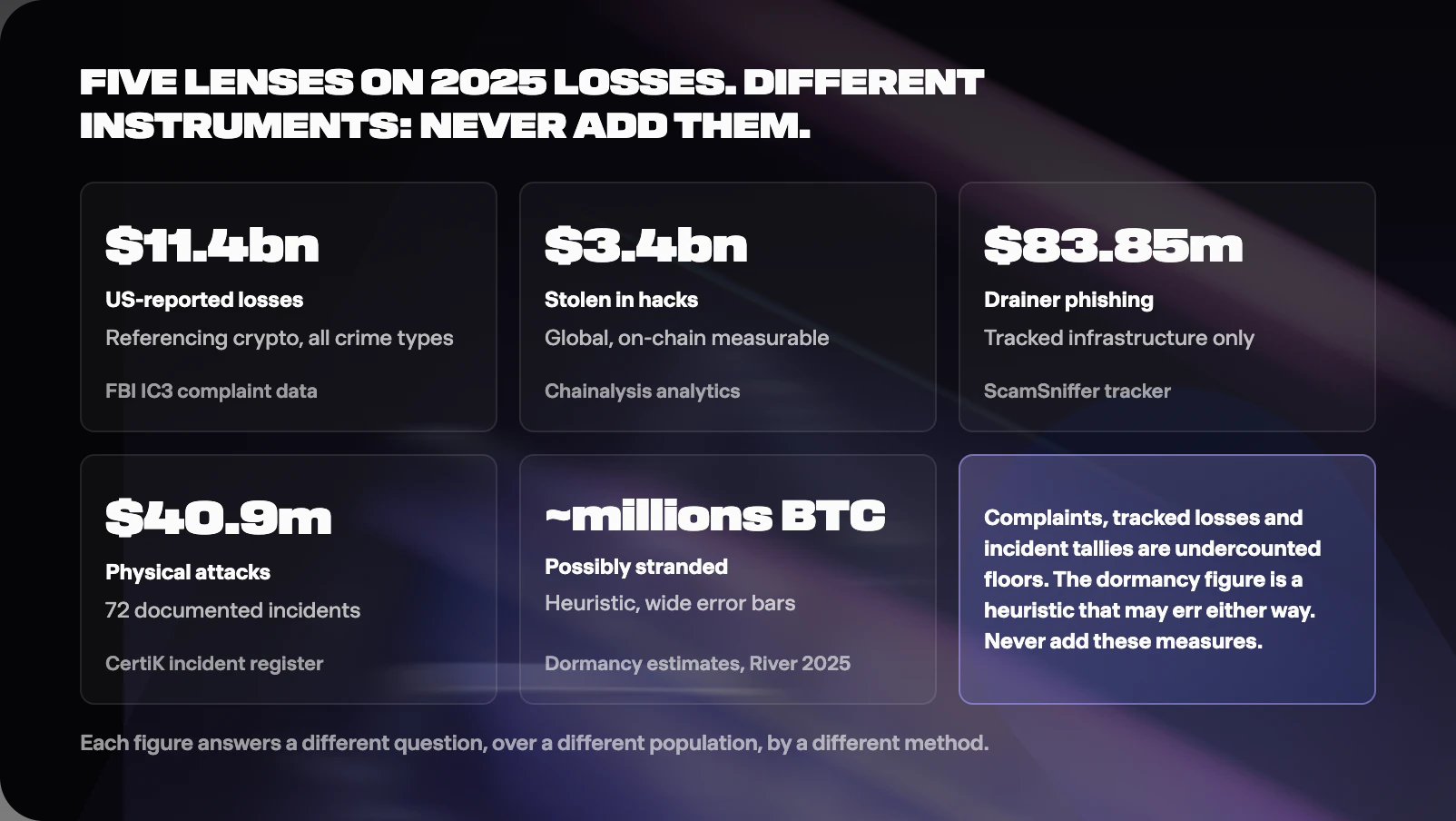
- Five kinds of evidence, none complete and none additive: complaint data, on-chain hack analytics, phishing-tracker data, incident registers and dormancy estimates, each observing a different slice of loss through a different instrument. Understanding the instruments is the difference between reading this report and misquoting it.
- By the broadest reported measure, 11.4 billion dollars in US complaints alone for 2025; by the on-chain measure, 3.4 billion stolen in hacks; and behind both, a possible stranded-coin overhang that dormancy heuristics place in the millions of bitcoin, with wide uncertainty. The honest headline is a range with named instruments, never one number.
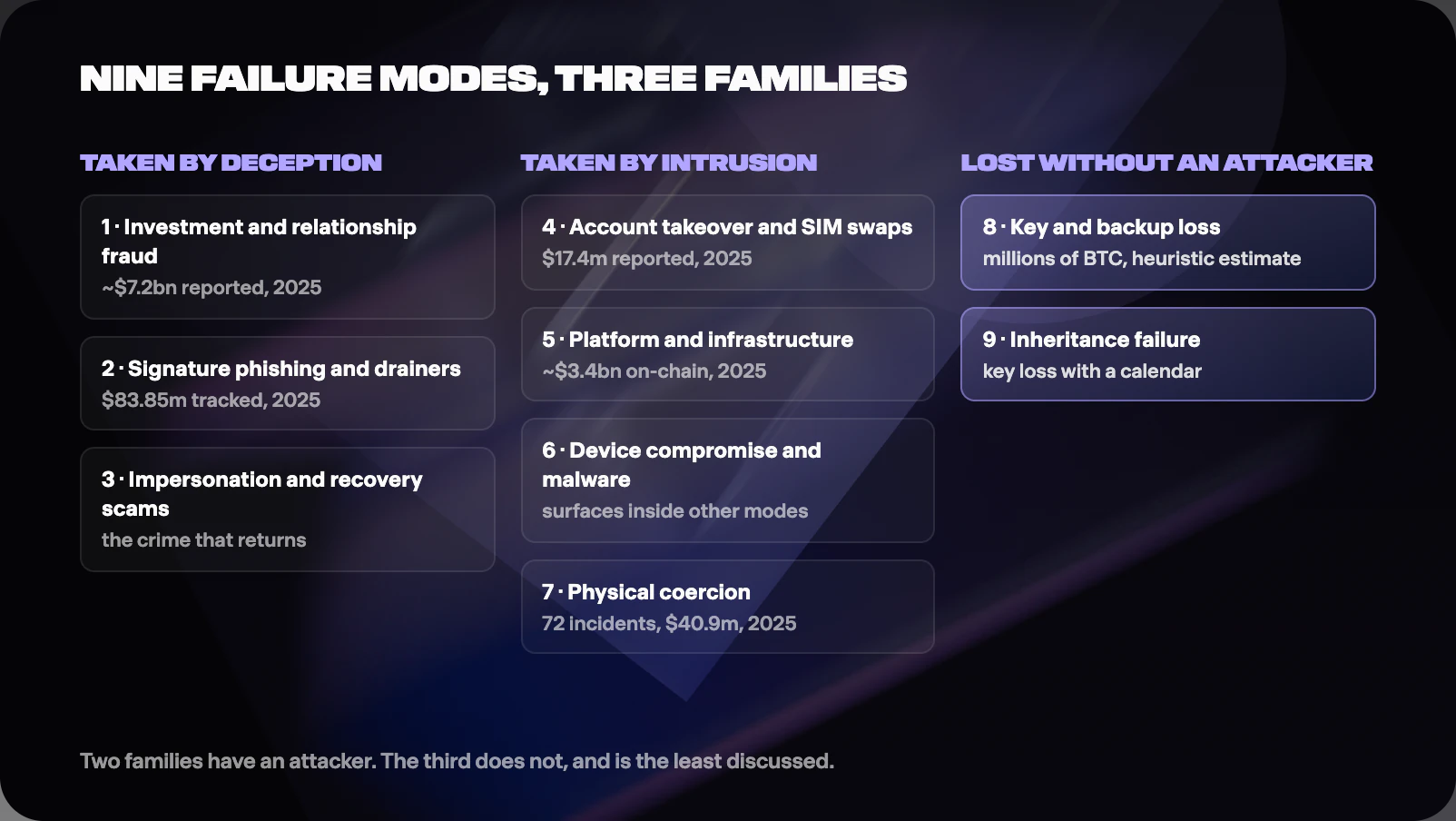
- Three families cover the record: taken by deception (fraud, signature phishing, impersonation), taken by intrusion (account takeover, platform compromise, device compromise, physical coercion), and lost without an attacker (key and backup loss, inheritance failure). Every documented loss the sources capture fits one of the nine modes.
- By manufacturing trust and urgency until the victim moves the money personally: long-con investment fraud took around 7.2 billion reported dollars in 2025, signature phishing industrialised the hostile approval, and impersonation scams harvest victims twice. No cryptography is broken at any point, which is precisely why the numbers are so large.
In one block
The Crypto Loss Report is a periodically updated taxonomy of the ways crypto holders actually lose assets, ordered by evidence rather than by fear.
What does this report measure, and how?
Quick answer
Five kinds of evidence, none complete and none additive: complaint data, on-chain hack analytics, phishing-tracker data, incident registers and dormancy estimates, each observing a different slice of loss through a different instrument. Understanding the instruments is the difference between reading this report and misquoting it.
Complaint data counts what victims report. The FBI's Internet Crime Complaint Center is the largest single window: for 2025 it recorded 181,565 complaints referencing cryptocurrency, with 11.4 billion dollars in reported losses, out of 20.9 billion across all cybercrime. Complaint data captures fraud that analytics never sees, because a victim who voluntarily wired funds to a scammer looks like an ordinary transaction on-chain. Its weaknesses run the other way: it is US-centric, counts only those who report, and mixes crypto-native crime with ordinary fraud that happened to be paid in crypto. Every serious study of fraud reporting finds heavy undercounting, from shame, from small losses not worth the form, and from victims who never realise.
On-chain analytics counts what can be traced. Chainalysis measured roughly 3.4 billion dollars stolen in hacks and exploits during 2025; TRM Labs counted 207 incidents and about 972 million dollars for the first half of 2026. These figures are global and independent of victim reporting, and they see only theft with an on-chain signature: service breaches, drained contracts, swept wallets. Voluntary transfers to fraudsters largely escape them, which is why the analytics number is a fraction of the complaint number and why adding the two double-counts some events and misses others.
Tracker and register data covers specific channels: ScamSniffer's monitoring of signature-phishing infrastructure put tracked drainer losses at 83.85 million dollars across 106,106 victims in 2025, against roughly 494 million in 2024; CertiK's review of physical attacks documented 72 incidents and 40.9 million dollars in confirmed losses in 2025. Both are explicit floors: they count what their instruments observe.
Dormancy estimates address loss without theft. Analyses of coins that have not moved in many years commonly place the figure in the low millions of bitcoin; River's 2025 custody analysis, the most careful current attempt, lands in a similar range while stating plainly that the exact amount, and the share truly attributable to lost keys rather than patient holders, cannot be known. These are heuristics with wide error bars, since dormancy is not proof of loss, and they are the only instrument that sees the quiet category at all.
Two definitions govern everything below. Theft: someone else gains the ability to move your assets. Loss: nobody retains it. The distinction matters because the defences differ, and because the second category, having no attacker, generates no headlines and almost no data, while possibly destroying value on a scale no instrument measures directly.
How much was actually lost in 2025 and early 2026?
Quick answer
By the broadest reported measure, 11.4 billion dollars in US complaints alone for 2025; by the on-chain measure, 3.4 billion stolen in hacks; and behind both, a possible stranded-coin overhang that dormancy heuristics place in the millions of bitcoin, with wide uncertainty. The honest headline is a range with named instruments, never one number.
The table collects the principal figures, each tagged with what it measures.
| Figure | Period | What it measures | Source |
|---|---|---|---|
| $20.9bn | 2025 | All US cybercrime losses reported to IC3 | FBI IC3 |
| $11.4bn (181,565 complaints) | 2025 | US-reported losses referencing crypto, all crime types | FBI IC3 |
| ~$7.2bn | 2025 | US-reported crypto investment fraud specifically | FBI IC3 |
| ~$3.4bn | 2025 | Global on-chain losses to hacks and exploits | Chainalysis |
| $1.5bn | Feb 2025 | Bybit theft, the largest single incident on record | Chainalysis; FBI attribution |
| $972m (207 incidents) | H1 2026 | Global on-chain hack losses, record incident count | TRM Labs |
| $83.85m (106,106 victims) | 2025 | Tracked wallet-drainer phishing losses | ScamSniffer |
| $40.9m (72 incidents) | 2025 | Confirmed losses to documented physical attacks | CertiK |
| $17.4m (971 complaints) | 2025 | US-reported SIM swap losses, all crime categories | FBI IC3 |
| Millions of BTC (heuristic) | cumulative | Dormancy-based estimate of potentially stranded bitcoin | dormancy analyses incl. River 2025 |
Three movements in the data deserve the reader's attention before the taxonomy.
Reported fraud keeps climbing: crypto-referencing complaints rose 21 percent and their losses 22 percent year on year, against a hacking total that fell. The gap between the deception economy and the intrusion economy is widening.
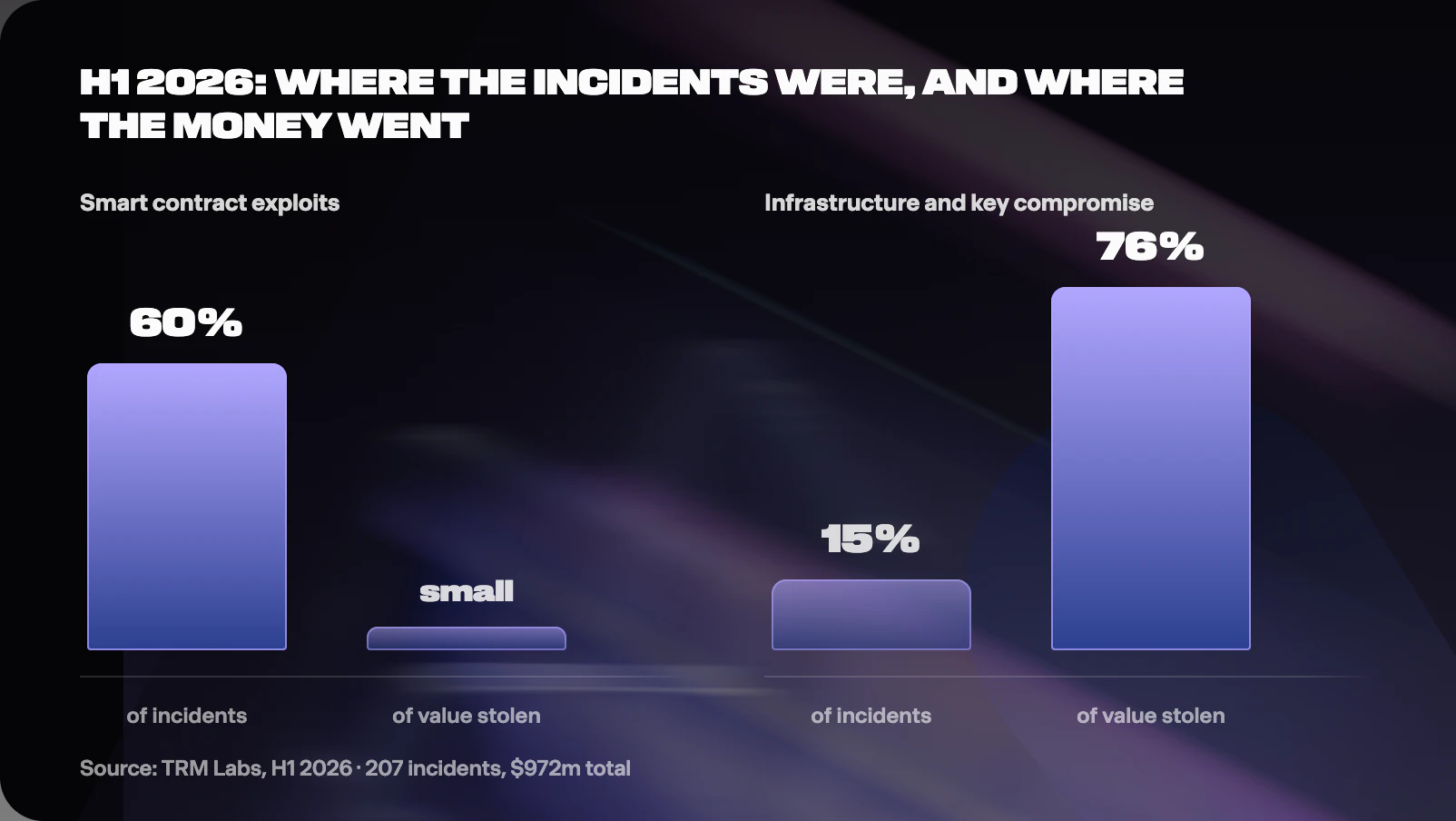
Technical theft is concentrating. 2025's on-chain total was dominated by one incident; H1 2026 set a record for incident count while losses fell below a billion, and the value migrated decisively toward infrastructure and key compromise, about 76 percent of H1 2026 losses from roughly 15 percent of incidents. Many small doors are being closed while a few large ones remain.
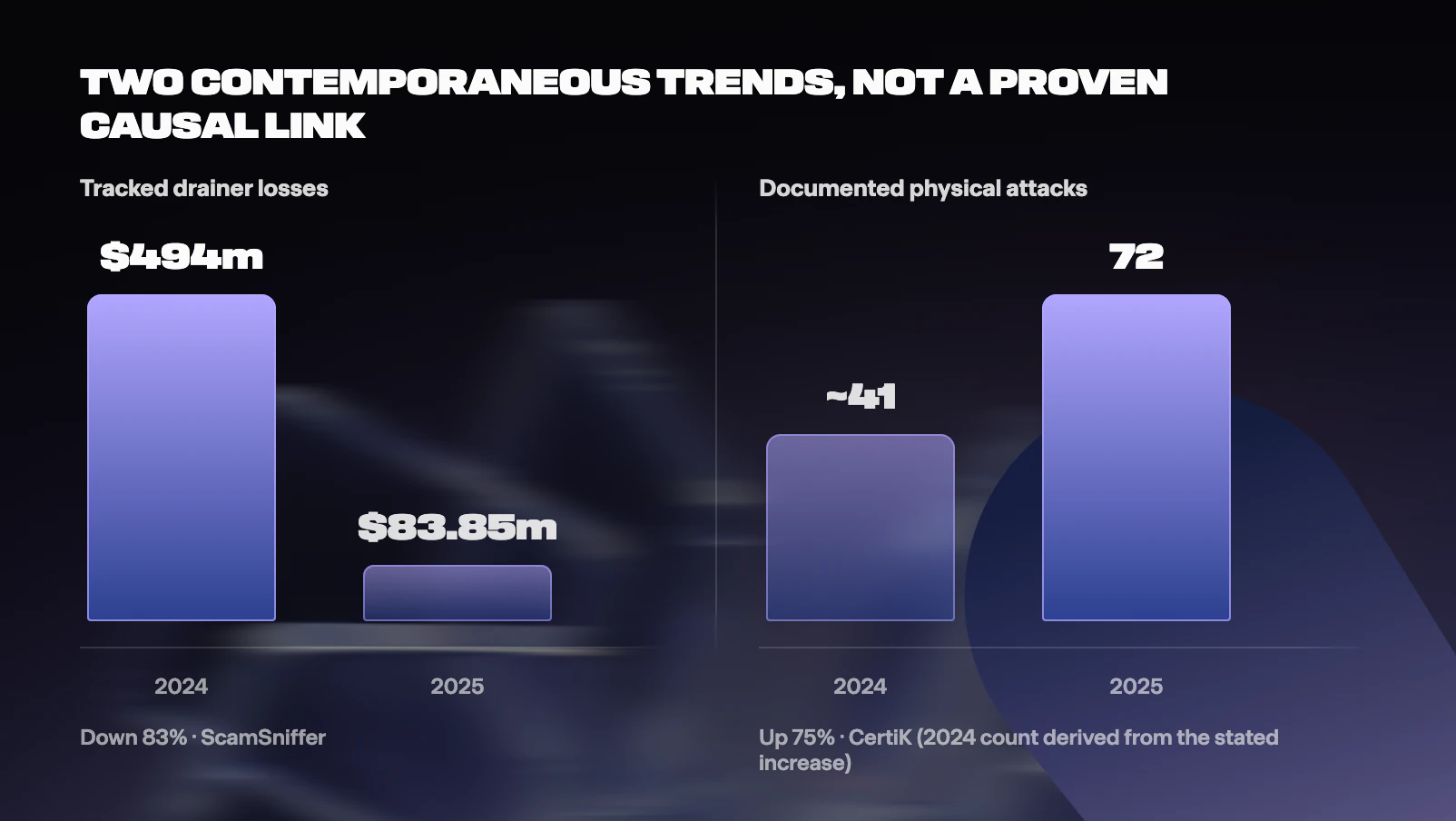
A displacement reading is tempting, and it remains a reading rather than a finding. Drainer losses fell by five sixths in a year; documented physical attacks rose by three quarters over the same period. The two datasets track different populations through different instruments and do not trace attackers or funds between the categories, so the parallel is suggestive, not proof that the same effort simply moved.
What are the nine ways people actually lose crypto?
Quick answer
Three families cover the record: taken by deception (fraud, signature phishing, impersonation), taken by intrusion (account takeover, platform compromise, device compromise, physical coercion), and lost without an attacker (key and backup loss, inheritance failure). Every documented loss the sources capture fits one of the nine modes.
The taxonomy, with each mode's best public measure:
| Mode | Family | Best available 2025 measure | Measure type |
|---|---|---|---|
| 1. Investment and relationship fraud | Deception | ~$7.2bn US-reported | Complaints |
| 2. Signature phishing and drainers | Deception | $83.85m tracked | Tracker |
| 3. Impersonation and recovery scams | Deception | Within IC3 fraud totals | Complaints |
| 4. Account takeover incl. SIM swap | Intrusion | $17.4m US-reported (SIM swap, all crime categories) | Complaints |
| 5. Platform and infrastructure compromise | Intrusion | ~$3.4bn on-chain | Analytics |
| 6. Device compromise and malware | Intrusion | No reliable standalone figure | Qualitative |
| 7. Physical coercion | Intrusion | $40.9m confirmed (72 incidents) | Register |
| 8. Key and backup loss | No attacker | Millions of BTC, heuristic est. (with mode 9) | Estimate |
| 9. Inheritance failure | No attacker | Within dormancy estimates | Estimate |
The families behave differently, and the difference organises the rest of this report. Deception scales like marketing: industrial, victim-by-victim, immune to better cryptography because the victim authorises the transfer. Intrusion scales like burglary: it follows concentrations of value and weaknesses in whatever guards them, and it responds to defensive engineering, which is why its internal mix keeps shifting. The attacker-free family scales like entropy: steady, silent, and governed entirely by how holders structure custody and succession.
One thread runs through all nine, and the reader will meet it in every section: value is lost where a single something carried everything. A single trusted stranger. A single signature. A single phone number. A single company. A single device. A single person under threat. A single word list. A single memory. The academy's security guides exist largely to remove those singles; this report is the evidence for why.
How does deception take the most?
Quick answer
By manufacturing trust and urgency until the victim moves the money personally: long-con investment fraud took around 7.2 billion reported dollars in 2025, signature phishing industrialised the hostile approval, and impersonation scams harvest victims twice. No cryptography is broken at any point, which is precisely why the numbers are so large.
Investment and relationship fraud, mode 1, is the heavyweight. The dominant form, often called pig butchering, opens with a wrong-number text, a dating-app match or a social contact, builds rapport over weeks, and introduces an investment platform that shows fabricated profits until the victim commits serious money, at which point withdrawal becomes impossible. IC3's 2025 data attributes roughly 7.2 billion dollars of reported US losses to crypto investment fraud, the largest single category in this report by a wide margin, and complaint data is the only instrument that sees it, because on-chain the victim simply sent funds to an address. The operational scale is industrial, with organised groups running scripted conversations across thousands of targets, and the defence is procedural rather than technical: money moves only on your initiative, investment opportunities that arrive through unsolicited contact are presumed hostile, and guaranteed returns are a fingerprint. The academy's scams pillar catalogues the current species.
Signature phishing, mode 2, is deception aimed one layer down, at the approval rather than the transfer. A counterfeit mint page, airdrop claim or support flow obtains a signature that grants standing permission over the victim's tokens, and automated infrastructure drains everything the permission reaches. ScamSniffer's tracking tells a rare good-news story with a sting: 494 million dollars tracked in 2024 fell to 83.85 million across 106,106 victims in 2025, an 83 percent drop that ScamSniffer and industry observers associate with better wallet warnings, simulation tools and user education, though causation is not directly established, with permit-style signatures still dominant among the large individual losses. The sting is that overall criminal pressure did not obviously fall; other modes below grew over the same period, though no dataset traces funds or offenders between them. The drainer guide in the academy dissects the mechanics and the revocation playbook.
Impersonation, mode 3, deserves separate billing for one habit: it returns. Fake exchange support, fake wallet teams and fake law enforcement open many account-takeover chains, and after any publicised loss the same industry re-approaches victims as recovery services, charging fees to retrieve funds they know are gone, sometimes harvesting the victim's remaining keys in the process. IC3 has warned about the pattern explicitly. The rule that defeats the whole mode costs nothing: nobody legitimate initiates contact to move your money or asks for your seed phrase, and everyone who does is the crime.
How does intrusion take what it takes?
Quick answer
By attacking whatever single thing guards the most value: a phone number, a platform's signing workflow, an infected device, or a human being who can be made to comply. Intrusion follows concentration, which is why its biggest losses are institutional and its ugliest are personal.
Account takeover, mode 4, is the retail workhorse. The SIM swap remains its signature move: persuade or pay a carrier employee to move the victim's number, receive their codes and resets, and walk through email into exchange accounts. IC3 logged 971 SIM swap complaints and 17.4 million dollars in 2025 across all crime categories, figures not limited to crypto and widely treated as a heavy undercount, and Princeton research demonstrated years ago how weak carrier authentication makes the attack repeatable. The defences are now well understood, phishing-resistant second factors, numbers stripped from recovery paths, withdrawal allowlists, and the academy's account security guide walks them in order.
Platform and infrastructure compromise, mode 5, produces the record-book numbers. The February 2025 Bybit theft took about 1.5 billion dollars, attributed by the FBI to North Korean actors, without breaking a single key: the signing interface was corrupted so that authorised officers approved a payload they could not see for what it was. The bridge era of 2022 told the same story at protocol scale, over 2 billion dollars taken from cross-chain bridges, mostly through compromised validator keys and broken verification, and H1 2026's distribution, three quarters of stolen value from infrastructure and key compromise, confirms where professional attention now lives. For individual holders the mode arrives as counterparty risk: funds on a platform share that platform's worst day. The academy's articles on custody, bridges and institutional key management cover the engineering on both sides.
Device compromise, mode 6, is the honest gap in every dataset. Stealer malware that lifts wallet files and clipboard hijackers that swap destination addresses are extensively documented as tools, and their losses surface inside other categories, a drained wallet here, a takeover there, rather than as a clean line item. This report follows its sources and declines to invent a number; the defensive relevance is unchanged, since device hygiene and hardware isolation of keys close the mode regardless of its exact size.
Physical coercion, mode 7, is the smallest by dollars and the fastest growing by harm. CertiK's review of 2025 counted 72 documented incidents, up 75 percent in a year, with 40.9 million dollars in confirmed losses, physical assaults up 250 percent, and Europe supplying around 40 percent of cases, France alone 19, including the kidnapping and mutilation of an industry executive. The mechanism is the oldest one: identify a holder, locate them, and apply force until access is surrendered, which works best exactly where custody has a single recitable secret. The academy's physical security article covers exposure reduction and the custody structures that change what force can extract.
How does crypto disappear with no attacker at all?
Quick answer
Through the quiet modes: keys forgotten, backups destroyed, devices discarded, and owners who die without leaving an access path, a family of failures whose true scale no instrument measures directly. Nothing here files a complaint, which is why this is the least measured category in the report.
Key and backup loss, mode 8, has crypto's most famous folklore: the hard drive in the landfill, the corrupted wallet file, the password that guarded a fortune and died with a memory. The measurable trace is dormancy: analyses of long-unmoved coins commonly produce estimates in the millions of bitcoin, and River's 2025 analysis, the current reference work, is explicit that the true figure and its causes cannot be pinned down, because a dormant coin and a lost coin look identical on-chain. The mechanisms are ordinary to the point of banality: phrases written once and lost to fire, flood or a house move; backups that never existed because setup was rushed; passphrases added for security and forgotten for the same reason; hardware discarded in a drawer purge. Two properties make the mode uniquely cruel. It is invisible until the exact moment of need, and it is absolute: an unreachable key is not frozen value awaiting appeal, it is value removed from the world. The academy's guides to seed phrases, storage models and recovery are, in effect, one long countermeasure to this section.
Inheritance failure, the final mode, is key loss with a calendar attached. Law transfers ownership at death; only cryptography transfers access; and an estate that inherits addresses without keys inherits entries on a ledger. QuadrigaCX is the case everyone reaches for here, and it deserves precise handling. When the exchange's founder died in 2018, clients were owed roughly 215 million Canadian dollars, and the Ontario Securities Commission's post-mortem found that the platform held almost no assets by the time he died, the shortfall having been created by his own fraud and unauthorised trading rather than by keys that were lost with him. The lesson is about governance rather than backups: one person's unchecked control, of the keys and of the books, was the entire failure surface, and his death merely exposed it. Private versions of a related story, undocumented custody meeting sudden death, recur constantly and mostly invisibly, absent from any dataset: holders who told no one, instructions that named assets without access, seed phrases hidden so well they were never found, and grieving families facing hardware they cannot unlock, sometimes turning in desperation to the recovery scammers of mode 3. The academy's inheritance article sets out the working designs, quorum arrangements with time triggers, documentation without secrets, and the principle underneath them: an inheritance mechanism is a recovery mechanism that must fail while you live and object, and must not fail after.
What patterns cut across every mode?
Quick answer
Four: losses concentrate on single points of failure; the human layer outspends the technical layer; hardened defences appear to shift criminal effort rather than end it, though the shift is inferred rather than measured; and irreversibility makes prevention the only strategy that scales. The taxonomy's modes are symptoms; these are the mechanics.
The single point of failure is the report's connective tissue, and by now the reader can trace it mode by mode. One trusted stranger carried the pig-butchering victim's judgement. One signature carried the drained wallet's permissions. One phone number carried the exchange account. One signing interface carried Bybit's quorum. One person under a wrench carried the household's savings. One word list carried the fortune through the fire, or failed to. One person's unchecked control carried Quadriga. Wherever the record shows catastrophic loss, it shows something singular that was allowed to matter totally, and the defensive literature converges on the same response from nine directions: distribute authority, so that no single deception, intrusion or accident is final.
The human layer dominates the ledger. Stack the measures with their caveats and the shape is unmistakable: reported deception losses run several multiples of on-chain hacking losses, and the largest hack of the era worked by deceiving humans about what they were signing. The industry's cryptography has held remarkably well; its people, interfaces and processes are where the money leaves. Security spending that ignores this ratio is decoration.
Displacement is the tempting reading of the pattern, and it stays a reading. Drainer losses fell 83 percent in a period of wallet and user hardening; physical attacks rose 75 percent in the same period; bridge losses collapsed after 2022's reckoning while operational compromise grew. The sources caution against over-reading: ScamSniffer ties drainer swings partly to market activity, CertiK ties the physical rise to organised groups and open-source targeting, and no dataset traces effort between the categories. What the record does not show is criminal capacity shrinking.
And irreversibility disciplines everything. There is no chargeback tier in this taxonomy: most modes end in value that does not come back, with the meaningful exceptions, platform and issuer freezes, court-ordered recoveries, depending heavily on speed of reporting. That is why this report pairs every mode with prevention rather than remedy, and why the response guide's honest core is damage limitation. In this asset class, the seatbelt is the whole strategy.
What actually changes outcomes?
Quick answer
A short list with long evidence: procedural scepticism against deception, phishing-resistant authentication against takeover, distributed custody against intrusion, coercion and self-loss alike, and rehearsed recovery with succession against the quiet modes. Every defence below maps to modes above and to a full guide in this academy.
| Defence | Modes it addresses | Guide |
|---|---|---|
| Money moves only on your initiative; no unsolicited opportunity or helper | 1, 3 | Crypto Scams and Threats |
| Read and verify every signature; revoke stale approvals | 2 | Wallet-Draining and Approval Attacks |
| Passkeys or hardware keys; phone number out of recovery; allowlists | 4 | Two-Factor Authentication and SIM-Swaps |
| Tiered balances; platform exposure sized to its worst day | 5 | Who Holds Your Crypto |
| Key isolation from everyday devices | 6 | Ways to Hold Your Keys |
| Discretion about holdings; custody no one present can surrender | 7 | Physical Security and Coercion |
| No single secret: quorum custody, distributed and refreshed | 2, 5, 6, 7, 8 | Multisig; Threshold Cryptography and MPC |
| Tested backups or share recovery; rehearsed restoration | 8 | Ways to Hold Your Keys; Recovery and Inheritance |
| Succession designed and documented without secrets | 9 | Recovery and Inheritance |
| A rehearsed first hour for the day something fails | all | How to Respond If Your Crypto Is Hacked or Stolen |
Reading the table against the data yields the report's practical conclusion. The two defences with the widest coverage are behavioural scepticism, which blunts the biggest dollar category, and the removal of single secrets through distributed custody, which appears against five separate modes because single secrets appear in five separate modes. Both are available to ordinary holders today, one for free and one at consumer prices. The complete programme, ordered for a person rather than a taxonomy, is the companion pillar, How to Keep Your Crypto Safe in 2026.
This report updates quarterly as sources publish. Corrections and newly published primary data are incorporated at each revision, and figures are never restated without a note.
Frequently asked questions
How do most people actually lose crypto?
By dollar volume in the reported data, to investment and relationship fraud: victims are talked into transferring funds or funding fake platforms, roughly 7.2 billion dollars of it in US complaints during 2025. For a careful self-custody holder, the quiet modes, lost keys, failed backups and absent succession plans, may be comparably dangerous over a lifetime: dormancy heuristics suggest millions of bitcoin could be unreachable, though the method cannot prove how much or why.
Are exchange hacks still the main risk for ordinary users?
They are the most visible risk and no longer the statistical centre. On-chain theft ran about 3.4 billion dollars in 2025, concentrated in infrastructure and key compromise at large targets, while reported deception losses ran several times higher and fell on individuals directly. For a user, platform risk is real and manageable through tiering; the scams aimed at you personally deserve more of your attention than the hackers aimed at your exchange.
Why do the report's figures not add up to one total?
Because they measure through different instruments: complaint data counts what victims report, analytics counts what chains reveal, trackers count specific channels, and dormancy studies estimate what never moves. The populations overlap and the gaps differ, so a grand total would be neither floor nor ceiling, only noise. This report quotes each figure with its instrument, and readers citing it should do the same.
Is crypto getting safer or more dangerous?
Both, in different layers. Contract exploits and drainer phishing fell sharply as defences matured, which is genuine progress. Deception losses grew, physical attacks reached a record, and the largest theft in history happened in 2025 through a corrupted signing workflow. The honest reading: the technical layer is hardening, criminal pressure appears to bear increasingly on humans and processes, an inference the parallel trends support without proving, and a holder's practical safety now depends mostly on habits and custody structure.
What is the single change with the best evidence behind it?
Removing single points of failure from custody. Across the record, catastrophic personal losses route overwhelmingly through something singular: one phrase, one device, one number, one person. Quorum-based arrangements, multisignature or MPC, appear as the countermeasure against more modes than any other defence in this report, and they are now available in ordinary consumer form.
Sources and further reading
Primary sources for this edition, current as of July 2026. Figures are re-verified each quarter, and changes are noted in revision history.
- FBI Internet Crime Complaint Center, 2025 Internet Crime Report. https://www.ic3.gov/AnnualReport/Reports/2025_IC3Report.pdf
- Chainalysis, 2026 Crypto Crime Report: stolen funds analysis. https://www.chainalysis.com/blog/crypto-hacking-stolen-funds-2026/
- Chainalysis, 2026 Crypto Crime Report introduction. https://www.chainalysis.com/blog/2026-crypto-crime-report-introduction/
- TRM Labs, H1 2026 crypto hacks analysis. https://www.trmlabs.com/resources/blog/h1-2026-crypto-hacks-reach-record-high-as-losses-fall-below-usd-1-billion
- ScamSniffer, 2025 Crypto Phishing Report. https://drops.scamsniffer.io/scam-sniffer-2025-crypto-phishing-losses-fall-83-to-84-million/
- CertiK, Skynet Wrench Attacks Report: 2025 physical-attack incidents and losses. https://www.certik.com/ko/skynet-report/skynet-wrench-attacks-report
- Jameson Lopp, Known Physical Bitcoin Attacks register. https://github.com/jlopp/physical-bitcoin-attacks
- FBI IC3, public service announcement attributing the Bybit theft to North Korea. https://www.ic3.gov/PSA/2025/PSA250226
- FBI IC3, public service announcement on cryptocurrency recovery schemes. https://www.ic3.gov/PSA/2023/PSA230811
- Chainalysis, research on cross-chain bridge thefts (2022). https://www.chainalysis.com/blog/cross-chain-bridge-hacks-2022/
- River, Bitcoin Custody Report 2025: dormancy-based loss heuristics and their stated limitations. https://river.com/content/bitcoin-custody-report-2025
- Lee, Kaiser, Mayer and Narayanan (Princeton University), An Empirical Study of Wireless Carrier Authentication for SIM Swaps (USENIX SOUPS 2020). https://www.usenix.org/conference/soups2020/presentation/lee
- Ontario Securities Commission, QuadrigaCX review report: fraud and unauthorised trading as the principal cause of the shortfall. https://www.osc.gov.on.ca/quadrigacxreport/
- Kappos et al., How to Peel a Million: Validating and Expanding Bitcoin Clusters (USENIX Security 2022). https://www.usenix.org/system/files/sec22-kappos.pdf
To cite this report: Bron Academy, The Crypto Loss Report 2026: How People Actually Lose Crypto, first edition, July 2026, bron.org/academy.
Quick quiz: did it stick?
A few questions to check the fundamentals landed. Answers with explanations follow, and nobody is grading you except your future portfolio.


You have completed a quiz on “The Crypto Loss Report 2026: How People Actually Lose Crypto”! Share your achievement on social media.
 Was this helpful?