TL;DR
- The blockchain itself enforces a rule that spending requires valid signatures from at least m of n designated keys, so the quorum is checked by every node on the network rather than by any wallet, server or company. That enforcement location is the design's deepest strength.
- Each unit of threshold m is theft resistance, each unit of slack n minus m is loss resistance, and the configuration is a budget you allocate between the two failure directions. Two of three is the canonical personal balance for a reason.
- Three patterns cover most real use: the individual removing their own single point of failure, the family or partnership sharing authority with survivorship, and the company or DAO making treasury movement a governed, auditable act. Same mathematics, three different problems.
- Both enforce a quorum; multisig does it on-chain with chain-specific mechanics and, in script and contract paths, publicly visible policy, MPC does it in cryptography with one standard signature, broad chain reach where signature schemes are compatible, and private policy, and both are defeated by quorum-scale compromise or a deceived signer set. The choice is architectural rather than moral.
In one block
A multisignature wallet is a custody arrangement that requires a threshold of independent keys, m of n, to authorise any transaction, enforced by the blockchain itself through a script or smart contract.
How does an m-of-n wallet actually work?
Quick answer
The blockchain itself enforces a rule that spending requires valid signatures from at least m of n designated keys, so the quorum is checked by every node on the network rather than by any wallet, server or company. That enforcement location is the design's deepest strength.
On Bitcoin, multisig is native to the script system: an output can be locked to a policy such as "two valid signatures from these three public keys", historically via pay-to-script-hash and its SegWit successors, with Taproot enabling more private and efficient constructions. A transaction that fails the policy is simply invalid; no node will relay it, no miner can include it usefully. The rule is as hard as the chain.
On smart-contract chains, multisig lives in contract wallets: the contract holds the assets and its code requires m approvals from its configured owner set before executing a transfer or call. The best-known implementations secure large protocol treasuries and DAO funds, and because the wallet is a program, policy can extend beyond counting signatures: daily limits, delays, role restrictions, allowlists, the policy-engine ideas the institutional custody article develops.
Operationally, a signing flow looks like this: one participant drafts the transaction; it circulates, as a partially signed file or through a coordinator interface, gathering signatures from independent devices, often hardware wallets in separate locations; at the threshold it is broadcast and the chain verifies the quorum. Nobody's device ever holds more than one key; no complete "master key" exists at any point, which is the property everything else in this article builds on.
Two vocabulary notes to keep later sections honest. The keys must be independent: three keys derived from one seed phrase, or three devices backed up to one drawer, are one key wearing costumes. And m-of-n describes authorisation, never backup: each individual key still needs its own recovery story, which is where many real setups quietly fail.
What do the numbers m and n actually buy you?
Quick answer
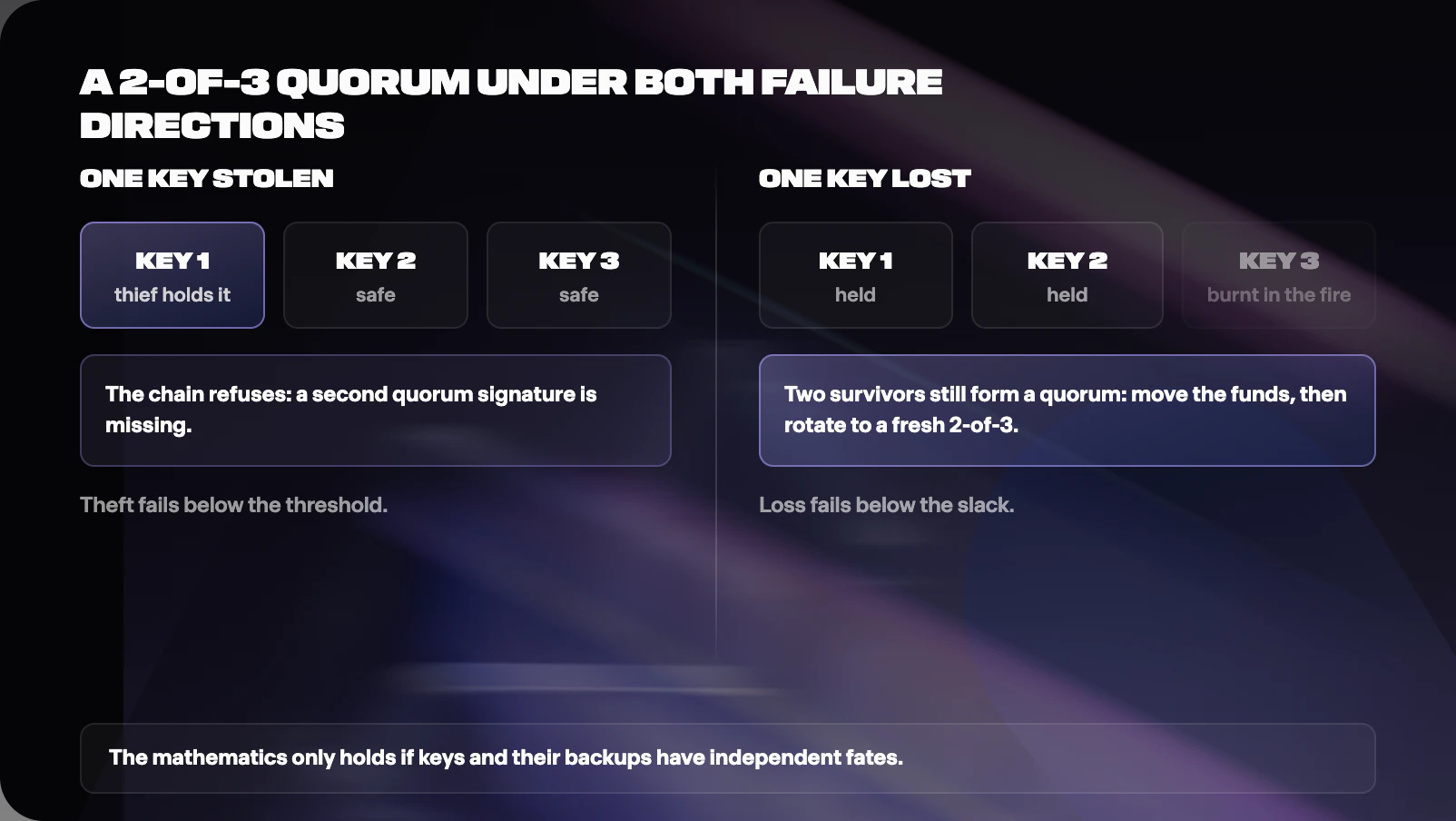
Each unit of threshold m is theft resistance, each unit of slack n minus m is loss resistance, and the configuration is a budget you allocate between the two failure directions. Two of three is the canonical personal balance for a reason.
Work the canonical case. In a 2-of-3, an attacker with one stolen key can move nothing: the chain demands a second signature the attacker does not have. Meanwhile you, having lost one key to a house fire, still hold two and can move funds to a fresh arrangement at leisure. One event, either direction, is survivable by construction. That single paragraph is the entire sales pitch, and it is true.
Now stress it, because the numbers interact with geography and people. If two of your three keys live in the same house, a burglary is a quorum. If two live with the same person, that person is a single point of coercion, the exact scenario the physical security article prices. The configuration only delivers its mathematics when the keys' fates are independent: different places, different devices, ideally different people or organisations. Independence is the real currency; m and n just denominate it.
Scaling up follows need. Three of five suits a family or small treasury: two keys can be lost without crisis, and a thief needs three simultaneous compromises across, if placed well, three sites or people. Higher configurations buy resilience at rising coordination cost, and the institutional article shows where that curve ends: quorums across continents with policy engines attached. The degenerate cases teach too: 1-of-2 is convenience with no theft resistance; 2-of-2 has no loss slack, one destroyed key strands everything, which is why it appears mainly inside protocols rather than as personal custody.
One more honest note on the loss direction: the quorum protects against key loss, never against backup loss. Each key still needs recoverability, and a 2-of-3 whose three seed backups sit in one safe has reassembled the single point of failure one layer down. Distribution has to go all the way through the design.
Who uses multisig, and for what?
Quick answer
Three patterns cover most real use: the individual removing their own single point of failure, the family or partnership sharing authority with survivorship, and the company or DAO making treasury movement a governed, auditable act. Same mathematics, three different problems.
The personal pattern uses 2-of-3 with all keys held by one owner across independent places and devices: hardware wallet at home, hardware wallet elsewhere, third key with a specialised co-signing service or in deep storage. What it buys, beyond the loss-and-theft mathematics, is coercion resistance with a credible story: the funds physically cannot move from the living room, as the physical security article's surrenderable-float design assumes. Co-signing services add a useful wrinkle: a counterparty that signs only under pre-agreed policy, delay, verification calls, and cannot move funds alone.
The shared pattern gives keys to different people: spouses at 2-of-3 with a third key escrowed, business partners at 3-of-5. Authority becomes jointly held; no individual can abscond or be coerced into total loss, and survivorship is structural, a surviving holder plus the escrowed key can recover without anyone's memory, which previews the inheritance article's territory. The price is that governance is now a human matter: the arrangement needs agreed procedures for signing, replacing keys and resolving disputes, written down before they are needed.
The treasury pattern is the shared pattern with stakes and process: protocol treasuries, DAO funds and company reserves behind 3-of-5 or higher contract-wallet quorums, with signers in different organisations and countries, transactions proposed and reviewed in public or semi-public, and policy modules enforcing limits and delays. On-chain multisig in its script and contract forms has a property institutions specifically value here: the policy is visible, holders and auditors can verify with a block explorer that moving the treasury requires the stated quorum, a transparency MPC deliberately does not offer. Worth knowing for completeness: newer Taproot key-path constructions can aggregate a quorum into what looks like a single signature on-chain, trading that public transparency for privacy and efficiency. The Bybit case, examined next, is the standing lesson on what transparency does not cover.
How does multisig compare with MPC, and what defeats both?
Quick answer
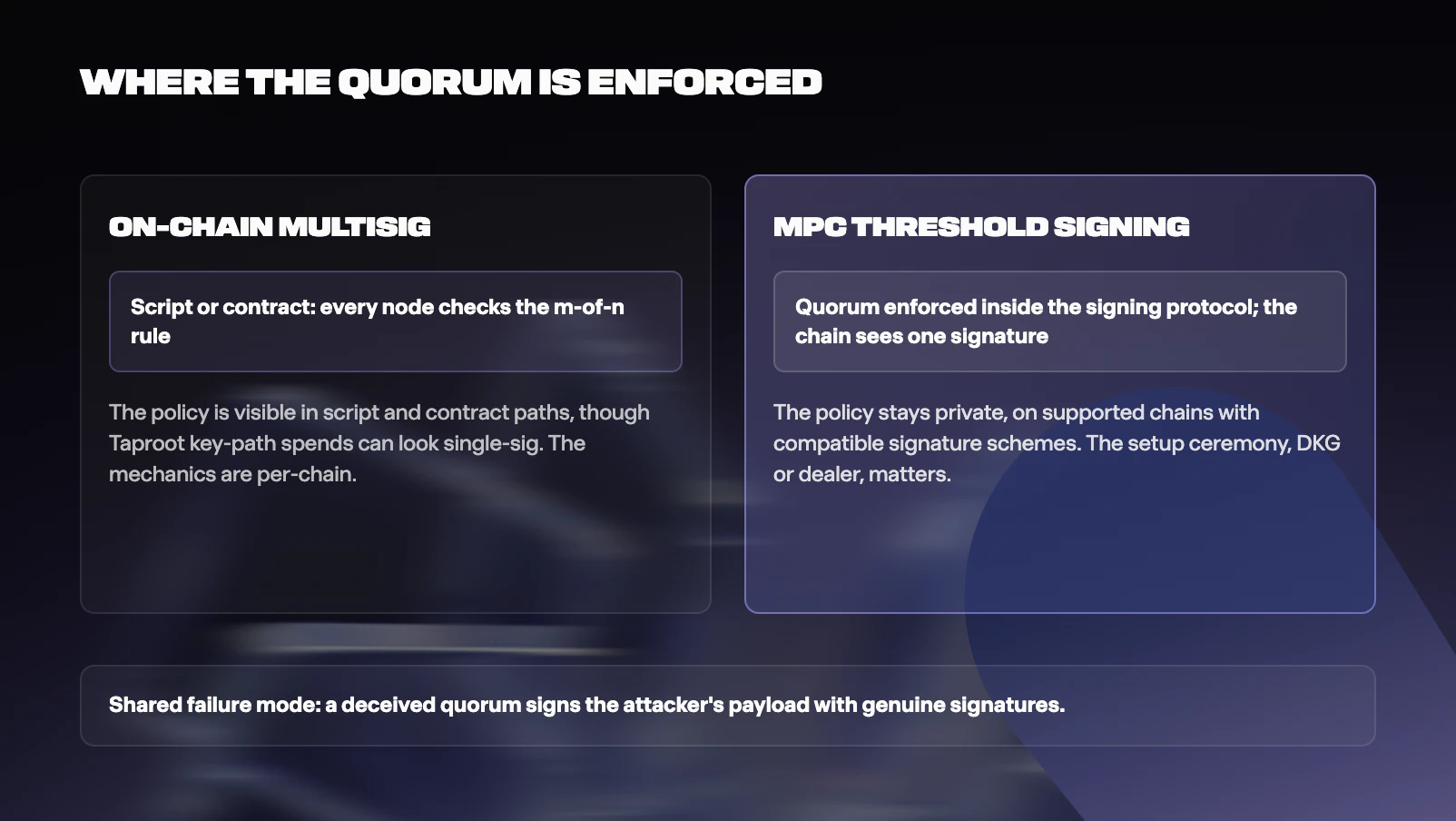
Both enforce a quorum; multisig does it on-chain with chain-specific mechanics and, in script and contract paths, publicly visible policy, MPC does it in cryptography with one standard signature, broad chain reach where signature schemes are compatible, and private policy, and both are defeated by quorum-scale compromise or a deceived signer set. The choice is architectural rather than moral.
The comparison, compressed:
| Property | On-chain multisig | MPC threshold signing |
|---|---|---|
| Where the quorum is enforced | By the blockchain, in script or contract | Inside the signing protocol; chain sees one ordinary signature |
| Chain support | Per-chain mechanics; contract wallets where supported | Supported chains with compatible signature schemes |
| Privacy | Policy public in script and contract paths; Taproot key-path spends can look like a single signature | Policy invisible on-chain |
| Fees and footprint | Larger transactions or contract calls | Standard single-signature cost |
| Key replacement | On-chain rotation, visible and chain-dependent | Share refresh without touching funds |
| Verifiability | Anyone can audit the policy on-chain | Trust in implementation and its audits |
The convergences matter more than the contrasts. Both remove the single recitable secret; both make loss survivable below threshold and theft unprofitable below quorum; both scale from personal to institutional use, and the institutional article shows them deployed together, MPC operationally with multisig or timelocks on deepest reserves.
And both share a failure family that no quorum arithmetic touches. First, threshold compromise: gather m keys or m shares, through one organisation holding too many, one location hosting several, or one supply chain behind all devices, and the design is beaten; independence, again, is the real currency. Second, the deceived quorum: the Bybit theft moved 1.5 billion dollars through a multisig whose signers all approved what their compromised interface displayed, genuine signatures on a lying payload. Clear signing on independent devices, payload verification through separate channels, and refusing what cannot be decoded are the countermeasures, and they are behavioural, which means they are the part that decays. Third, the quiet perimeter: on contract chains, whoever can upgrade the wallet contract, or the modules it trusts, holds a meta-key over the quorum, the same governance trap the bridge article documents at industrial scale.
The summary an expert would sign: quorum designs move custody's hard problem from secrecy to governance and verification. That is an enormous upgrade, and it is a relocation, never an abolition.
How do you actually set up a resilient multisig?
Quick answer
Design the failure map before touching software: choose m-of-n for your loss and theft budget, place keys and their backups so no event, place or person spans a quorum, write the procedures down, and rehearse recovery with small amounts first. The setup is an afternoon; the design is the product.
A practical sequence, kept tool-agnostic.
Model first: list the events you must survive, fire, burglary, device failure, coercion, your own death, a signer leaving, and check each against your proposed configuration. This is the individual's version of the institutional threat model, and it usually redesigns the first draft.
Choose the quorum for your situation: 2-of-3 for one owner, 3-of-5 for shared or higher-value arrangements, resisting the temptation of high thresholds without loss slack. Then place for independence: separate locations for keys, separate locations for each key's backup, no two quorum members sharing a building, a person or a cloud account. Hardware devices as signers keep key isolation; mixed vendors reduce supply-chain correlation.
Document the arrangement as if for a stranger, because your future self or your executor is one: what the wallet is, where each key and backup lives, how to sign, how to replace a key, who to contact. Store the document with appropriate care, it maps your defences, and connect it to your estate plan; the inheritance article takes that thread onward.
Rehearse: fund with a trivial amount, sign from the quorum, simulate a lost key and perform an actual rotation, restore a key from backup. Every step that fails in rehearsal was going to fail in an emergency instead. Repeat the rehearsal annually and after any life change; arrangements rot quietly as devices age, firmware moves and people relocate.
And keep the float rule from the wallet comparison article: the multisig guards savings, while daily spending lives in a small hot wallet, so that convenience pressure never erodes the quorum's discipline.
Frequently asked questions
Is a 2-of-3 multisig really safer than one hardware wallet?
Against single events, categorically: one stolen key moves nothing, one lost key strands nothing, and a hardware wallet's seed phrase is precisely such a single event in both directions. The trade is coordination and setup care, and a badly placed 2-of-3, keys or backups co-located, quietly returns to single-point-of-failure behaviour. Placement, more than the product, is the security.
What happens if I lose one key of a 2-of-3?
You retain a spending quorum with the remaining two. Best practice is prompt rotation: create a replacement key and move funds, or rotate signers in a contract wallet, so the arrangement returns to full 2-of-3 slack rather than running as a fragile 2-of-2. Rehearsing exactly this rotation with small amounts is part of a serious setup.
Multisig or MPC for an individual?
Both remove the single secret; the practical differences are operational. Multisig offers on-chain verifiable policy and works best where the chain supports it well, at the cost of per-chain mechanics and visible structure. MPC offers single-signature operation across supported chains, private policy and share refresh, at the cost of trusting an implementation you cannot eyeball. Comfort with the tooling and the quality of the specific product tend to decide, and the properties can be combined.
Can a multisig protect me from being coerced at home?
It changes what coercion can achieve: funds that require a key held elsewhere, or a co-signer enforcing a delay and verification policy, physically cannot move from your living room, and the arrangement is credible to explain under pressure. Pair it with the surrenderable-float design from the physical security article, and never build a setup whose story you would have to prove by dying for it.
Did the Bybit hack prove multisig does not work?
It proved the quorum is only as good as what signers can verify. The signatures were genuine and the threshold held; the deception happened upstream, in the interface showing signers a false payload. The lesson is clear signing on independent devices and out-of-band payload verification, disciplines now standard in institutional custody, rather than abandonment of quorum designs, which remain the strongest structure available.
Sources and further reading
Key references for this article, current as of July 2026. Volatile figures are re-checked at each quarterly review.
- Bitcoin Wiki, multisignature. https://en.bitcoin.it/wiki/Multi-signature
- BIP16, Pay to Script Hash. https://github.com/bitcoin/bips/blob/master/bip-0016.mediawiki
- BIP67, Deterministic multisig key sorting. https://github.com/bitcoin/bips/blob/master/bip-0067.mediawiki
- Bitcoin Optech, Taproot and multisignature resources. https://bitcoinops.org/en/topics/multisignature/
- Safe (contract wallet) documentation: threshold configuration and modules. https://docs.safe.global/
- ethereum.org, smart contract wallets and account abstraction. https://ethereum.org/en/roadmap/account-abstraction/
- NIST, Threshold Cryptography project. https://csrc.nist.gov/projects/threshold-cryptography
- FBI IC3 public service announcement attributing the Bybit theft to North Korea. https://www.ic3.gov/PSA/2025/PSA250226
- Chainalysis, 2026 Crypto Crime Report: operational compromise analysis. https://www.chainalysis.com/blog/crypto-hacking-stolen-funds-2026/
- Investopedia, multisignature wallets explained. https://www.investopedia.com/terms/m/multisignature.asp
- TRM Labs, H1 2026 hacks analysis: infrastructure attacks and signing compromises. https://www.trmlabs.com/resources/blog/h1-2026-crypto-hacks-reach-record-high-as-losses-fall-below-usd-1-billion
- FBI IC3, theft reporting channels. https://www.ic3.gov
Quick quiz: did it stick?
A few questions to check the fundamentals landed. Answers with explanations follow, and nobody is grading you except your future portfolio.


You have completed a quiz on “What Is Multisig, and How Does It Remove Single Points of Failure?”! Share your achievement on social media.
 Was this helpful?